

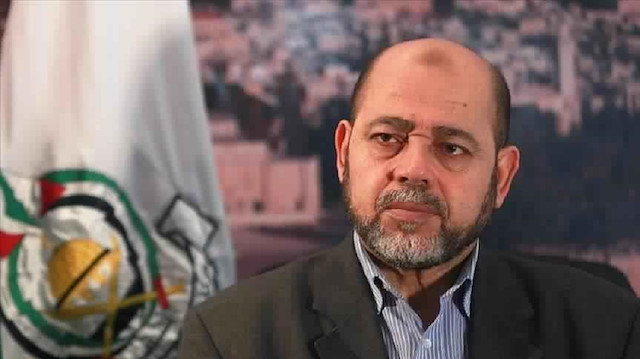
Mousa Abu Marzook
Leading Hamas member Mousa Abu Marzook on Thursday spoke to Anadolu Agency about recent developments pertaining to the Israel-Palestine file.
According to Abu Marzook, Ismail Haniyeh, head of Hamas’s influential political bureau, is preparing to go on an international tour to promote the Palestinian national cause overseas.
"Arab and Muslim countries, along with some other states, have expressed readiness to receive Haniyeh and an accompanying delegation," he said.
Israeli Justice Minister Ayelet Shaked said Wednesday that the backchannel U.S. Middle East peace plan known as the “Deal of Century” is a “waste of time”, according to Israeli daily The Jerusalem Post. “The U.S. shouldn’t waste its time preparing a peace plan as the gap between Israel and the Palestinians is too great to bridge,” Shaked said at a Jerusalem conference organized by the newspaper. She went on to assert that the deterrent capability that Israel achieved against Hamas following its 2014 onslaught on Gaza had eroded over the last two years. According to The Jerusalem Post, Shaked believes that a ceasefire signed last week between Israel and Hamas-led resistance factions in Gaza will not hold for more than a few months. “And when it collapses, Israel will likely have to use greater force than it did in previous rounds of fighting,” the justice minister said. Within the last 10 days, at least 14 Palestinians across the blockaded Gaza Strip have been killed by Israeli airstrikes and artillery.And early last week, an Israeli officer was killed -- and another injured -- during a botched ground incursion into the Hamas-run coastal enclave. The violence eased slightly last Tuesday after an Egypt-brokered ceasefire deal came into effect between Israel and Hamas-led resistance factions.
‘Deal of Century’ is ‘waste of time’: Israeli minister
Commenting on the group’s recent talks with Egyptian officials aimed at implementing earlier agreements between Hamas and rival faction Fatah, Abu Marzook clarified that the talks in Cairo had yielded “humanitarian understandings rather than signed agreements”.
The talks, he said, were aimed at “ending blockaded Gaza’s humanitarian crisis… without making any political concessions”.
Abu Marzook also noted that European efforts were now underway -- led by Norway -- aimed at de-escalating the situation in Gaza and easing its dire humanitarian situation.
He went on to commend Egypt and Qatar, along with UN peace envoy Nikolay Mladenov, for their recent mediation efforts.
The Ezzedine al-Qassam Brigades, the armed wing of Hamas, “has footage of the Israeli commander being killed,” Hamas’s leader of the Gaza Strip Yahya Sinwar said while addressing a crowd during a ceremony honoring the seven martyrs of the brigades killed during a firefight on Sunday with Israeli forces.Sinwar said Hamas was determined to break the Israeli blockade imposed on Gaza and provide the Palestinian people with a prosperous life.“We will not allow the siege to continue. The enemy has realized that our calm following the attacks targeting Gaza they have conducted since 2014 is not in vain,” Sinwar said. “Our missiles are more precise, have a greater range and carry more explosives than in the past,” he added.During the ceremony, Sinwar pulled out a handgun with a silencer, and claimed it belonged to one of the Israeli Special Forces troops that entered Gaza in a botched operation on Sunday.Sinwar warned that if Israeli troops entered the Gaza Strip again, then would only be set free for a prisoner exchange of “thousands of prisoners.” Israeli media reports early elections likely in IsraelSeven Palestinians were martyred, including Hamas military commander Nour Baraka, when an Israeli force staged a raid in Khan Younis in the southern Gaza Strip on Sunday. An Israeli soldier was killed and another injured in the raid.Since Sunday, at least 14 Palestinians have been martyred by Israeli airstrikes and artillery across the blockaded territory. Tensions appeared to ease slightly late Tuesday after Israel and Gaza-based resistance factions agreed to an Egypt-brokered ceasefire.Israel’s 12-year blockade of the Gaza Strip has gutted the coastal enclave’s economy and deprived its two million inhabitants of many basic commodities.Israel’s US-funded Iron Dome fails to down Hamas rockets
Hamas 'has footage of Israeli commander being killed,' says Gaza chief
On Wednesday, a Hamas delegation led by group deputy leader Saleh al-Arouri arrived in Cairo for more talks.
Notably, the U.S. administration recently offered a $5-million reward for information leading to al-Arouri’s capture.
Commenting on the move, Abu Marzook said the bounty “will not restrict al-Arouri's movements or otherwise affect him, especially given that he doesn’t keep funds in U.S. banks or their affiliates”.
“Our talks with Egypt, meanwhile, have borne fruit,” he added. “They have led to the opening of commercial crossings and allowed fuel shipments into Gaza, enabling us to produce badly-needed electricity."
Fresh funds recently allowed into the strip, he said, "will directly reach 50,000 poor families in Gaza and create job opportunities for thousands of young people”.
Israel’s outgoing defense minister has warned that Hamas is only growing in strength in the blockaded Gaza Strip.“We are feeding the monster,” Avigdor Lieberman, speaking on Facebook, said in reference to the Palestinian resistance faction.“If we don't stop it from getting stronger, we will have Hezbollah's twin within a year,” he added. Lieberman made the remarks on Friday -- two days after resigning his post in protest against a Tuesday cease-fire between Israel and Hamas-led resistance factions. Gazans gather along Israel buffer zone for 34th Friday“It is unacceptable that after 500 rockets are fired at southern Israel [earlier this week], the Israeli government is providing immunity to Hamas leaders,” Lieberman said in reference to this week’s truce. “Under [the Israeli government’s] current policy, not only [Hamas chief Ismail] Haniyeh, but all Hamas leaders, remain safe and sound,” he added. “For two and a half years, I… tried to change government policy [vis-à-vis Gaza] from within,” Lieberman went on to assert.“But the last two decisions -- the transfer of $90 million to Hamas and the cease-fire deal -- have been too much for me to bear,” he added.Israeli media reports early elections likely in IsraelIsraelis demand Netanyahu resign for Gaza truce
Israel’s Lieberman voices fear of empowered Hamas
Abu Marzook also dismissed recent media reports that a 300-meter buffer zone would be set up between Gaza and Israel.
“Hamas has not -- and will not -- accept this,” he said.
He also denied recent reports that the German authorities were mediating indirect talks between his group and Israel for the release of Israeli soldiers captured by Hamas in 2014.
‘Reconciliation’
Regarding the stumbling “reconciliation process” with rival faction Fatah, Abu Marzook said the latter was refusing to hold meetings with Hamas officials.
“We’ve only seen progress in terms of the Egypt-brokered truce with Israel,” he said, referring to a cessation-of-hostilities deal hammered out early last week.
He went on to voice hope that Fatah would “abandon its preconditions, stop punishing Gaza, and implement the terms of past reconciliation agreements”.
"We don’t want to bypass the [Fatah-led] Palestinian Authority (PA), but its current isolation -- and its continued rejection of any practical solutions to the crisis in Gaza -- is only aggravating the situation,” Abu Marzook said.
Hamas, he added, wants “a national partnership” with Fatah with a view to establishing “a national unity government with defined objectives and able to hold elections”.
He described Fatah’s preconditions for reconciliation as “obstacles”, saying the Ramallah-based faction was insisting on “controlling security [inside the Gaza Strip] and deciding the fate of the armed resistance”.
Abu Marzook also pointed out that last week’s botched Israel ground incursion -- during which an Israeli officer was killed inside Gaza -- had seen Israeli forces enter the strip through a border crossing controlled by the PA.
“The PA’s control of border crossings and the absence of our [Hamas] security forces… has negatively affected Gaza’s security situation,” he said.
Regarding Hamas’s ties with Cairo, Abu Marzook said that relations had picked up noticeably after Egypt opened the Rafah border crossing (linking Gaza to Egypt’s Sinai Peninsula) on a semi-permanent basis for the first time since the Israeli blockade was imposed in 2006.
Deal of Century
Commenting on a backchannel U.S. peace plan known as the “Deal of the Century” (details of which have yet to be made public), Abu Marzook hinted that “indirect” communication was now underway between Hamas and the U.S. administration.
Hamas’s inclusion on Washington’s list of alleged “terrorist groups” bars U.S. officials from speaking directly to the resistance group, which has governed the Gaza Strip since 2007.
Abu Marzook also stressed Hamas’s continued commitment to the right of Palestinian refugees to return to their homes in historical Palestine, from which they were driven in 1948 to make way for the new state of Israel.
“We will never drop our longstanding demand for the refugees’ right to return,” he said, going on to voice alarm over what he described as "strange attacks by the Arab regimes on the rights of Palestinian refugees”.
He also dismissed reports that the so-called Deal of the Century would yield a truncated Palestinian state in the Gaza Strip.
“If we wanted that, we would have accepted earlier proposals supported by certain foreign capitals,” he said.
“But our goal is the liberation Palestine -- in its entirety -- which we want to see unified, not divided,” Abu Marzouk concluded.