

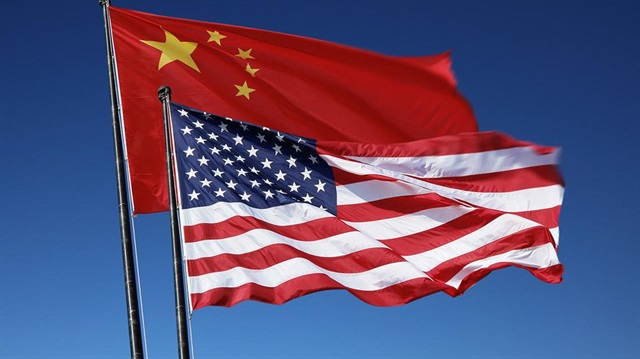
File photo
A bipartisan group of U.S. lawmakers on Wednesday urged the United States to impose sanctions on Chinese officials responsible for human rights abuses of minority Muslims in Xinjiang, saying the region was being turned into a "high-tech police state."
The group, led by Senator Marco Rubio and Representative Chris Smith, Republican co-chairs of the bipartisan Congressional Executive Commission on China, made the call in a letter to Secretary of State Mike Pompeo and Treasury Secretary Steven Mnuchin.
Muslims in China's far western region of Xinjiang were "being subjected to arbitrary detention, torture, egregious restrictions on religious practice and culture, and a digitized surveillance system so pervasive that every aspect of daily life is monitored," said the letter, signed by 15 U.S. senators and representatives, besides Rubio and Smith.
China said on Thursday that trade issues with the United States can only be resolved through talks as equals, and it will press on with the steady opening of its economy regardless of U.S. actions."The only correct choice in resolving trade friction between China and the U.S. is through talks based on sincerity and equality," Commerce Ministry spokesman Gao Feng told reporters at a regular briefing."Whatever repressive measures the U.S. adopts, China will firmly and steadily push forward reform and opening at its own pace."Some Chinese firms and foreign companies in China have been affected by the U.S. tariffs and are working to mitigate the impact, Gao said, without elaborating.Can Trump tweet his way out?"We are confident that foreign trade will maintain steady momentum... and will roll out targeted policies to safeguard the legitimate rights of all firms in China, including foreign-invested firms," said Gao.China's manufacturing sector is under pressure from higher borrowing costs, cooling investment and consumer spending, and a potential shock to exports as a result of the trade frictions with the United States.A Reuters poll showed on Thursday that activity in the vast factory sector likely slowed for a third straight month in August, as domestic demand remained weak and exporters faced rising uncertainties from the brewing U.S.-China trade war.China denies planning military base in AfghanistanThe head of China's top planning agency also warned that the economy faces increasing risks in the second half of the year and policymakers need to step up efforts to meet key development goals.In the meantime, U.S. economic growth was a bit stronger than initially thought in the second quarter, notching its best performance in nearly four years.However, U.S. goods trade deficit widened sharply in July as exports of agricultural products tumbled, indicating trade could be a drag on growth in the third quarter.
China says trade talks with US should be based on 'equality'
The letter, signed by nine Republicans, seven Democrats and one Independent, called for sanctions under the Global Magnitsky Act against senior Chinese government and Communist Party officials overseeing the policies, including Xinjiang party chief Chen Quanguo, and for other measures to be considered.
The Magnitsky Act was originally designed to target Russian Rights violators, but has been expanded to allow sanctions for abuses anywhere in the world.
"The Chinese government is creating a high-tech police state in (Xinjiang) that is both a gross violation of privacy and international human rights," the letter said.
China has said Xinjiang faces a serious threat from Islamist militants and separatists who plot attacks and stir up tension between the mostly Muslim Uighur minority who call the region home and the ethnic Han Chinese majority.
In Beijing on Thursday, foreign ministry spokeswoman Hua Chunying said the United States did "not have the right" to make "unwarranted criticism" of China's policies toward ethnic minorities, and pointed to racial discrimination in the U.S.
"If viewed without bias or prejudice, China's ethnic minority policies, and the rights and equality ethnic minorities enjoy, are even stronger than in the United States," she told a regular news briefing.
She said U.S. lawmakers should concentrate on serving Americans rather than "interfere with the domestic affairs of other countries", adding that China protected religious freedoms in line with the law.
A United Nations human rights panel this month said it had received many credible reports that 1 million ethnic Uighurs in China were held in what resembled a "massive internment camp that is shrouded in secrecy."
Hundreds of people have been killed in violence in Xinjiang in recent years, prompting the tough security measures.
The U.S. lawmakers' letter said as many as a million or more Uighurs and other predominantly Muslim ethnic minorities were being detained in "political re-education" centers or camps, and called for "a tough, targeted, and global response."
It added, "No Chinese official or business complicit in what is happening ... should profit from access to the United States or the U.S. financial system."
The U.S. State Department has said it is deeply troubled by Beijing's crackdown in Xinjiang, but has declined to comment on the possibility of future sanctions on Chen and others.
Critics have said the security and surveillance in Xinjiang have created near martial law conditions, with police checkpoints, reeducation centers and mass DNA collection.