

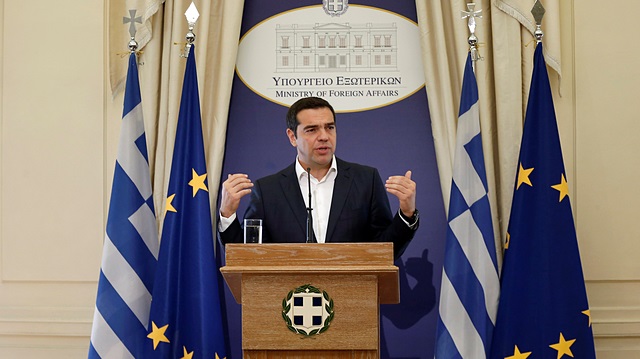
Greek Prime Minister Alexis Tsipras
The European Union's executive has approved Greece's first post-bailout draft budget without requiring the implementation of legislated pension cuts, the Greek prime minister said on Saturday.
Athens emerged from its final international bailout in August and Prime Minister Alexis Tsipras has pushed to rescind unpopular pension cuts slated for January as part of austerity measures, claiming there is ample fiscal space to do so.
Trailing the conservative opposition in polls, Tsipras is counting on a less austere budget to win over voters next year, when his term expires. "The European Commission approved the Greek budget without pension cuts after eight years of austerity," Tsipras said, calling the development a "success".
There was no immediate comment from the EU's executive.
The government has argued it does not need to implement the pension cuts agreed with creditors, as it aims to outperform on primary surplus targets for a fifth straight year.
Greece has promised its euro zone lenders and the International Monetary Fund it will achieve a 3.5 percent of GDP primary budget surplus this year, excluding debt servicing outlays.
In its draft 2019 budget it targets a surplus of 4.14 percent of GDP next year. If it does not apply the pension cuts it puts the figure at 3.56 percent.
The draft budget projects economic growth will pick up to 2.5 percent in 2019 from an expected 2.1 percent this year.
The government is now expected to submit its final draft next month and put it on a parliamentary vote in December.
Greek Prime Minister Alexis Tsipras ruled out a snap election on Friday following the resignation of his foreign minister, saying his administration still had backing from a majority of lawmakers.Nikos Kotzias unexpectedly resigned on Wednesday, becoming the first major political casualty of a Tsipras-driven campaign to end a decades-old name dispute with Macedonia.Speaking to reporters in Brussels, Tsipras said he would take over the foreign affairs portfolio until the process to approve the accord, which changes the ex-Yugoslav republic's name to North Macedonia, was successfully concluded.Kotzias, who was Greece's main negotiator over the name deal, resigned after a row with Defence Minister Panos Kammenos during a cabinet meeting on Tuesday.Tsipras said his government still "enjoys the full and absolute support of the majority in parliament."His administration is backed by 153 lawmakers in the 300-seat legislature, including the small right-wing party that Kammenos heads. The defence minister views the name-change deal as a national sellout.Syriza is trailing badly in the polls ahead of national elections due next year.Tsipras, who said he would still seek advice from Kotzias, is scheduled to formally take charge of the foreign ministry on Saturday.
Greek PM rules out snap polls after foreign minister quits
Greek population may shrink by between 450,000 and 1.4 million by the end of 2035, a recently released report said.According to a report published by the Hellenic Association of Geriatrics and Gerontology earlier this month, Greece’s population will come down to between 9.5-10.4 million in 2035, compared to 10.9 million in 2015.Variables such as low birth rates and negative migration balance will inexorably lead to a reduced population in the next three decades, with one in three people aged over 65 by 2050, the report said.The association also mentioned that the Greek fertility rate -- children per couple -- is at 1.26 compared to 1.49 in the European Union.Experts say the fertility rate must be at least 2.1 for a population to remain stable, according to the report.Turkish ship to continue explorations in Mediterranean, energy minister saysGreek PM takes over as foreign minister, says wont tolerate dissent
Greek population may shrink by 1.4M by 2035: Report