

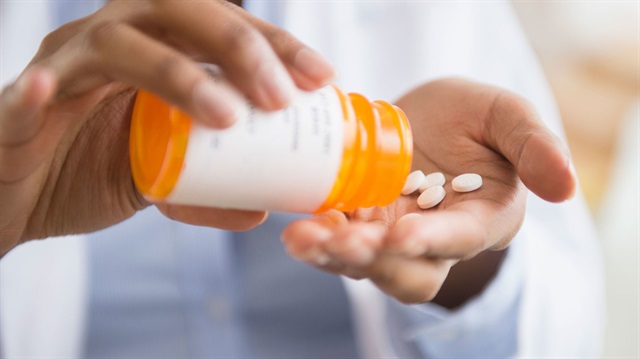
File photo
German drugmakers have been asked by the government to examine their supply chains for any vulnerability that could cause shortages of essential drugs in the event that Britain leaves the European Union without a Brexit deal.
More than 2,600 drugs have some stage of manufacture in Britain and 45 million patient packs are supplied from the UK to other European countries each month, while another 37 million flow in the opposite direction, industry figures show.
Germany's Federal Institute for Drugs and Medical Devices (BfArM) has ordered the country's main drug industry associations to gather information on the effect of a no-deal Brexit, a spokeswoman for the health ministry said.
"The Ministry of Health currently has no evidence that the exit of the United Kingdom will lead to any disruptions in the supply of medicines in Germany," the spokeswoman said.
As the U.K. government has proven to be unprepared for Brexit, this could serve as a vast opportunity for developing relations with non-EU states like Turkey, experts said.According to Seckin Baris Gulmez, an assistant professor of international relations at Izmir Katip Celebi University, Turkey and the U.K. have been experiencing parallel situations in their relations with the EU, despite technically different processes.Turkey applied for EU membership in 1987 while accession talks began in 2005.As for the U.K., it is set to leave the EU in March 2019 but a final deal to shape future U.K.-EU relations has yet to be agreed upon.“Comparably, it seems that neither of the countries will totally get what they want from the EU,” Gulmez told Anadolu Agency in an email interview.“It shows that both countries will get closer to each other while getting away from the EU in a harsh way,” he said.The talks between Turkey and the EU stalled in 2007 due to the objections of the Greek Cypriot administration in the divided island of Cyprus, as well as opposition from Germany and France.Pointing out the friendly relations between Turkey and the U.K. for almost a century, Gulmez said both countries were of the opinion that “bilateral relations independent from the EU” would be beneficial.Expressing hope for improved Turkey-U.K relations, Gulmez, highlighted that the U.K. was now in search of potential partners in the post-Brexit period.“In this context, I believe that the Brexit process is a significant opportunity for Turkey to improve bilateral relations [with the U.K.] and gain a position against the EU,” said Gulmez, who recently worked on Turkish-British diplomatic relations.It seems that Turkey would not miss that opportunity. As unveiled in the country's 100-day action plan, it aims to strengthen trade and economic ties with the U.K. in the post-Brexit period.-Referendum without ‘alternative roadmap’The British public opted to leave the EU in a 2016 referendum, ending the country’s 44-year-long membership with the bloc. Talks with the EU on the conditions of leaving the bloc began on June 2017.According to Gulmez, the latest resignations in the Conservative Party in July was evidence that the British government was unprepared for Brexit.Last month, Boris Johnson resigned as foreign secretary over disagreements with Theresa May and her Chequer’s Plan that sets out the U.K.’s relationship with the EU after Brexit.Two vice chairs of the ruling Conservatives jumped ship following Johnson’s resignation, citing similar reasons.“They couldn’t filter the determination of the public for Brexit till the very last moment,” said Gulmez.Emre Gonen, an academic from the International Relations Department at Istanbul Bilgi University, puts the blame for the Brexit hurdle in the U.K. on the lack of an “alternative road map”.“The main problem is that the Tory government organized the referendum without having an alternative road map,” Gonen said.It led to difficulties in establishing a negotiating stance before the European Commission, which has “an experienced negotiator”, according to Gonen.“This has created a very asymmetric situation where we see the parade of negotiators and politicians of the U.K. desisting one after the other, practically because they see the fragility of their stance,” he added.-Reversing Brexit, not probableIn recent months there have been growing calls for a second referendum on the final deal -- yet to be agreed upon -- between Brussels and London. "People’s Vote” -- a campaign for a public vote on the final Brexit deal -- has been steadily growing to show the government that support for remaining in the EU has grown considerably in the last two years.On the recent shift in public opinion from Leave to Remain, Gonen said people discovered the vacuity of the arguments put forward by the Brexit supporters.“However, a nationwide referendum was organized and there will be immense difficulties to overlook such a decision,” Gonen said.Similarly, Gulmez does not consider the cancellation of Brexit or another referendum as likely. However, he emphasized the Conservatives' failure in managing the Brexit process as the main motive for the public to revise the Brexit decision.“The increased likelihood that the EU cannot be abandoned with the conditions desired has led to a focus on the disadvantages that Brexit will now cause, rather than its necessity. This naturally leads to regret," Gulmez said.
Brexit, opportunity for boosted Turkey-UK ties: Expert
It is not yet clear when results will be available, she said.
The UK government has already asked British drugmakers to build an additional six weeks of medicine stockpiles to prepare for any no-deal Brexit - a target the industry has said will be challenging.
Germany is using BfArM's quarterly "Jour Fixe" meetings with various stakeholder groups on drug shortages to prepare for Brexit.
BfArM in 2016 instated the meetings with groups representing drugmakers, physicians, pharmacists, drugs distributors as well as other government bodies to monitor and mitigate against drug shortages.
British Trade Minister Liam Fox has urged his Asian counterparts to make their views on Brexit known to the European Union, he told CNBC on Tuesday."I have been urging my colleagues in a number of Asian countries to make their views (on Brexit) known to the European Union," he told CNBC in an interview."Because if the European Union decides to introduce impediments to trade or investment that don't exist today, that sends a global message about Europe's lack of competitiveness in the global context".Irish foreign minister urges Britain to clarify its Brexit stanceThe opening up of the Chinese services sector would be key for the United Kingdom, he told CNBC, the remarks coming days after Fox held talks with China's commerce ministry.China and Britain will look at the possibility of reaching a "top notch" free trade agreement after Britain leaves the EU, the Chinese commerce ministry had said on Saturday. UK May says no-deal Brexit not 'the end of the world'
British trade minister urges Asia counterparts to convey Brexit views to EU
The meetings have dealt with shortages of treatments such as Mylan's Epipen against allergic shock, branded as Fastjekt in Germany, as well as disrupted supply of blood pressure drug valsartan after batches produced in China had to be recalled due to toxic impurities.
Industry groups, which include German drugmakers including Bayer, Merck KGaA and Boehringer Ingelheim as well as foreign suppliers such as Teva and Roche , have been asked to consider the "worst-case-scenario of a hard Brexit without transition period", according to meeting protocols.
The highly regulated drugs sector is one of the most vulnerable to Britain's decision to leave the EU because of uncertainty as to how medicines oversight will function in the event of an abrupt exit next March.
That has sparked fears of drug shortages, and some companies including AstraZeneca, Sanofi and Novartis have said they plan to increase stockpiles in Britain in case of a no-deal Brexit.
Britain is set to leave that EU regulatory system and the Europe-wide drugs watchdog is moving from London to Amsterdam, prompting many drugmakers to prepare duplicate product testing and licensing arrangements.
British Prime Minister Theresa May has said that failing to secure a deal with the European Union before Britain leaves the bloc next year "wouldn't be the end of the world", Sky News reported on Tuesday.May's comment, made to reporters as she headed to Africa to boost Britain's trade ties ahead of Brexit in March 2019, came after her finance minister Philip Hammond said last week that a no-deal departure from the EU would damage public finances.Ahead of her arrival in South Africa, May said the forecasts cited by Hammond were out of date."I think when they came out I was very clear on a previous trip that those figures were a work in progress at that particular time," she said according to Sky.Britain will use aid budget to boost trade in AfricaShe repeated comments from the head of the World Trade Organisation (WTO) that Britain leaving the EU without a deal "would not be a walk in the park" but that "it would not be the end of the world", Sky said.Hammond was criticised by some lawmakers in May's deeply divided Conservative Party for saying last week -- on the day the government published contingency plans for a no-deal Brexit -- that such a scenario could mean borrowing would be about 80 billion pounds ($102.02 billion) a year higher in 15 years' time as the economy grew more slowly.May is hoping to a agree "business-friendly" deal with the bloc on the key issue of trade which has split her party between those who want a definitive break from the EU, and those, like Hammond, who want to keep close ties.However, in her comments to reporters on her way to Africa, May repeated her warning that a no-deal Brexit was better than leaving with a bad deal."I think it's absolutely that the government is preparing for no deal because we don't know what the outcome is going to be," she said. 
UK May says no-deal Brexit not 'the end of the world'