

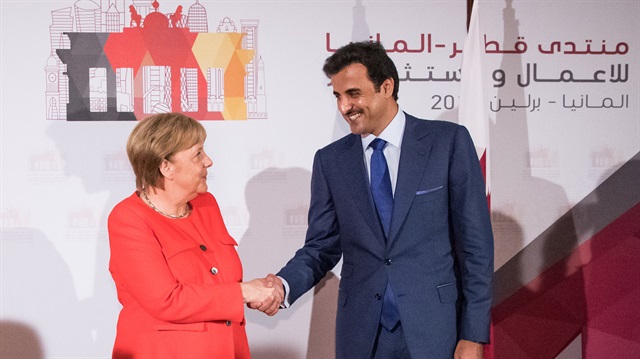
German Chancellor Angela Merkel welcomes Qatar's Emir Tamim bin Hamad al Thani before the start of a business conference in Berlin, Germany, September 7, 2018
Germany and Qatar’s leaders vowed on Friday to boost economic and trade ties between the two countries.
Speaking at a Qatar-Germany business forum in Berlin, Chancellor Angela Merkel underlined that Qatar has been an important economic partner of Germany, and expressed interest in closer cooperation in the energy sector.
"Today, Qatar is the largest exporter of liquefied natural gas (LNG) in the world," Merkel stressed and added that LNG has recently become more important for energy security and diversification.
"Our federal government is working on further developing the LNG infrastructure in Germany, and several companies are considering and working on projects to construct an LNG important terminal in Germany," she said.
Merkel said German companies could also be interested in LNG imports from Qatar, but underlined that such decisions on gas purchases were always made according to the economic criteria.
Speaking at the same forum, Qatar's Emir Tamim bin Hamad al-Thani said his country is planning to make €10 billion direct investments in Germany in the next five years.
"We are proud of our relations and our cooperation with Germany," al-Thani said and invited German companies to invest in his country.
Turkey and Germany share a strong will to boost bilateral relations, German foreign minister said on Wednesday.In a series of tweets ahead of his contacts in Turkey, Heiko Maas named the country as a big neighbor and significant partner to Germany.“We have a strong will to further improve our relations,” the minister tweeted, saying that he hopes that his Turkey trip will contribute to the bilateral relations.Mentioning Germany’s concerns on "some developments, especially human rights" in the country, Maas said the issue would be raised during the meetings.“We should note: Our humanitarian relations with Turkey is so intense that we must continue to work very hard to ameliorate our relations,” he added.Over the past two years, political relations between Ankara and Berlin have suffered setbacks, but in recent months both sides have taken steps towards improving ties.As part of his visit, Maas will be hosted by Turkish President Recep Tayyip Erdogan and meet Turkish Parliament Speaker Binali Yildirim.Following his high-level talks in the capital, Maas is scheduled to visit Istanbul on Thursday, where he will attend a ceremony alongside his Turkish counterpart Mevlut Cavusoglu to mark the 150th anniversary of the German School of Istanbul.Maas' two-day trip to Turkey comes ahead of Erdogan’s key visit to Berlin on Sept. 28-29.EU heavyweight Germany remains Turkey’s main economic and trade partner, despite the political disagreements between the two governments on a number of issues.Berlin’s reluctance to take serious measures against terrorist groups such as the PKK and the Fetullah Terrorist Organization (FETO) has long been a source of tension between the two countries.Both terrorist groups use Germany, which is home to more than 3 million migrants from Turkey, as a platform for their propaganda fund raising and recruitment activities.Kremlin says keen on Syria talks with Turkey, France, GermanyGermany wants to improve ties with Turkey: FM MaasGerman FM to pay working visit to Turkey on WednesdayGermany urges prevention of disaster in Syria’s Idlib
Turkey, Germany have strong will to boost ties: FM Maas
Kremlin aide Yuri Ushakov said on Wednesday that Moscow was keen to see four-way talks with Turkey, France and Germany take place to discuss the Syrian conflict.Ushakov said that, as far as he knows, all sides have agreed to hold the talks in Istanbul and advisers have been tasked with working out an appropriate date.Kremlin says no current plans for future Putin-Trump meetingUshakov said there were no ongoing preparations for a future meeting between Russian President Vladimir Putin and his U.S. counterpart Donald Trump."We don't have any information about the preparation of such a meeting," Ushakov told journalists. The two presidents last met in Helsinki in July.Trump, without evidence, accuses social media firms of election meddlingUS, UK stand together in holding Russia accountable for Salisbury: US envoy
Kremlin says keen on Syria talks with Turkey, France, Germany
Germany wants to improve relations with Turkey and enhance cooperation on issues of common interest, Foreign Minister Heiko Maas has said ahead of his talks in Ankara on Wednesday."Germany has a strategic interest in reshaping our relations with Turkey in a constructive way. Turkey is not only a big neighbor of us but also an important partner of Germany," he said in a statement.Maas is scheduled to meet his Turkish counterpart Mevlut Cavusoglu and other senior officials on Wednesday in the capital Ankara.Germany urges prevention of disaster in Syria’s IdlibOver the past two years, political relations between Ankara and Berlin have suffered setbacks, but in recent months both sides have taken steps towards improving ties.Maas' trip to Turkey comes ahead of Turkish President Recep Tayyip Erdoğan’s key visit to Berlin on Sept. 28-29.EU heavyweight Germany remains Turkey’s main economic and trade partner, despite political disagreements between the two governments on a number of issues.
Germany wants to improve ties with Turkey: FM Maas
A growing number of countries can hack into private computer networks and install malicious software to sabotage another country's infrastructure, Germany's domestic spy chief said.China, Russia and other countries continued to try to break into German companies' computers to steal valuable industrial information, Hans-Georg Maassen, head of the BfV domestinc intelligence agency, told a security conference.But intelligence officials are increasingly worried about so-called "cyber bombs" that could be planted in the network of an unsuspecting company and detonated later."In the case of China, Russia, we clearly see measures like espionage, but it could also be sabotage with the goal of attacking companies in Germany - infrastructure firms in the widest sense - at some future point," Maassen said. "That is a scenario that we view with concern."Cyber experts warn that Germany - with its high level of technology expertise - is a particularly attractive target for cyber attackers of all kinds, including state actors.A company could be completely oblivious to a cyber attack that had been used to plant malware - a "cyber bomb", Maassen said. Then the bomb could shut down power networks, for example, perhaps during a time of geopolitical tension.He said such attacks could come from a range of countries that have expanded their cyber expertise. In its annual report, the agency cited rapid strides in cyber technology by Iran, although it did not specifically spell out concerns about such sleeper attacks.Germany is also increasingly concerned that China is seeking to gain dominant positions in key technology sectors by investing in German firms as part of its larger "Made in China 2025" drive, Maassen said."That is a political project in which the government is spending a lot of money, not just to invest, but to buy information for its own technical progress, or to gain a position in specific areas that will make it impossible for others to continue developments there," he said.Maassen's remarks come amid a push by Germany and other European Union states to protect sensitive technologies from Chinese takeovers. In December, the BfV also warned about efforts by China to use fake LinkedIn accounts to recruit German business executives and researchers as spies.
Germany concerned about possible 'sleeper' cyber sabotage
Germany has urged the international community to act against a humanitarian disaster in the Syrian province of Idlib amid reports of a potential military offensive by the regime forces.“We will do everything to prevent a humanitarian disaster in Idlib,” Foreign Minister Heiko Maas told a news conference in Berlin on Monday.“This will be one of the main topics during my visit to Turkey on Wednesday and Thursday,” he added.Located near the Turkish border, Idlib is home to more than 3 million Syrian people, many of whom fled from other cities which were attacked by the Assad regime’s forces.Trump warns Assad against ‘recklessly attacking’ Idlib“We have witnessed the brutality of the Assad regime in the past … it is a very, very serious situation,” Maas said.He also warned that a military escalation would severely undermine ongoing efforts for a political solution to the seven years of civil war in Syria.
Germany urges prevention of disaster in Syria’s Idlib