

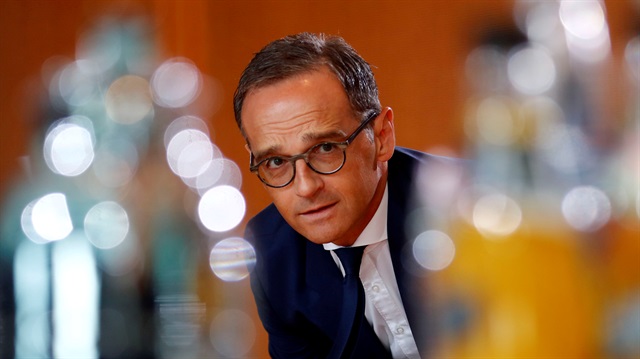
German Foreign Minister Heiko Maas
Foreign Minister Heiko Maas on Wednesday proposed measures against U.S. dominance in global finance amid a growing row between Washington and Berlin over the Iran nuclear deal.
In an article he wrote for daily Handelsblatt, Maas slammed American President Donald Trump for imposing unilateral sanctions on Iran, without consulting European allies.
“It is essential that we strengthen European autonomy by establishing payment channels independent of the U.S., a European monetary fund and an independent SWIFT [payment] system,” he said.
Maas also called on EU partners to maintain their unity and pursue a common policy towards the U.S. in the ongoing row over sanctions.
“In this situation, it is of strategic importance that we make it clear to Washington that we want to work together.
"But also: That we will not allow you to go over our heads, and at our expense. That is why it was right to protect European companies legally from sanctions,” he said.
The German government will launch a special aid programme worth up to 340 million euros to help farmers after this summer's drought massively damaged harvests, agriculture minister Julia Kloeckner said on Wednesday.Kloeckner said she had agreed special federal government drought aid of between 150 million and 170 million euros ($172 million and $194 million) with German finance minister Olaf Scholz.Along with additional aid from German regional state governments, farms should receive a total of about 340 million euros in aid, Kloeckner said in a statement.The association of German farmers DBV has called for around 1 billion euros in special aid to help farmers after huge crop losses this summer.German crops wilted under the highest summer temperatures since 1881 and prolonged dryness. EU wheat prices hit 5-year highs in August on concern about supplies.Germany's 2018 grains harvest is likely to fall by about 22 percent this year after the heatwave and drought, the DBV said on Wednesday.Dairy farmers were especially suffering from reduced crops of feed grains, straw and hay, the DBV said. Dairy farmers were being forced to reduce their herds because of high feed costs, sending more cattle to slaughter."I declare this year's period of dryness to be a weather event with a national impact," Kloeckner said.If the existence of farms is threatened, they will qualify for special aid, Kloeckner said. It was believed that the existence of about 10,000 farms was under threat, or about 1 in every 25 in Germany.It is vital that farms facing closure receive aid as fast as possible, she added. Farms must have suffered a loss of earnings of at least 30 percent.
Germany pledges up to 340 mln euros in farm aid after drought
Castigated by U.S. President Donald Trump as relying too much on Russian gas supplies, German Chancellor Angela Merkel heads to Azerbaijan this week to discuss the development of a southern pipeline to deliver gas to Europe from the Caspian.The visit underscores Merkel's openness to finding alternative sources of affordable gas even as she remains committed to the Nord Stream 2 pipeline, which will carry gas directly from Russia under the Baltic Sea to Germany."We have a big interest in further developing the Southern Corridor," a senior German government official said."This is part of the EU's diversification strategy of getting gas from other regions, not just Russia, to Europe."In Baku, Merkel will discuss energy issues, including improving the infrastructure to help transport gas from Azerbaijan to Europe via Turkey, officials said.Azerbaijan looks set to play a crucial role as it plans to launch the second stage of a gas pipeline from the vast Shah Deniz field to Europe. Shah Deniz II is expected to produce 16 billion cubic metres (bcm) of gas a year from 2020, with 10 bcm earmarked for Europe and 6 bcm for Turkey and Georgia.Later, gas could be brought from Turkmenistan, Iran and Iraq to Europe. In a sign of progress, Iran, Russia, Kazakhstan, Turkmenistan and Azerbaijan agreed in principle this month on how to divide the potentially huge oil and gas resources of the Caspian Sea.However, the southern pipeline is dwarfed by Nord Stream 2, a Gazprom initiative that will double Russia's export capacity to Europe to 110 bcm. That pipeline is welcomed by much of German industry, which wants as much cheap gas as possible.Last month Trump, who is pressing Germany to buy more U.S. liquefied natural gas, lambasted Germany as being "a captive" of Russia due to its dependence on Russian energy, a charge Germany denies. Trump has called Nord Stream 2 "horrific".Germany imported 39 percent of its gas from Russia in the first half of 2018, figures from state foreign trade authority BAFA showed.Merkel discussed energy in talks with Russian President Vladimir Putin at a palace outside Berlin at the weekend. She is trying to assuage some Nord Stream 2 critics by ensuring Ukraine does not suffer from lower gas transit revenues.Merkel also travels to Georgia and Armenia on her three-day trip, which starts on Thursday. She will hold talks with Azeri President Ilham Aliyev on Saturday.
After Trump attack on Russia ties, Merkel eyes Azeri gas
The U.S. announced Tuesday it has deported to Germany one of the last Nazi war crimes suspects known to reside within the U.S.Jakiw Palij, 95, was removed from his Queens, New York home by Immigration and Customs Enforcement (ICE) officers on Monday after having lied to U.S. authorities about his Nazi past when he immigrated in 1949.Palij concealed his history as an armed guard at the Trawniki slave-labor camp for Jews in Nazi-occupied Poland, initially telling immigration officials he had worked as a farmer and at a German factory during World War II.Palij admitted to the Justice Department in 2001 that he was an armed guard at the camp in 1943, the same year when 6,000 Jewish men, women and children were brutally shot to death there.The Trawniki camp was part of "Operation Reinhard”, a Nazi plan to kill two million Jews living in the part of Poland not formally annexed into Germany, according to the Holocaust Museum.Palij was stripped of his U.S. citizenship in 2003 "based on his wartime activities and postwar immigration fraud," according to the Justice Department.He was subsequently ordered deported to either Germany, Poland or Ukraine, but the countries had refused to accept him, leading Palij to live in legal limbo in the U.S. where his Queens home was regularly the site of demonstrations.Palij was born in a part of Poland that has since become Ukrainian territory.The State Department expressed "its deep appreciation" to Berlin for accepting Palij.The White House said Palij's deportation was the result of "extensive negotiations" between President Donald Trump and German officials."Despite a court ordering his deportation in 2004, past administrations were unsuccessful in removing Palij," spokeswoman Sarah Sanders said in a statement. "To protect the promise of freedom for Holocaust survivors and their families, President Trump prioritized the removal of Palij."Palij is the 68th Nazi removed from the United States, according to the Justice Department.
US deports Nazi war crimes suspect to Germany
Germany's former foreign minister slammed U.S. President Donald Trump on Tuesday for pursuing the ‘irresponsible” policy of threatening Ankara with economic pressure and sanctions.“Under the Trump administration, the U.S. is now trying to exploit Turkey’s economic difficulties, so to say, it is pushing Turkey off a cliff. I think this is irresponsible,” Sigmar Gabriel said in Berlin.The Social Democrat politician stressed the importance of Turkey’s economic stability for European states, and urged the latter to look for ways to support Ankara, should it seek financial support from Europe.“A destabilization of the Turkish economy, its society is not in our interest. The U.S. is far away, but we are neighbors. We have to shoulder any negative consequence,” he stressed.Turkey-U.S. relations took a nosedive on Aug. 1, when the Trump administration announced sanctions on Turkey’s interior and justice ministers after Ankara refused to release an American pastor who faces terrorism-related charges in Turkey.On Aug. 10, Trump upped the ante by doubling U.S. tariffs on Turkish aluminum and steel imports.In response, Turkey raised tariffs on several U.S.-made goods, including alcohol and tobacco products as well as vehicles.Political tensions between Ankara and Washington had sparked worries in markets, but the Turkish lira has staged a recovery last week, after positive messages from European capitals and Qatar’s decision to invest $15 billion in Turkey.
Former German minister slams Trump’s Turkey policy