

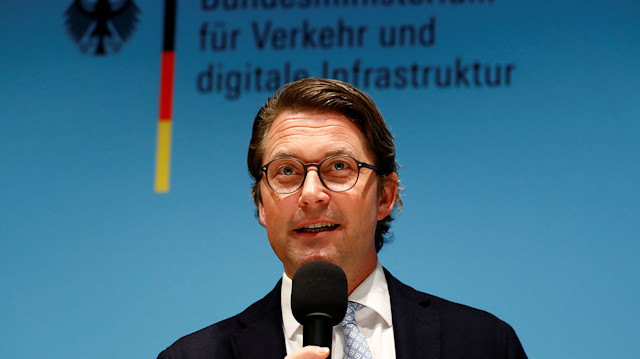
German Transport Minister Andreas Scheuer addresses a news conference in Berlin, Germany.
Transport Minister Andreas Scheuer wants to open the German market to car pooling services offered by Uber and other companies by 2021, Focus magazine reported Saturday.
Scheuer told Focus in an interview that online taxi services and pooling services could help provide critical services in rural areas, and he wanted to change existing regulations to permit their operation.
"We can create new possibilities, especially in rural areas and for older people, with car services and pooling systems," said Scheuer, a member of the Bavarian conservatives. "That is a giant opportunity."
Current law bans drivers from accepting contracts directly from individuals, reserving that right for taxi drivers licensed by local authorities.
"I'm against bans and limits. I'm for incentives," Scheuer told the magazine. "We can't just exclude a service provider."
At the same time, he said, taxi services would clearly be affected and their interests also had to be taken into consideration.
Germany has been a difficult market for Uber given the strict regulatory environment. The company's app allows users to order licensed taxis in Berlin and Munich, and Uber has said it hopes to have a presence in every major German city by 2020.
Uber operates in many parts of Europe, but offers different services, depending on local regulations.
Dutch Prime Minister Mark Rutte on Friday rejected the idea of a European army, as raised in Germany and France."The idea of a European Army goes way too far for the Netherlands," he said after a cabinet meeting. "NATO is and remains the cornerstone of our defence policy."
Dutch PM Rutte: NATO remains cornerstone of European defence
Despite the first indictments in Saudi probe, many questions remain unanswered in the murder of journalist Jamal Khashoggi, Germany’s Foreign Ministry said on Friday.Speaking at a news conference in Berlin, Christofer Burger, deputy spokesman for Foreign Ministry, said Germany was still waiting for a full disclosure and accountability from Saudi Arabia.“There has been some developments yesterday. That was a first step. However, many questions remain open, as it has been before,” he said.The Saudi public prosecutor's office announced on Thursday that 11 suspects had been indicted for murdering Khashoggi inside Saudi Arabia’s Istanbul Consulate. It called for death penalty against five suspects.The prosecutors absolved Saudi Crown Prince Mohammed bin Salman of any blame for the murder.Burger underlined that Germany expected a full and transparent investigation in line with the international standards.“The murder of Khashoggi must be completely and thoroughly investigated. We expect that those responsible for the killing would be held accountable,” he added.Khashoggi, a Saudi national and columnist for The Washington Post, was killed on Oct. 2 inside the Saudi Consulate in Istanbul.After weeks of denying involvement, the kingdom admitted that Khashoggi had been killed at the consulate but claimed that the Saudi royal family had no prior knowledge of a plot to murder him.So far, 21 people, including security officers, have been arrested in Saudi Arabia in connection with the murder.
Germany says many questions in Khashoggi case remain open
Alice Weidel, co-leader of Germany's far-right Alternative for Germany (AfD), on Friday accused media that uncovered evidence of large, unexplained donations to her party of seeking to discredit her.The AfD, which is Germany's largest opposition party but suffered lacklustre results in two regional elections last month, has been reeling since an investigative media consortium alleged Weidel's local party had received 130,000 euros ($147,251.00) from a Swiss firm in 2017.The party later also said it had received 150,000 euros from a Belgian - later revealed to be a Dutch - foundation. The AfD returned both sums after concerns were raised about a lack of clarity over funding, party officials told German media.The affair threatens to overshadow an AfD congress this weekend that some had seen as an opportunity for a relaunch after a difficult period for the anti-immigrant party.Donations from non-German citizens living in non-EU countries such as Switzerland are illegal in Germany, while all gifts of more than 50,000 euros must be declared in a parliamentary register - something the AfD did not do for either the Swiss or the Dutch donations.Weidel criticised the media treatment of her role."The accusations made against me regarding apparently illegal party donations are known to me only from the media," she said. "They lack any basis in fact and are an attempt to discredit me personally and politically."She did not say which details in the media reports she was contesting, adding that she would not say anything further while a planned investigation by prosecutors was under way.The AfD did not immediately respond to a request to clarify precisely what allegations she was rejecting in her statement.PARLIAMENTARY IMMUNITYProsecutors have asked for Weidel's parliamentary immunity to be lifted, an indication that they wish to carry out a preliminary examination of the affair.The party's other co-leader, Alexander Gauland, has so far stood by her, but the head of the party in her home state of Baden-Wuerttemberg told the Frankfurter Allgemeine newspaper she should resign if the donations turned out to have been illegal.The party is holding a congress this weekend to choose its candidates for next year's European Parliament elections, the next major test of whether it has managed to recover the momentum that saw it burst into parliament with 13 percent of votes cast in last year's national election.The AfD made little progress in elections in Bavaria and Hessen in October, which were both marked by surging support for the pro-immigration Greens, their ideological antithesis. ($1 = 0.8828 euros) 
German far-right leader attacks media over donations scandal