

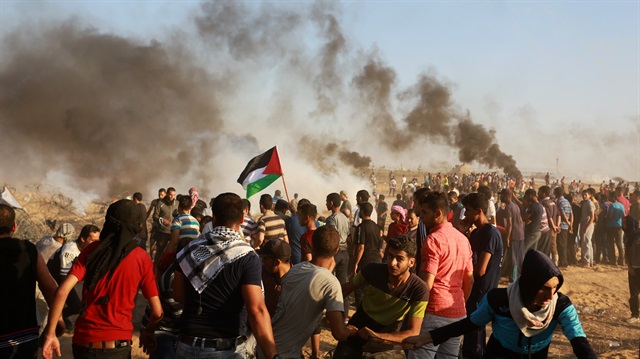
Protest at Israel-Gaza border
Fresh Israeli sanctions on the blockaded Gaza Strip, including restrictions on the movement of goods, went into effect on Tuesday.
Trucks loaded with humanitarian needs only were allowed on Tuesday into the Palestinian territory through the Kerem Shalom crossing, south of Gaza, according to an Anadolu Agency reporter.
On Monday, Israel imposed fresh sanctions on the seaside enclave, including restrictions on the movement of goods and a reduction of the area off Gaza’s coast in which Palestinian fishermen are allowed to ply their trade.
A second humanitarian flotilla set out from the Gaza Strip on Tuesday in hopes of breaking an 11-year Israeli blockade on the coastal enclave, a Palestinian NGO said.“Gaza has proved to the whole world that it does not accept submission despite the continuous blockade,” Hani al-Thawabtah, a member of Gaza’s National Committee for Breaking the Siege, told a press conference in Gaza City.Israel imposes fresh sanctions on blockaded GazaEleven Palestinians are participating in the “Freedom Boat 2” flotilla, including those who had been injured in peaceful protests by Israeli army fire, medical patients and university students.“Latest Israeli procedures of tightening up the blockade on Gaza will not force Palestinians to give up on Palestine,” al-Thawabtah said.Turkish doctors to provide surgeries in blockaded GazaThe “Freedom Boat 2” is the second humanitarian flotilla to set out from blockaded Gaza since Palestinians first began holding regular rallies along the Gaza-Israel security fence on Mar. 30.The NGO urged local and international officials to provide the flotilla and its Palestinian passengers with protection “from any possible Israeli violations”.The first flotilla set out from Gaza on May 29 carrying Palestinian medical patients -- many of whom were injured during the rallies -- and university students.A main boat was accompanied by dozens of smaller vessels in a show of defiance against Israel’s crippling blockade.Israeli naval forces swiftly intercepted and seized the ship, detaining all 17 Palestinian passengers aboard.While all detained passengers were subsequently released, the ship’s captain, Suheil Muhammad al-Amoudi, remains in Israeli custody until now.The Gaza Strip has groaned under a crippling Israeli blockade since 2007, which has gutted the coastal enclave’s economy and deprived its roughly 2 million inhabitants of many basic commodities.Since Mar. 30, more than 130 Palestinians have been killed by Israeli army gunfire -- and thousands more injured -- while taking part in regular demonstrations along the Gaza-Israel security fence.Demonstrators demand an end to Israel’s decades-long occupation of Palestinian land and its ongoing blockade of Gaza, which has brought the strip to the verge of humanitarian catastrophe.
Second humanitarian flotilla sets out from Gaza
According to a statement released by the Israeli army, the Kerem Shalom border crossing will be closed in response to “incendiary kite attacks” by Palestinian activists.
The military statement did not say how long the crossing -- which had served as Gaza’s only functioning commercial crossing -- would remain closed.
Local authorities on the Palestinian side of the crossing said they were told by the Israeli side that only fuel, foodstuffs, health and medical materials, livestock and feeds would be allowed through the terminal.
Chinese President Xi Jinping on Tuesday pledged a package of $20 billion in loans and $1.6 billion in financial aid to countries in the Middle East, as part of what he called an "oil and gas plus" model to revive economic growth in the region.Beijing has ramped up engagement in the Middle East in recent years as Arab nations play an important role in Xi's signature Belt and Road foreign policy plan for strong trade routes linking China with central and southeast Asia.Development was key to resolving many security problems in the Middle East, Xi told a gathering with representatives of 21 Arab nations in the Chinese capital."We should treat each other frankly, not fear differences, not avoid problems, and have ample discussion on each aspect of foreign policy and development strategy," he said.Israel imposes fresh sanctions on blockaded GazaChina would offer aid worth 1 billion yuan ($150 million) to Palestine to support economic development, besides providing a further 600 million to Jordan, Syria, Lebanon and Yemen, he added.A consortium of banks from China and Arab nations, with a dedicated fund of $3 billion will also be set up, he said.It was unclear what the relationship between the bank consortium, financial aid and the overall loan package would be.The loans will fund a plan of "economic reconstruction" and "industrial revival" that would include cooperation on oil and gas, nuclear and clean energy, Xi said.Israel says closing Gaza's main trade terminal in anti-Hamas crackdownHe urged "relevant sides" to respect the international consensus in the Israel-Palestine dispute, and called for it to be handled in a just manner, so as to avoid regional disruption.China, which traditionally played little role in the Middle East conflicts or diplomacy, despite its reliance on the region for energy supplies, has been trying to get more involved in resolving long-standing disputes.China says it sticks to a policy of "non-interference" when offering financial aid and deals to developing countries, which, coupled with development, can help resolve political, religious and cultural tension.It applies this pattern of economic support, as well as a strict security regime, to its restive western region of Xinjiang. But rights groups have criticised the approach, saying the clampdown has further stoked, not eased, tension between the Muslim Uighur minority and the ethnic Han majority.
China to offer aid of $15 mln to Palestine
Palestinian economists have decried the Israeli sanctions, warning that the move would aggravate Gaza’s already dire humanitarian situation.
In recent weeks, Palestinian activists have been flying incendiary kites and balloons over Israeli territory as part of ongoing popular demonstrations near the Gaza-Israel security fence.
Since the demonstrations began on March 30, at least 137 Palestinian protesters have been martyred -- and thousands more injured -- by Israeli army gunfire.
Protesters demand the “right of return” to their homes and villages in historical Palestine from which they were driven in 1948 to make way for the new state of Israel.
They also demand an end to Israel’s 11-year blockade of the Gaza Strip, which has gutted the coastal enclave’s economy and deprived its roughly two million inhabitants of basic commodities.