

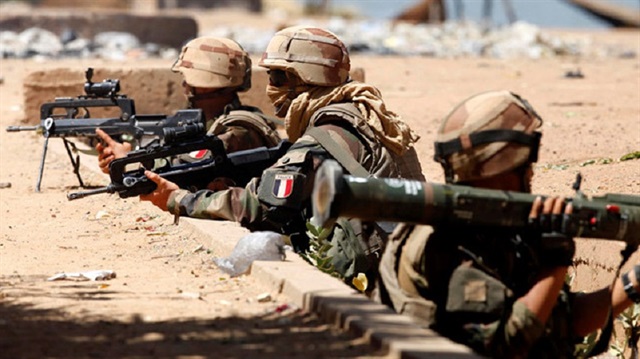
File photo
French troops are expected to move to Syria’s Sunaym region, located east of the Euphrates, which is home to French cement factories, once the Manbij deal between Ankara and Washington is actualized.
Turkey and the United States earlier this week agreed on a Manbij roadmap that focuses on the withdrawal of the PKK-affiliated PYD/YPG terror group from the northern Syrian city and on stability in the region. France has no role in the deal, so eyes have turned to the country regarding its presence in the region.
Once the Manbij deal is implemented and the terror group withdraws from the region, French soldiers are also expected to withdraw. It is expected that the French troops will relocate to Sunaym, which is positioned 15 to 20 kilometers to the east of Manbij.
The Turkish Armed Forces' (TAF) air-backed operations, which were launched on March 11 against the Kurdistan Workers’ Party (PKK) in northern Iraq, has so far cleared 400 square kilometers of terror elements as the PKK’s so-called senior administrators flee the region.Military establishes 11 bases along 23-kilometer borderTurkish soldiers have established 11 bases along the 23 kilometer-long border line, clearing terrorists and preventing possible infiltration of terrorists into Turkey.The cross-border operations coordinated by the Second Army Commander, Lt. Gen. Ismail Metin Temel, and conducted by commando units located in southeastern Hakkari province's Yuksekova district have already neutralized 155 terrorists since March 11.Additionally, the Turkish army’s Operation Olive Branch in Syria’s Afrin has neutralized 4,197 terrorists as operations in Iraq’s north to clear it of terror elements are ongoing.Turkish army destroys terrorists' shelters in N. IraqTurkish army captures PKK terror campsNorthern Iraq's Hakurk, Armus camps as well as Avasin Basyan, Kani Rash, Bermize and Sidekan, known as the terror group PKK's so-called "rear guard logistic base," are now all under the control of Turkish soldiers.The terror group's so-called ranking leaders have withdrawn from the above mentioned regions and fled to Mt. Qandil.Turkish soldiers have also seized a number of explosives, ammunition and living materials during the operations, as they strongly retaliate against the terrorists' attacks.Video: Two codes of the Qandil operationNorthern Iraq’s Qandil Mountains have been a haven for PKK terrorists over the past few decades. Considered as the main base of the PKK, which control checkpoints and entrances to the mountains, the structuring in the area is used for cover and concealment by terrorists.The PKK is listed as a terrorist organization by Turkey, the European Union and the United States. The PKK has been conducting armed violence in the southeastern part of Turkey since 1984. More than 40,000 people, mostly civilians, have been killed in the three-decade long conflict.Turkish army clears 400 sq km of Iraqi border regionIftar meal hosted at BursayaAn iftar dinner organized by the Kilis Governorate was hosted at Mt. Bursaya, which was cleared of terror elements as part of Turkey’s Afrin Operation. Lt. Gen. Temel as well as Kilis Governor Mehmet Tekinarslan attended, and shared conversation and a warm meal with the troops stationed at the base. Turkey to establish ‘safe corridor’ between Syria, Iran bordersMt. Qandil not distant target anymore says Turkish min.
Top PKK figures flee as Turkish troops advance in northern Iraq
Sunaym is known for its French cement factories, which supply Daesh and the PKK/PYD terror groups support. French giant Lafarge, which was exposed for paying taxes to Daesh, came into the spotlight when it was found that it supplied the cement used by the PKK/PYD for tunnels and bunkers in Afrin, where the Turkish Armed Forces are currently conducting an operation.
The PYD and its military YPG wing are Syrian branches of the PKK, which has waged war against Turkey for more than 30 years.
Relations between Turkey and the U.S. would improve in every field if the U.S. severed all ties with terror group PYD/YPG, a Turkish deputy prime minister said Thursday. "The strategic U.S. move that would satisfy Turkey would be to stop considering PYD/YPG as a partner in the region [...] and to cut off all ties completely on the field," Fikri Isik told a televised interview on the private Turkish news channel Haberturk."This will pave the way for new developments in the region. It will [also] bring the relations between Turkey and the U.S. to a more positive level in every field," he added.The U.S. has supported a number of militia groups under the umbrella of the Syrian Democratic Forces, also known as the SDF, including the PYD/YPG, which is considered by Ankara as the Syrian offshoot of the PKK terror group.Isik said the strategy of supporting the terror group was built during the Obama administration, "but the U.S. has seen that it actually was wrong".U.S. military support for the YPG/PKK terrorist group in Manbij, Syria, has strained ties between Ankara and Washington and it has led to fears of military clashes between the two NATO allies since there are roughly 2,000 U.S. troops in the city.On Monday, a Manbij roadmap was announced after a meeting in Washington between Turkish Foreign Minister Mevlut Cavusoglu and U.S. Secretary of State Mike Pompeo.The deal focuses on the withdrawal of the PKK-affiliated PYD/YPG terror group from the northern Syrian city and on stability in the region.- Qandil operationOn an ongoing military operation against terrorist PKK positions in northern Iraq’s mountainous Qandil region, Isik said: "Turkey has moved from defense to offense in the fight against terrorism."Airstrikes on PKK targets in northern Iraq, where the terror group has its main base in the Mt. Qandil region, near the Iranian border, have been carried out regularly since July 2015, when the PKK resumed its armed campaign.In its more than 30-year terrorist campaign against Turkey, the PKK -- listed as a terrorist organization by Turkey, the U.S. and the EU -- has been responsible for the death of nearly 40,000 people, including women and children.
Sever all ties with YPG terror group, Turkey tells US
Turkey is planning to establish a 30-kilometer-deep corridor that is cleared of all terror elements extending from northern Syria all the way toward the Iranian borders, as operations targeting terrorists from the Kurdistan Workers’ Party (PKK) in northern Iraq continue to deal large blows to the terror group. Manbij is set to be the first step in establishing the “safe corridor” that extends from Idlib- Jarabulus- Bab and Azaz, and will encompass eastern Euphrates regions in Syria at a depth of 30- 40 kilometers along Turkey’s southern borders, until it converges with the safe zones created in northern Iraq.A large blow to PKK terrorSince March 2018, an operation named after a martyred soldier, Specialist Sergeant Gökhan Kurak, is ongoing in Turkish Iraq borders to maintain border security.During the operation, armed unmanned air vehicles, air and ground forces are being used to eliminate terrorists and destroy their hideouts.The military has also ensured influence over an area of 30 kilometers inside Iraq’s territory, which is considered as the “First step toward Qandil.”The second phase is a Qandil operation to be carried out in cooperation with Iraq and Iran.Northern Iraq’s Qandil Mountains have been a haven for PKK terrorists over the past few decades. Considered as the main base of the PKK, which control checkpoints and entrances to the mountains, the structuring in the area is used for cover and concealment by terrorists.Work is underway to establish military bases in the regions cleared of PKK terror in order to ensure lasting peace and security in the area, and provide communication with regions where bases had already been established.Turkish airstrikes killed six PKK terrorists and destroyed 16 targets in northern Iraq, the General Staff said Wednesday.According to a General Staff statement, the airstrikes include terror camps regions of northern Iraq such as Hakurk, Gara, Metina, Zap, Qandil, and Avaşin Basyan, among others. Currently, two Turkish army brigades are taking part in the operations carried out in northern Iraq, in addition to the brigades in Turkey’s southern provinces, Hakkari and Şırnak, which carried out highly-effective campaigns.At the breaking pointTurkey’s domestically-produced recon and combat drones played a large part in the successful blow dealt to the terror organization in southeastern Turkey and northern Iraq, which resulted in disrupting 80 percent of the PKK’s logistical resources following ongoing operations in the region.The operations also helped bring the participation and support of the PKK among local population to a breaking point and helped minimize the terror group’s financial sources, which it obtains through exerting tolls on the region’s impoverished population. Operations also helped dry the terror group’s drug trade, which is a main source of income for the PKK. A large blow was also dealt after a large number of high-ranking PKK terrorists were neutralized as a result of the ongoing operations, disrupting and weakening the group’s ability to reproduce a leadership structure.Iraq launches air strike against Daesh in SyriaMt. Qandil not distant target anymore says Turkish min.Qandil is within reachTurkey's interior minister on Wednesday said an anti-terror operation in northern Iraq's mountainous Qandil region is not a distant target for Turkey.In an interview to Turkish channel NTV Süleyman Soylu said: "Diyarbakır is not free as long as Qandil stands there," referring to a possible PKK terrorist attack.He said that Turkish forces were forming a line some 27 kilometers from the border in northern Iraq.Soylu also noted that Turkey has a very high level of technological capability, human resources, unmanned aerial vehicles and intelligence to carry out the operation."Turkey now with its capacity can launch an operation wherever and whenever it wants," Soylu added. Airstrikes on PKK targets in northern Iraq, where the terror group has its main base in the Mt. Qandil region, near the Iranian border, have been carried out regularly since July 2015, when the PKK resumed its armed campaign.US defense secretary comments on Syria's Manbij talks
Turkey to establish ‘safe corridor’ between Syria, Iran borders
The U.S. defense secretary said Turkey was a front-line state for NATO and its legitimate interests needed to be addressed, referring to recent talks between both countries regarding Syria's northern Manbij.Speaking to reporters during his flight to Brussels, Jim Mattis said talks had taken place between U.S. secretary of state and the Turkish minister of foreign affairs in Washington D.C.The Manbij roadmap was announced after a meeting in Washington on Monday between Turkish Foreign Minister Mevlüt Çavuşoğlu and U.S. Secretary of State Mike Pompeo.The deal focuses on the withdrawal of the PKK-affiliated YPG terror group from the northern Syrian city and on stability in the region.Süleyman Shah tomb to return to Manbij after PKK withdrawal"We are working out, how do we take -- again, Turkey, a NATO ally -- how do we take Turkey's legitimate security interests and enhance their security? They are the only NATO nation with an active insurgency inside its borders," said Mattis, according to a transcript made available by the Department of Defense."They're the front-line state for NATO [...] -- on the front line of this disaster that [Bashar al-]Assad has visited upon his people in Syria, with the Iranians' help, the Russians' help. And we have got to find a way to work Turkey's legitimate interests," he stressed.Mattis said the SDF were the only organization at the time able to thwart and defeat Daesh in "very, very tough fighting"."And we will not simply cast that organization aside, because it is critical to stopping -- to defeating the ISIS [Daesh] caliphate now, which we've still not defeated. It is critical to destroying the physical caliphate that -- the operations that are going right now. And it's critical to preventing the rise of ISIS 2.0."NATO chief welcomes Turkey-US roadmap on Manbij, Syria'Complex battle space'Mattis added it was the "most complex battle space" he had ever seen."We are working with Turkey for how we work this issue, and we will continue to work it forward," he said."There's no doubt that we are working with Turkey to try and address their concerns -- at the same time, defeat ISIS. And it's a very difficult job, I'll be the first to admit. But we're doing it. We're working it, and we're ranking it with Turkey, not against Turkey," Mattis added.Manbij roadmap must include regions east of Euphrates in SyriaTurkey has long criticized the U.S. for supporting the YPG/PKK terror group under the name of SDF, which is considered by Ankara as the Syrian offshoot of PKK.PKK has waged a more than 30-year terror campaign against the Turkish state that has resulted in some 40,000 deaths.Washington views the SDF as a "reliable partner" in its fight against Daesh and continues to provide it with arms and equipment in the face of strong objections by Turkey.Joint roadmap for Manbij is for stabilization: US
US defense secretary comments on Syria's Manbij talks