

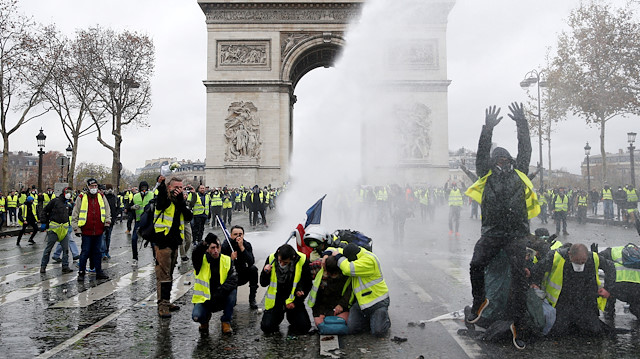
Protesters wearing yellow vests, a symbol of a French drivers' protest against higher diesel taxes, stand up in front of a police water canon at the Place de l'Etoile near the Arc de Triomphe in Paris, France, December 1, 2018.
The French government on Tuesday suspended planned increases in three taxes on fuel for a six-month period starting Jan.1 in response to nationwide protests against high pump prices and living costs, Prime Minister Edouard Philippe announced.
"This anger, you'd have to be deaf or blind not to see it or hear it," Philippe said in an address.
"The French who have donned yellow vests want taxes to drop, and work to pay. That's also what we want. If I didn't manage to explain it, if the ruling majority didn't manage to convince the French, then something must change."
The so-called "yellow vest" movement, which started on Nov. 17 as a social-media-organised protest group named for the high-visibility jackets all motorists in France must have in their cars, has focused on denouncing a squeeze on household spending brought about by Macron's taxes on fuel.
However, over the past three weeks the protests have evolved into a wider anti-Macron uprising, with many criticising the president for pursuing policies they say favour the rich and do nothing to help the working poor.
Despite mostly peaceful nationwide demonstrations, the protests have turned violent on successive weekends in Paris. On Saturday, the Arc de Triomphe national monument was defaced and avenues off the Champs Elysees were damaged. Cars, buildings and some cafes were torched.
The French government is preparing to suspend fuel tax increases after weeks of sometimes violent protests, a government source said on Tuesday, in what would mark a major U-turn by President Emmanuel Macron after 18 months in office.Prime Minister Edouard Philippe was due to announce the suspension later on Tuesday, the source said, although it was unclear whether he would announce a time-limited "moratorium" or abandon the next carbon-tax increase entirely.The so-called "yellow vest" movement, which started on Nov. 17 as a social-media-organised protest group named for the high-visibility jackets all motorists in France must have in their cars, has focused on denouncing a squeeze on household spending brought about by Macron's taxes on fuel.The president says the taxes are needed to combat climate change. Ditching them could be a major embarrassment as governments meet in Poland to try to pin down measures to avert the most damaging consequences of global warming.Video: 'Yellow Vest' protests spread from France to the NetherlandsHowever, over the past three weeks the protests have evolved into a wider anti-Macron uprising, with many criticising the president for pursuing policies they say favour the rich and do nothing to help the working poor.Despite mostly peaceful nationwide demonstrations, the protests have turned violent on successive weekends in Paris. On Saturday, the Arc de Triomphe national monument was defaced and avenues off the Champs Elysees were damaged. Cars, buildings and some cafes were torched.The unrest is estimated to have cost the economy millions, with large-scale disruption to retailers, wholesalers, the restaurant and hotel trades. In some areas, manufacturing has been hit in the run up to Christmas.Senior members of Macron's La Republique En Marche party said the government could also increase the minimum wage from January along with other measures to deliver a quick boost low-income households, although the details remained unclear.Video: Macron greeted by ‘yellow vest’ in ArgentinaCHANGE FRANCE?Macron, a 40-year-old former investment banker and economy minister, came to office in mid-2017 promising to overhaul the French economy, revitalise growth and draw foreign investment by making the nation a more attractive place to do business.In short order he made changes to the labour code to make hiring and firing easier, he took on the rail unions by forcing through changes to the national rail company, and he cut wealth taxes in a bid to stimulate investment.However, in the process he earned the tag "president of the rich" for seeming to do more to court big business and ease the tax burden on the wealthy. Discontent has steadily risen among blue-collar workers and the middle-class struggling to make ends meet.The government's decision to push ahead with an increase in fuel taxes from January, part of a longer-term effort to discourage fossil fuel use, angered people in rural or outer urban areas who use their cars more.Economic impact of yellow vest protests 'severe': French fin minIt was not immediately clear if suspending the tax rise would be enough to placate the "yellow vests" or head off a repeat of the violence that erupted in Paris on Saturday, which officials said was driven by extreme groups on the far-left and far-right, such as the Black bloc and anarchist factions.The U-turn could also undermine Macron's credentials as a "new style" president willing to shake up France.He has said repeatedly that he will not back down but with his ratings barely above 20 percent and with other major changes in the pipeline, including pensions reform, party officials say he needs to find a way of cooling the turbulent atmosphere.He is also aware that the anti-establishment fervour spurring the yellow vests on could spell trouble in next year's European election.Macron has described that election as a battle between progressives like himself and populists on the far-right and the far-left, who have made recent gains in the polls on the back of the popular discontent. Paris riots hurt French tourism and transport stocksMacron to call on US funds to build French start-ups, not steal themFrench PM meets opposition as Macron seeks way out of 'yellow vest' crisis
Macron set for tax U-turn to quell 'yellow vest' protests
The estimated damage caused by the last weekend’s protests held by “yellow vests” in French capital Paris against fuel taxes was €3-4 million ($3.4-4.5 million), local media reported on Monday.Anne Hidalgo, mayor of Paris, told France 3, a local broadcaster, that she estimates that Saturday's riots costed Paris “between $3-4 million euros.”Thousands of "yellow vest" protesters had gathered in Paris and several other cities to protest French President Emmanuel Macron's controversial fuel tax.Demonstrators, who generally live in rural areas due to high rents in the cities, called on Macron to cut fuel taxes and make economic arrangements to ease their lives.French police on Saturday cracked down on protesters around the famous Champs-Elysees in Paris with tear gas and water cannons.Demonstrators set a large number of vehicles and trash cans ablaze and pelted stones and bottles at the police.In the riots, at least two people have been killed, while 1,043 others -- including 222 security forces -- were injured, and as many as 1,424 persons were arrested.According to a recent survey, 84 percent of French people -- mostly from the middle-income group -- support the protests.Over the last year, fuel prices in France have risen more than 20 percent.Video: Hundreds arrested during Paris protestsMacron puts off Serbia visitMeanwhile, Macron has postponed his visit to Serbia over the "yellow vests" riots in France, Serbian President Aleksandar Vucic announced on Monday.Macron was expected to go to Serbia on Dec. 5 but he postponed his visit to the Balkan country.In a news conference, Vucic said Macron told him over the phone that he has postponed his visit to Belgrade over the ongoing fuel tax protests in France.
'Yellow vests' riots in Paris cost at least €3M