

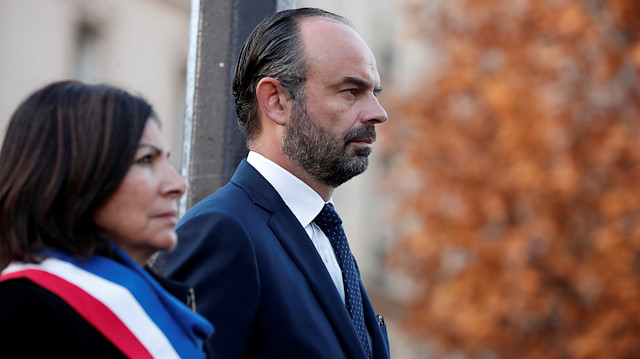
Paris Mayor Anne Hidalgo and French Prime Minister Edouard Philippe
French Prime Minister Edouard Philippe said on Thursday that ongoing political uncertainty in Britain over Brexit raised concerns about whether the agreement struck with Brussels to leave the European Union would end up being ratified.
"We need to prepare ourselves for the possibility of a 'no-deal' Brexit," Philippe said during a visit to Dunkirk, a port city in northern France where locals are concerned about the impact of Brexit on business and trade.
"It will escape no one that the current political situation in Britain could fuel uncertainty... over the ratification of the accord," he said, referring to the resignation of several British ministers over the deal.
British Prime Minister Theresa May told lawmakers on Thursday that their choice was clear: back her Brexit deal, leave with no deal, or have no Brexit at all."The choice is clear: We can choose to leave with no deal, we can risk no Brexit at all, or we can choose to unite and support the best deal that can be negotiated," May told parliament in a statement on Thursday.May said she shared the concerns of those who believe a Brexit backstop to avoid a border on the island of Ireland impinges on British sovereignty, but it was an improvement on previous proposals."The references to the backstop do raise some difficult issues," May told parliament."I fully accept that across the house, there are concerns in relation to the backstop. Indeed, I share some of those concerns," she said.French PM Philippe: We have to be ready for 'no-deal' BrexitBritain is still preparing for no-deal Brexit May said on Thursday the government was continuing to prepare for a no-deal Brexit after her draft divorce deal sparked a raft of ministerial resignations."We have been preparing for no-deal and we continue to prepare for no-deal because I recognise that we have a futher stage of negotiation with the European council and then that deal when finalised ... has to come back to this House," she told parliament.UK's Brexit Secretary Raab resigns thrusting May's government into turmoilBritain will leave the EU in March as plannedBritain will leave the European Union on March 29 and will not suspend the process of leaving, Prime Minister Theresa May said on Thursday, adding that it would meet its legal obligations on a financial settlement with the bloc."We will not extend Article 50," May told parliament, when asked about the clause in the EU's Lisbon Treaty which allows for countries to leave the bloc.EU summit to endorse Brexit deal to take place on Nov 25
UK PM May warns: It is my deal, no deal or no Brexit
Philippe said the withdrawal agreement, reached between Britain and the European Union after 17 months of negotiation, was a "step forward", but crucially it now depends on ratification by Britain's parliament as well as the parliaments of the European Union and the 27 other EU member states.
The concern in Britain is that Prime Minister Theresa May could face a no-confidence vote given the growing opposition to the deal within her Conservative Party. If she were forced out, the risk of a 'no-deal' Brexit would greatly increase.
Philippe said that if Britain were to leave the EU without a deal in March next year, it would cause "very serious problems" for France, especially around trade across the Channel.
"We therefore need to prepare ourselves for the eventuality that remains on the table -- one that I must say very clearly we do not wish for -- that of a 'no-deal' Brexit," he said.
Sterling slipped on Thursday after a volatile overnight session as UK Prime Minister Theresa May faces an uphill task to get parliament to approve her draft European Union divorce deal.The British pound ended higher on Wednesday after May said she had won over her divided cabinet following a five-hour meeting, which includes some senior Brexiteers.But in a sign of just how hard the vote in the British parliament might be, Shailesh Vara, who backed EU membership in the 2016 referendum, quit on Thursday as a junior minister in May's government.Those concerns were reflected in the foreign exchange derivatives markets where three and six-month gauges of expected volatility in the British currency remained firm while extreme short-dated volatility indicators edged lower.British government bonds were also a beneficiary of the greater uncertainty on the progress of the Brexit deal with gilt yields falling four to five basis points across the board."PM May is not out of the woods yet and the price action suggests FX markets are cautious about the outcome," said John Marley at FX risk management specialist, Smart Currency Business.In the currency markets, the pound edged 0.1 percent lower at $1.2961.While the currency has been extremely volatile this week -- realised price swings this week alone has averaged about 12 percent annualised on a daily basis, twice that of end October, prices have stayed within broad ranges.Though a Brexit endgame is still some way away and risks have intensified, Goldman Sachs strategists said in an overnight note their base case scenario is that the Parliament will ratify a withdrawal deal by then.Against the euro, the British pound fell half a percent to 87.56 pence.Britain's Brexit minister Raab quitsEU summit to endorse Brexit deal to take place on Nov 25
Sterling slips as PM May faces mounting opposition
British Brexit Secretary Dominic Raab resigned on Thursday thrusting Prime Minister Theresa May's government into turmoil after she clinched a Brexit deal that was mauled by opponents, allies and mutinous members of her party."I regret to say that, following the Cabinet meeting yesterday on the Brexit deal, I must resign," Raab said. May's plan threatened the integrity of the United Kingdom, he said."I cannot reconcile the terms of the proposed deal with the promises we made to the country in our manifesto at the last election. This is, at its heart, a matter of public trust."EU summit to endorse Brexit deal to take place on Nov 25European Union leaders will meet on Nov. 25 to endorse the divorce deal. May now faces the much more perilous struggle of getting parliament to approve the deal.British journalists said anger among Brexit-supporting Conservative lawmakers was so high that they might call for a vote of no confidence in her leadership. There was no confirmation.ITV reporter Robert Peston said enough demands for a no confidence vote could be lodged by lunchtime on Thursday.The ultimate outcome for the United Kingdom remains uncertain: scenarios range from a calm divorce to rejection of May's deal, potentially sinking her premiership and leaving the bloc with no agreement, or another referendumBritish junior minister quits May's governmentBritish PM May bets all on Brexit deal as opponents plot
UK's Brexit Secretary Raab resigns thrusting May's government into turmoil