

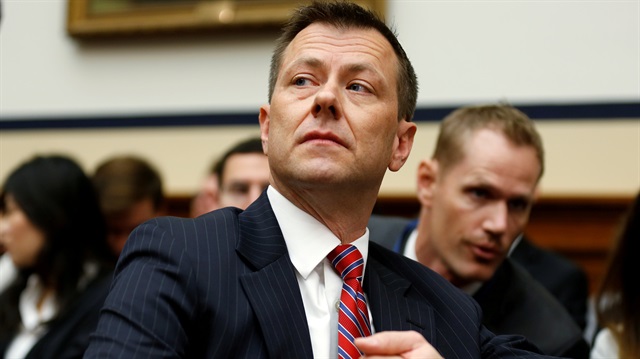
FBI Deputy Assistant Director Peter Strzok
Peter Strzok, the FBI agent who came under fire from President Donald Trump and other Republicans for sending text messages that disparaged the candidate during the presidential campaign, was fired late on Friday, his attorney said on Monday.
Strzok is the third high-ranking person to be fired from the Federal Bureau of Investigation during the Trump administration, including former Director James Comey. During his FBI career, Strzok rose to deputy assistant director, focusing on counterintelligence.
After Justice Department internal investigators found the texts, Strzok was reassigned from Special Counsel Robert Mueller's investigation into the Trump campaign. The firing came after a lengthy internal investigation.
Strzok's attorney, Aitan Goelman, said in a statement that FBI Deputy Director David Bowdich made the decision to terminate his client.
The decision, Goelman added, was at odds with a recommendation by the FBI's Office of Professional Responsibility, which had called for Strzok to face a 60-day suspension and demotion from his supervisory responsibilities.
He also said it went against promises that FBI Director Christopher Wray made in the past about adhering to proper processes on personnel matters.
The FBI said in a statement it had followed its standard review and disciplinary process after the inspector general referred the Strzok case to the FBI's Office of Professional Responsibility.
"OPR reviewed the investigative materials, as well as the written and oral responses of Mr. Strzok and his counsel, and issued OPR's decision. The deputy director, as the senior career FBI official, has the delegated authority to review and modify any disciplinary findings ... as deemed necessary," the statement said.
Strzok's attorney Goelman, however, said that normally FBI personnel can appeal such decisions to a five-person review board. Goelman said the appeals step was bypassed in Strzok's case and the FBI did not follow the normal course afforded to other FBI agents.
Trump took to Twitter not long after the news broke on Monday.
"Agent Peter Strzok was just fired from the FBI-finally," wrote Trump, who had called for Strzok's ouster before.
"The list of bad players in the FBI & DOJ gets longer & longer."
A post under a newly created Twitter account under Strzok's name said he was "deeply saddened" by the decision to fire him.
The post also linked to a GoFundMe page, which had raised more than $48,700 toward a $150,000 goal as of late Monday.
"All funds raised on this GoFundMe will be put into a trust dedicated to covering Pete’s hefty – and growing – legal costs and his lost income," the fundraising website says.
Goelman said that his client's firing was politically motivated and that his texts represented political speech protected by the First Amendment.
'RUSSIA THING'
In March, Attorney General Jeff Sessions fired FBI Deputy Director Andrew McCabe after a scathing report by the Justice Department's internal watchdog concluded he had leaked information to reporters and misled investigators about his actions.
Comey was fired by Trump in May 2017 after Deputy Attorney General Rod Rosenstein helped write a memo that was critical of how Comey handled the FBI's probe into then-Secretary of State Hillary Clinton's use of a private email server for official business.
Later, however, Trump claimed he fired Comey over that "Russia thing," apparently referring to the FBI probe into whether his presidential campaign colluded with Russia. Trump has repeatedly denied any collusion and called the investigation a witch hunt.
Both Comey and McCabe said, however, they believe they were fired because they are key witnesses in Special Counsel Mueller's probe into whether Trump may have tried to obstruct the investigation.
Strzok was deeply involved in the FBI's Clinton email investigation and was temporarily assigned to Mueller's office. He was removed from that post after his texts came to light.
The texts were criticized by the Justice Department's inspector general in a recent report that examined the FBI's handling of the Clinton email probe. Republicans in Congress have repeatedly pointed to them as evidence the FBI is biased against Trump.
A U.S. judge on Monday refused to dismiss charges against a Russian company accused of helping fund a propaganda operation to sway the 2016 presidential election in Donald Trump's favor, saying Special Counsel Robert Mueller had not exceeded his power.Judge Dabney Friedrich, in an opinion filed in the U.S. District court for the District of Columbia, rejected Concord Management and Consulting LLC's argument that Mueller was unlawfully appointed and lacked prosecutorial authority.Top US intel officials warn Russia still meddlingTrump calls on top lawyer to end special counsel probe
'Mueller case against Russian company can proceed': US judge
U.S. prosecutors on Monday plan to wrap up their tax and bank fraud case against former Trump campaign chair Paul Manafort, making it likely the case will go to the jury by midweek if the defense decides not to call any witnesses.The trial is in its 10th day in Alexandria, Virginia, federal court and is not scheduled to resume until Monday afternoon. The case arose from U.S. Special Counsel Robert Mueller's probe of Russian meddling in the 2016 presidential election.Before completing their case, prosecutors will call James Brennan, an executive at the Federal Savings Bank. On Friday, a former salesman at Federal testified that the bank's chief executive personally approved $16 million in loans to Manafort while seeking Manafort's help getting a post in President Donald Trump's cabinet.The prosecution also wants to recall Paula Liss, an agent with the Treasury Department's Financial Crimes Enforcement Network. The defense is seeking to block further questioning of her, and the judge has not yet ruled. Liss testified last week that Manafort did not disclose his foreign bank accounts.Manafort's lawyers will then face a choice: call their own witnesses or hope the prosecution's case is not strong enough to outweigh defense attacks on the credibility of Rick Gates and the testimony of more than two dozen other witnesses.Gates testified last week that Manafort, his former boss, directed him to help commit the tax and bank frauds, but the defense portrayed him as living a "secret life" of infidelity and embezzlement.Prosecutors contend Manafort hid a significant portion of the approximately $60 million he earned as a consultant for pro-Russian politicians in Ukraine, then lied to borrow millions more in a bid to maintain an extravagant lifestyle when the Ukraine work dried up.Shanlon Wu, who represented Gates before he pleaded guilty in February and started cooperating with Mueller's probe, said he expected the defense to rest its case and move on to closing arguments.While the prosecution has built a solid case, Manafort's lawyers appeared to have raised some doubts about the testimony of Gates and other witnesses, Wu said."The big question is, did the government do enough to show willfulness," said Wu, who is no longer involved in the case and said he was speaking from knowledge of the publicly available evidence.If the defense decides not to call any witnesses, the court may on Monday hold a conference with the lawyers to decide what instructions should be given to the jury before they begin deliberations, Judge T.S. Ellis said on Friday.Closing arguments may take place on Tuesday. Ellis ordered each side to limit its summation to two hours.It was unclear if Ellis will make public the reason behind an unexpected recess on Friday that lasted into the midafternoon and included a lengthy discussion with the lawyers and judge at the bench, the contents of which remain under seal.Some legal experts have speculated that it may have been triggered by a problem with the jury after Ellis reminded jurors in unusual detail and multiple times about the defendant's presumed innocence, the need to "keep an open mind" about the trial and not to talk to anyone about the case."My sense is that it probably has to do with juror misconduct," said Joshua Dressler, a law professor at Ohio State. But it was not likely severe enough to prompt the judge to declare a mistrial, he said, noting Ellis resumed witness testimony on Friday afternoon.US senator says Russians have penetrated Florida election systemsUS Senator Paul delivers letter from Trump to PutinUS senator invites Russian lawmakers to Washington
US prosecutors to wrap up Manafort case, may soon go to jury
A rally that called for white nationalists to make their presence known Sunday instead reflected just how far in the minority their views lie.The roughly two dozen white nationalists and neo-Nazis who came to the nation's capital were greeted unceremoniously when they exited the Foggy Bottom metro station as over one hundred counter-demonstrators erupted in chants of "Nazi scum," and other, sometimes explicit, rhetoric.Dozens of police officers, some on motorcycles and bicycles, escorted the Unite the Right 2 demonstrators on the three-quarter mile (1.2 kilometer) walk from Foggy Bottom to the White House where they rallied under tight guard. Officers were working to ensure the clashes that erupted one year ago in Charlottesville, Virginia and which brought that city to international infamy were not repeated in Washington, D.C.One counter-protester was killed in the city in 2017 when a white nationalist drove his car into a crowd of people protesting against the gathering of Ku Klux Klan members, alt-righters and neo-Nazis. Several people were injured that day in violent clashes between the groups. Sunday's demonstration and counter-demonstration were planned to coincide with that anniversary. Over one thousand counter-demonstrators amassed in Lafayette Park, which sits across from the executive mansion, and one block to the west on 17th Street and Pennsylvania Avenue, as the group of over 20 white nationalists gathered near the White House, cordoned off by multiple layers of police security.Unite the Right 2 rally organizer Jason Kessler told the handful of people who joined him Sunday that "a lot of white people feel aggrieved, because they feel like the country they're waking up in in 2018 is a very, very different country than the other they woke up in in 1960, 1970, 1980."His rally skidded to a halt when rain came pouring down Sunday evening, but the voluminous crowd in Lafayette Park had no shortage of criticism for Kessler and his ilk during the roughly two hours they spent in front of the White House.“I can’t stand by and let Nazis march in my city," said Gentry Lane, a 49 year-old D.C. resident who said her maternal and paternal grandparents fled the Nazis in Europe during the Second World War.“My grandparents ran from them, grandparents on both sides, so I’ll be the first one in my family to stand up to them," she said.For Lane, the small turn-out across the separation barriers was a point of delight."I'm happy," she said. “They’re not wanted in this society. They’re not wanted here.”Lena Giri, a 27 year-old D.C. resident also rejoiced in the poor Unite the Right 2 showing, saying "it's a little embarrassing for the other side.""I don’t even know why they chose to do this. They should have just stayed home,” she said.Kessler and his group left the White House in white vans with police escort.Some protesters, mostly with the Antifa group that regularly clads themselves in head-to-toe black clothing, took issue with the level of security police provided to the white nationalists. But apart from minor confrontations Sunday's demonstrations were largely peaceful though sometimes tense.President Donald Trump was not at the White House for the demonstrations, instead staying at his New Jersey golf club.
White nationalist rally dwarfed by opposition in US