

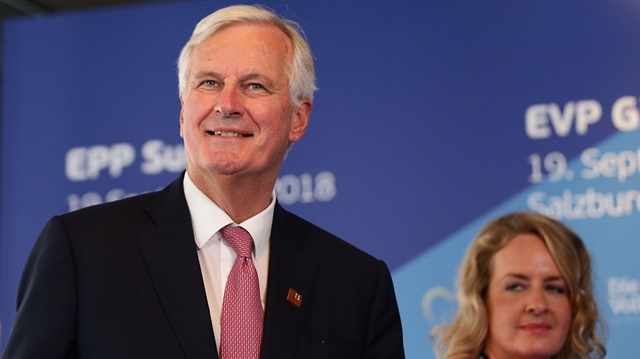
European Union's chief Brexit negotiator Michel Barnier
The European Union's Brexit negotiator Michel Barnier on Wednesday called for "decisive progress" in negotiations with Britain in time for a summit of all 28 EU nation leaders next week.
Brexit negotiators from both sides have been locked in intense discussions this week, trying to overcome differences on the biggest outstanding hurdle to a Brexit deal - how to keep the Ireland-UK border open after Britain leaves the bloc in March.
Speaking after Barnier briefed the executive European Commission, spokesman Margaritis Schinas told a news conference: "He recalled that decisive progress must be made in time for the October European Council next week and negotiations at the technical level will continue this week."
The 27 EU states will get an update at a meeting of national ambassadors, without Britain, on Friday evening. The sides will continue negotiations through the weekend with hopes for a breakthrough as early as Monday.
The European Union's top migration official said on Wednesday that Brexit negotiators were holding intense talks but they have not yet concluded a deal."Michel Barnier and his team are working day and night to reach a deal, but we are not there yet," Migration Commissioner Dimitris Avramopoulos told a news conference, referring to the bloc's chief Brexit negotiator.EU, Britain narrowing differences on Irish border in Brexit talksUK PM May's possible Brexit deal could be backed by 30-40 Labour lawmakers
EU's commissioner says 'we are not there yet' on Brexit
The 27 EU leaders meeting next Wednesday and Thursday in Brussels want to be able to announce decisive progress on the Brexit deal to agree to hold another summit in November. That would be to finalise work on a declaration of close future ties with Britain that would also be part of the Brexit package.
"Michel Barnier and his team are working day and night to reach a deal, but we are not there yet," EU Migration Commissioner Dimitris Avramopoulos told the news conference.
In a sign of progress, diplomats in Brussels told Reuters the European Union no longer expected a new proposal from Britain for the Ireland-UK border fix after Brexit as negotiators from both sides were seeking to agree on it in direct talks.
Previously, the 27 states who will remain in the bloc insisted that London present formal new proposals for the border in writing.
The European Union no longer expects a new proposal from Britain for the Ireland-UK border fix after Brexit and negotiators from both sides are seeking to narrow differences together in direct talks, diplomatic sources in Brussels said.That marks a small step forward in the Brexit talks as the 27 states who will remain in the bloc have previously insisted that London present formal new proposals for the border in writing.Brexit negotiators from both sides - Sabine Weyand for the EU and Oliver Robbins for Britain - have been locked in Brussels this week in what one diplomat described as "tunnel negotiations" to narrow down the outstanding differences.The issue of how to preserve an open border between EU state Ireland and the British province of Northern Ireland - Britain's only land frontier - after Brexit is the last remaining hurdle, with nearly everything else in the withdrawal agreement agreed before Britain leaves next March.UK PM May's possible Brexit deal could be backed by 30-40 Labour lawmakersThe 27 EU states will hear on progress at a meeting of national ambassadors, without Britain, on Friday evening. The sides are expected to continue intense negotiations through the weekend with hopes for a breakthrough as early as Monday.The 27 EU leaders meeting next Wednesday in Brussels want to be able to announce "decisive progress" on the Brexit deal to agree to hold another summit in November. That would be to finalise work on a declaration of close future ties with Britain that would also be part of the Brexit package.Both the EU and Britain have signalled progress in recent days, boosting the sentiment on the market, which fears the most damaging no-deal Brexit."My feeling is that there is a smaller probability for lack of deal now than we have had for some time," Danuta Hubner, a European Parliament lawmaker dealing with Brexit, told a committee. 
EU, Britain narrowing differences on Irish border in Brexit talks
The issue of how to avoid extensive checks at the border between EU state Ireland and the British province of Northern Ireland - Britain's only land frontier - after Brexit is the last remaining hurdle, with nearly everything else in the withdrawal agreement agreed before Britain leaves next March.
NO-DEAL
Both the EU and Britain have signalled progress in recent days, boosting the sentiment in markets, which fear the most damaging no-deal Brexit.
"My feeling is that there is a smaller probability for lack of deal now than we have had for some time," Danuta Hubner, a European Parliament lawmaker dealing with Brexit, told a committee.
But the Commission has also looked at preparations among the 27 states for a no-deal scenario on Wednesday, discussing a document laying out the multiple disruptions that would ensue, including customs checks and duties kicking in immediately on all imports and exports between the EU and Britain.
Around 30 to 40 lawmakers from the opposition Labour Party would be prepared to back a Brexit deal that British Prime Minister Theresa May is trying to strike with the European Union, The Times newspaper reported, citing unidentified lawmakers.The EU's Brexit negotiators believe a divorce deal with Britain is "very close", diplomatic sources told Reuters last week, though it is unclear whether May could get the deal approved by the British parliament.Around 320 votes in the 650-seat parliament are needed to be certain of winning a vote.May has 315 lawmakers and governs with a working majority of 13 thanks to a deal with the 10 lawmakers of the Northern Irish Democratic Unionist Party (DUP), though rebels in her own party say 40 of her lawmakers could vote against her deal.EU envoys schedule late Friday talks in Brexit countdownThe Times said a group of between 30 to 40 Labour lawmakers could defy their leader, Jeremy Corbyn, and vote for a deal that May hopes to bring back by the end of the year.In one scenario being discussed, Labour lawmakers would initially vote down any deal to prove loyalty to the leadership, but if parliamentary deadlock remained the rebels would back any deal that prevented a chaotic departure, The Times said.If lawmakers reject a deal, May could fall and Britain would face leaving the EU without an agreement, a move investors and company chiefs say would weaken the West, panic financial markets and block the arteries of trade.Without a deal the United Kingdom would move from seamless trade with the EU to customs arrangements set by the World Trade Organization for external states. At least 40 lawmakers in UK PM May's party willing to vote down Brexit deal: Steve BakerNo divorce without precise future framework: spokesman for UK's May
UK PM May's possible Brexit deal could be backed by 30-40 Labour lawmakers
While some in the Commission wanted to publish the document, the Brexit negotiators feared it would upset Britain and could hurt the negotiations.
"We are working hard for the Brexit negotiations to succeed. But since we can't guarantee the result right now, we have to prepare for all possible outcomes," one diplomat said.
"There is a growing sense among the EU27 that outstanding preparedness questions have to be addressed very quickly and in a detailed way... The EU27 need to be ready on day one to address issues like citizen's rights, transport or customs coherently."
Avramopoulos also said the bloc's no-deal contingency plans on security were driven by "goodwill", stressing the bloc would want to continue cooperating with Britain closely, including on sharing intelligence.