

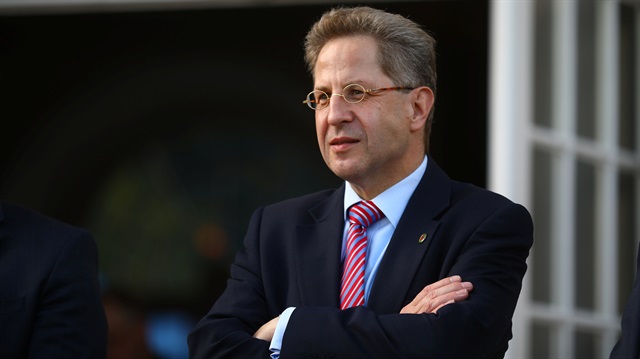
Head of the German Federal Office for the Protection of the Constitution (Bundesamt fuer Verfassungsschutz) Hans-Georg Maassen attends a reception of Germany's safety authority in Berlin, Germany, September 11, 2018.
The embattled chief of Germany's BfV domestic security agency wants to more than double his staff to 6,000 people by 2021, German news magazine Der Spiegel reported Saturday, citing sources at the interior ministry.
Hans-Georg Maassen is facing calls to step down after he cast doubt on the authenticity of video footage showing far-right protesters chasing migrants in the eastern city of Chemnitz after the fatal stabbing of a German-Cuban man.
Chancellor Angela Merkel and Interior Minister Horst Seehofer - both conservatives - have said the issue will not bring down their fragile ruling coalition with the Social Democrats (SPD), who are calling for Maassen's ouster.
Maassen, who has said his comments on Chemnitz were misunderstood, plans to expand his agency to match the size of the BND foreign intelligence service, which employs 6,500, Der Spiegel reported. The BfV currently has around 2,900 employees.
The head of Germany's domestic spy agency, facing calls to quit for questioning whether a video showing far-right gangs hounding migrants in the city of Chemnitz was genuine, now accepts the footage was real, two papers reported on Tuesday.Germany's most violent far-right protests in decades, which took place in the eastern city over the fatal stabbing of a German man blamed on two migrants, have reignited a heated debate about Chancellor Angela Merkel's 2015 decision to open the country's borders to more than a million refugees.Hans-Georg Maassen, who heads the BfV intelligence agency, prompted anger from lawmakers of mainstream parties last week for telling top-selling Bild he was not sure if the footage, shot in Chemnitz two weeks ago and circulated online, was genuine.Germany's spymaster must explain doubts over Chemnitz videos: interior ministerThe Sueddeutsche Zeitung and the Frankfurter Allgemeine Zeitung said Maassen had written to Interior Minister Horst Seehofer saying that the video had not been falsified and that his comments had been misunderstood.Maassen said he had meant to express doubt about whether the video genuinely showed people being chased, the papers wrote.Lawmakers including the leader of the Social Democrats (SPD), who share power with Merkel's conservatives, called on Maassen to resign if he failed to explain his comments, and it is not yet clear to what extent the new explanation will ease the pressure on him.Two Afghans detained on suspicion of killing man in east GermanyMaassen had appeared to contradict Merkel's view of the events in Chemnitz. She last week rebuked a conservative ally, head of the state of Saxony where Chemnitz is located, for playing down the violence. Police also arrested people in the city for giving the Nazi salute, an action that is illegal in Germany.Merkel and her spokesman have repeated several times that far-right violence is unacceptable in Germany.On Monday evening several hundred right-wing supporters dressed in black gathered in the eastern city of Halle, in Saxony-Anhalt, following the death at the weekend of a German man and the arrest of two Afghans in the nearby city of Koethen.Police said they made 14 arrests, mainly for showing banned right-wing symbols, but there had been no serious violence.Pressure mounts for surveillance of Germany's far-right AfD partyGermany suspends two policemen over Nazi salute
German spy chief backtracks over Chemnitz protest video doubts
A spokesman for the interior ministry, which oversees the BfV agency, declined to comment on the Spiegel report, citing restrictions on public information about the agency.
Der Spiegel said Maassen planned to restructure the agency divisions responsible for counter-espionage, Islamist extremism and counter-sabotage to keep up with expanding threats.
Merkel is due to meet Seehofer and SPD leaders on Tuesday to discuss Maassen's fate after failing to end the row on Thursday.
Police have arrested two migrants, an Iraqi and a Syrian, as suspects in the killing of the German-Cuban man, which triggered the worst far-right violence Germany has seen in decades and counter-protests by supporters of Merkel's liberal immigration polices.
The head of Germany's domestic spy agency must explain why he cast doubt on the authenticity of videos showing far-right gangs hounding migrants in an eastern city, Interior Minister Horst Seehofer said on Monday.BfV head Hans-Georg Maassen has faced calls to resign from across the mainstream political spectrum after he said he was not sure if footage circulated online showing skinheads chasing foreigners in Chemnitz were authentic.Violent protests in the city last month by far-right groups over the fatal stabbing of a German man blamed on two migrants have widened already deep social divisions that were exposed by Chancellor Angela Merkel's decision in 2015 to open Germany's borders to more than one million migrants.Seehofer heads the Bavaria-based Christian Social Union (CSU) party, which is generally further right on social issues than its alliance partner, Merkel's Christian Democrats (CDU).German finance minister expects digital tax reform to take timeHe has been criticised for saying he would have joined in the Chemnitz protests, albeit not with far-right groups.But on Monday he took a more conciliatory line."We are waiting to see what he has to report to us," he told reporters when asked if Maassen could remain as BfV chief. "Everything else will be dealt with then."Seehofer also urged caution over the arrest of two Afghans following the death at the weekend of a German man in the eastern city of Koethen, where far-right and left-wing protesters held rival demonstrations.Germany, Qatar vow to boost economic ties"We need to do everything to overcome what is happening in our country: terrible anti-Semitic incidents, far-right radicalism but also crimes by migrants. We need to face all those challenges," Seehofer said.Anne-Marie Keding, justice minister of Saxony-Anhalt where Koethen lies, said an initial autopsy showed the 22-year-old man had died of a heart condition.Its interior minister Holger Stahlknecht urged participants at a wreath-laying ceremony for the man on Monday evening to behave "reasonably".The BfV has presented its report on events in Chemnitz to Seehofer and Merkel.Merkel vows support for Turkey’s economyMerkel rebuked the premier of Saxony, the state where Chemnitz is situated, after he said no mobs hunted down migrants in the city, where a Jewish restaurant was also attacked.Seehofer noted the Saxony premier's comments, and said police and the spy agency chief had reached the same conclusion."The second thing is the veracity of the videos. Mr Maassen has said he doubts the videos are real. He must have reasons to reach this conclusion," the minister said.
Germany's spymaster must explain doubts over Chemnitz videos: interior minister
A growing number of countries can hack into private computer networks and install malicious software to sabotage another country's infrastructure, Germany's domestic spy chief said.China, Russia and other countries continued to try to break into German companies' computers to steal valuable industrial information, Hans-Georg Maassen, head of the BfV domestinc intelligence agency, told a security conference.But intelligence officials are increasingly worried about so-called "cyber bombs" that could be planted in the network of an unsuspecting company and detonated later."In the case of China, Russia, we clearly see measures like espionage, but it could also be sabotage with the goal of attacking companies in Germany - infrastructure firms in the widest sense - at some future point," Maassen said. "That is a scenario that we view with concern."Cyber experts warn that Germany - with its high level of technology expertise - is a particularly attractive target for cyber attackers of all kinds, including state actors.A company could be completely oblivious to a cyber attack that had been used to plant malware - a "cyber bomb", Maassen said. Then the bomb could shut down power networks, for example, perhaps during a time of geopolitical tension.He said such attacks could come from a range of countries that have expanded their cyber expertise. In its annual report, the agency cited rapid strides in cyber technology by Iran, although it did not specifically spell out concerns about such sleeper attacks.Germany is also increasingly concerned that China is seeking to gain dominant positions in key technology sectors by investing in German firms as part of its larger "Made in China 2025" drive, Maassen said."That is a political project in which the government is spending a lot of money, not just to invest, but to buy information for its own technical progress, or to gain a position in specific areas that will make it impossible for others to continue developments there," he said.Maassen's remarks come amid a push by Germany and other European Union states to protect sensitive technologies from Chinese takeovers. In December, the BfV also warned about efforts by China to use fake LinkedIn accounts to recruit German business executives and researchers as spies.
Germany concerned about possible 'sleeper' cyber sabotage