

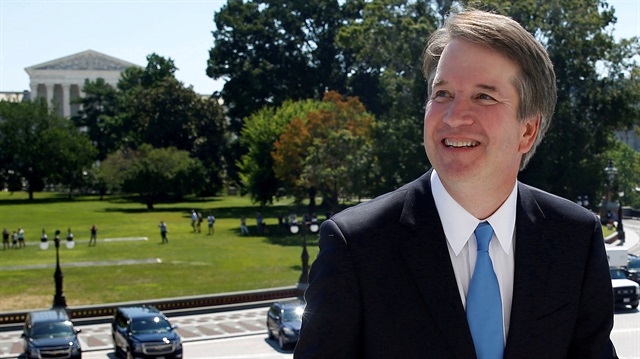
Brett Kavanaugh
U.S. Senate Democrats plan to hammer President Donald Trump's Supreme Court nominee Brett Kavanaugh over his views on abortion and presidential power in hearings starting on Tuesday, but the conservative judge looks likely to be confirmed.
Trump's fellow Republicans hold narrow majority control of the Senate so they can approve Kavanaugh if they stay united. So far, there were no signs of defections, with the Senate likely to vote by the end of the month.
The hearing, expected to last four days, gives Democrats a chance to make their case against Kavanaugh ahead of November's congressional elections.
The Kremlin dismissed U.S. President Donald Trump's warning to Syria not to launch an offensive in the opposition-held enclave of Idlib, saying on Tuesday that the area was a "nest of terrorism".Trump on Monday warned Syrian President Bashar al-Assad and his allies Iran and Russia not to "recklessly attack" the northwestern Syrian province, saying hundreds of thousands of people could be killed."Just to speak out with some warnings, without taking into account the very dangerous, negative potential for the whole situation in Syria, is probably not a full, comprehensive approach," Kremlin spokesman Dmitry Peskov said.The presence of the opposition in Idlib was undermining the Syrian peace process and making the region a base for attacks on Russian forces in Syria, Peskov added.Trump warns Assad against ‘recklessly attacking’ Idlib"A fairly large group has settled there and of course this leads to a general destabilisation of the situation. It undermines attempts to bring the situation onto the track of a political-diplomatic settlement," he said."We know that Syria's armed forces are preparing to resolve this problem," he added.Russia resumed air strikes in Idlib province on Tuesday after a hiatus of several weeks, according to a Syrian opposition member and a war monitor.A source has told Reuters that Assad is preparing a phased offensive to regain the province.The situation around Idlib will be one of the main items on the agenda when the leaders of Russia, Iran and Turkey meet in Tehran this week, Peskov told reporters on a conference call, declining to elaborate further. UN sees 'moment of truth' for Syria political processAssad sought peace with Israel in 2010: Kerry memoir
Kremlin dismisses Trump warning on Syria's Idlib
"There will be sparks at this hearing. Sparks will fly, and there will be a lot of heat," Democratic Senator Richard Blumenthal, a member of the judiciary committee that will convene the hearings, said on Friday.
Trump nominated Kavanaugh, 53, to replace Justice Anthony Kennedy, who announced his retirement on June 27 at age 81. He is Trump's second nominee to a lifetime appointment to the nation’s highest judicial body. Trump last year appointed Justice Neil Gorsuch, part of his push to make the courts more conservative.
Liberals are concerned Kavanaugh could provide a decisive fifth vote on the nine-justice court to overturn or weaken Roe v. Wade, the landmark 1973 case that legalized abortion nationwide.
The Trump administration’s diplomatic row with Turkey is reminiscent of former British Prime Minister Winston Churchill’s “bungles” during World War I which resulted in the Ottoman Empire joining the war on the side of Imperial Germany, according to a U.S. expert. Martin Sieff, who worked as a senior correspondent for United Press International and The Washington Times for 24 years and also appeared on CNN, NPR, Fox News and BBC as a commentator, made the remarks in an article published on the U.S.-based Strategic Culture Foundation’s website.“Today, Washington’s reckless and abusive policies towards Turkey are repeating the catastrophic bungles that Churchill inflicted more than a century ago,” Sieff wrote in “Repeating Churchill’s Bungles: Will US Drive Turkey into Joining the Shanghai Pact?”.Sieff said Churchill, as the political head of the British Navy, ordered the seizure of two state-of-the-art battleships being built in British shipyards for Turkey even though they were already paid for, and this “brought the Turkish Ottoman Empire needlessly into World War I on the side of Imperial Germany and the Austro-Hungarian Empire”.“The move was the political and psychological equivalent of telling Turkey today that the United States is not going to sell Ankara the F-35 Joint Strike Fighters it had promised,” Sieff wrote.In June, the U.S. Senate passed a bill prohibiting sales to Turkey of F-35 jets, citing Ankara’s decision to purchase Russia’s S-400 air missile defense system as well as its detention of U.S. citizens.Last December, Turkey announced it had concluded an agreement with Russia for the purchase of two S-400 systems by early 2020. This April, both parties agreed on early delivery of the systems.According to Sieff, more and more Turks “no longer trust NATO,” and “the only other obvious international security body for Turkey to seek protection with is the Shanghai Cooperation Organization”.The SCO is a Eurasian political, economic and security organization established in 2001. Originally it included Russia, China, Kazakhstan, Kyrgyzstan, Tajikistan and Uzbekistan.Last year, India and Pakistan joined the organization. Iran and Afghanistan currently have observer status. “Today, Washington is moving heaven and earth to integrate such major world powers as Macedonia, Montenegro and Georgia into NATO to join those vital pillars of world security Estonia, Latvia and Lithuania. And at the same time, it is obsessed with imposing ruinous sanctions on Turkey,” Sieff wrote.“Yet Turkey has been a major member of NATO for 63 years. It continues to play a crucial role in U.S. strategic deployments across the Eastern Mediterranean and the Middle East. Its cooperation is absolutely essential to ensure the supply and – if war were ever to break out with Russia – the very survival of all U.S. warships operating in the Black Sea.”
US ‘repeating Churchill’s bungles’
Without Kennedy, the court is now split 4-4 between conservatives and liberals. Kennedy was a solid conservative but sided with the court's liberals on some issues, including abortion and gay rights.
Beyond social issues, Kavanaugh is also likely to face questions about his views on investigating sitting presidents and the ongoing probe led by Special Counsel Robert Mueller into Russian meddling in the 2016 U.S. presidential election and possible collusion between Moscow and the Trump campaign.
Kavanaugh spent four years working for Kenneth Starr, the independent counsel who investigated former Democratic President Bill Clinton in the 1990s. Kavanaugh also spent more than five years working for Republican President George W. Bush.
U.S. President Donald Trump on Monday warned Syrian leader Bashar al-Assad not to “recklessly attack” Idlib province amid reports of a potential military offensive by regime forces.“President Bashar al-Assad of Syria must not recklessly attack Idlib Province. The Russians and Iranians would be making a grave humanitarian mistake to take part in this potential human tragedy,” Trump posted on Twitter.“Hundreds of thousands of people could be killed. Don’t let that happen!” he added.Located near the Turkish border, Idlib is home to more than 3 million Syrians, many of whom fled from other cities that were attacked by the Assad regime’s forces.In May, Idlib was designated a “de-escalation zone” -- in which acts of aggression are expressly forbidden -- as part of ongoing peace talks in the Kazakh capital, Astana.Earlier Monday, Germany and France expressed concern about a possible major offensive in the region.Meanwhile, Iranian Foreign Minister Javad Zarif, who arrived in Damascus Monday for talks ahead of a planned trilateral summit on war-torn Syria, said the Al-Nusra and Hayat Tahrir al-Sham terrorist groups “must be cleaned out of Idlib”.
Trump warns Assad against ‘recklessly attacking’ Idlib
In 2009, many years after the Starr inquiry, Kavanaugh wrote a law review article saying presidents should be free from the distractions of civil lawsuits, criminal prosecutions and investigations while in office.
As a judge, he has amassed a solidly conservative record since 2006 on the influential U.S. Court of Appeals for the District of Columbia Circuit.
With Senator John McCain's death, the Republican Senate majority shrank to 50-49, but McCain's replacement is likely be seated before a final vote on Kavanaugh, restoring the majority to 51-49 and providing the votes needed for confirmation.
Liberal activists have pinned their slim hopes to block Kavanaugh on two Republican senators who support abortion rights: Susan Collins and Lisa Murkowski. So far, neither has indicated she is likely to oppose Kavanaugh.