

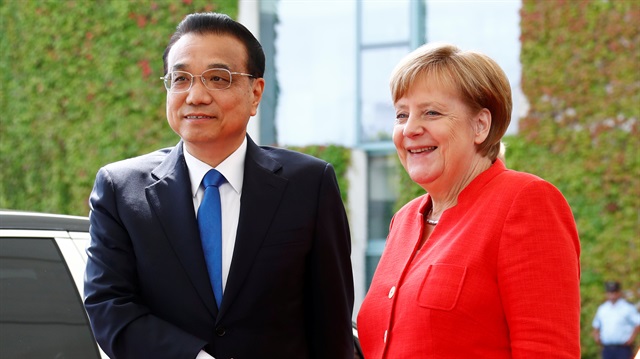
German Chancellor Angela Merkel and Chinese Prime Minister Li Keqiang shake hands at the chancellery in Berlin, Germany.
The visit of Chinese Prime Minister Li Keqiang to Germany is intended to signal that the two exporting powerhouses stand together against unilateralism and protectionism, Beijing's ambassador to the European Union said.
The trade conflict between Europe, China and the United States is high on the agenda for the consultations between Li and Chancellor Angela Merkel in Berlin on Monday.
China's Premier Li Keqiang called on Berlin to sweep aside barriers hindering Chinese firms' investment in Europe, urging German companies "not to be afraid" of cooperating with their Chinese counterparts.Li's message, in an article for the Frankfurter Allgemeine, comes ahead of an intergovernmental summit in Berlin next week, when German manufacturers' concerns about loss of technological leadership to China are likely to be high on the agenda.The manufacturing and exporting powerhouses are allies as well as rivals, since both stand to lose from the looming trade war being pushed by the U.S. President Donald Trump.But European officials are concerned at flush Chinese companies' acquisitions in Europe, fearing that Europe's know-how and technology advantage is being lost. Both Brussels and Berlin have proposed new instruments for blocking Chinese acquisitions in strategic sectors."(I hope) Germany changes its mind and creates a fair, open environment and a stable institutional framework for companies that invest in Germany or Europe," Li wrote in the opinion piece.Chancellor Angela Merkel has stated she wants Europe to play a more interventionist role in preserving and strengthening strategic sectors such as semiconductors, battery technology or artificial intelligence, to avoid a loss of know-how that could damage local industries.But Li said Europe was wrong to fear that Chinese investments would lead to European companies suffering a loss of expertise or technological advantage.German companies should not be afraid of cooperating with Chinese companies, he wrote, since China protected intellectual property and "does not force foreign companies into technology transfer."
China's Premier Li Keqiang tells Germany to open firms to Chinese investment
In an interview with Handelsblatt newspaper, ambassador Zhang Ming warned that China and Europe were prepared to do what it takes to retaliate and show the United States that a policy of escalating trade conflict would be harmful.
"China has tried extensively to stop the trade conflict with the United States escalating into a trade war but it takes two hands to clap," Zhang Ming said in the interview, adding that no one would profit from a global trade conflict.
Washington imposed tariffs on $34 billion of Chinese imports on Friday and Beijing has said it will retaliate with punitive measures on U.S. products worth a similar amount, including soybeans, pork and cotton.The Chinese government had not officially confirmed on Friday afternoon that the retaliatory tariffs had taken effect.But the tit-for-tat measures have escalated the trade dispute between the world's two largest economies and the world's commodities markets are increasingly embroiled in the bust-up.The higher U.S. tariffs went into effect just after noon in Beijing (0401 GMT).The U.S. and China have also issued a second batch of proposed duties on $16 billion of each other's goods. These would hit U.S. energy exports, such as coal and crude oil, among other areas. It is unclear when these will come into effect.Below is a detailed breakdown of the markets affected by the tariffs imposed and proposed:FOOD:* Beijing's tariffs will have the biggest impact on soybeans, the United States' top agricultural export to China in 2017 worth about $12.7 billion, hurting U.S. farmers in states, such as Iowa and Texas, which backed Republican President Donald Trump in the 2016 election.Buying interest in U.S. beans from China, the world's top importer of the oilseed, has slowed to a trickle ahead of the tariffs, with one remaining U.S. cargo heading for China still on the water.The vessel, Peak Pegasus, carrying 70,000 tonnes of the U.S. oilseed for state grain trader Sinograin, was due to arrive in the port of Dalian at 5:00 p.m. (0900 GMT) on Friday, just hours after the duties went into effect.Some shipments marked for China were due to be loaded from the U.S. Pacific Northwest, and are likely to get sent elsewhere as exporters scramble to avoid paying the tariff, a U.S. trader said.In the months ahead though, China will struggle to replace the U.S. beans, forcing processors, which crush the beans to make oil and animal feed, to pay the extra duty or find substitutes.Rabobank reckons China may have to buy up to 15 million tonnes of U.S. beans at tariff prices. Crushers may not pass on the inflated cost at least in the short term, further eroding their already low margins, the bank said in a research note.The biggest impact will likely be seen in sales of the next U.S. crop, which will come to market in September.In the meantime, Brazil, the world's top exporter, will likely pick up the slack, although a trade association warned on Thursday the South American country may need to import the oilseed from the United States this year to satisfy demand from local processors.* U.S. pork was already saddled with duties enacted in an earlier round of the trade row and now faces an extra 25 percent tariff that would raise the total charges up to 62 percent.European pork will gain some ground over the U.S., which shipped almost $500 million worth of pork to China last year. U.S. shipments have nearly ground to a halt since the 25 percent tariffs implemented on April 2.ENERGY:* A record volume of U.S. crude oil is heading to China even as Beijing's planned tariffs threaten to cut off a relatively new and burgeoning business for U.S. exporters.Nine vessels with 26.6 million barrels of crude oil loaded in Texas and Alaska and worth about $2 billion are due to land over the next five weeks, Thomson Reuters trade flow data shows.That equates to 700,000 barrels per day, 8 percent of China's daily imports and a large volume for the United States, a newcomer to the Chinese market.If enacted, the import duty would make U.S. oil less competitive than other crudes, likely causing a decline in Chinese purchases and forcing U.S. oil firms to find other buyers.Amid a relatively well-supplied global oil market, energy consultancy Wood Mackenzie said the United States "would find it hard to find an alternative market that is as big as China," as Chinese buyers make up 20 percent of U.S. overseas crude sales.China would likely replace the lost U.S. barrels from their top sellers Russia or Saudi Arabia, which have recently announced plans to raise output.Among other energy products, China noticeably spared U.S. liquefied natural gas (LNG) exports from potential import tariffs, but in doing so, it has preserved a potential weapon should the trade war with Washington deepen.However, coal could be caught in the crossfire if the second batch of duties are introduced.Replacing American shipments with coal from other places would not be difficult for China, but a loss of business with the world's top importer of the fuel would hurt companies in West Virginia, a state that heavily favoured Trump in the 2016 presidential election.
The fallout from the US-China Trade war: what's at stake
The United States and China exchanged the first salvos in what could become a protracted trade war last week, slapping tariffs on $34 billion worth of each others' goods and giving no sign of willingness to start talks aimed at a reaching a truce.
"The Chinese are peaceful people and I think the Europeans as well, but we must demonstrate to the trade war's initiator that its action is wrong," he said.