

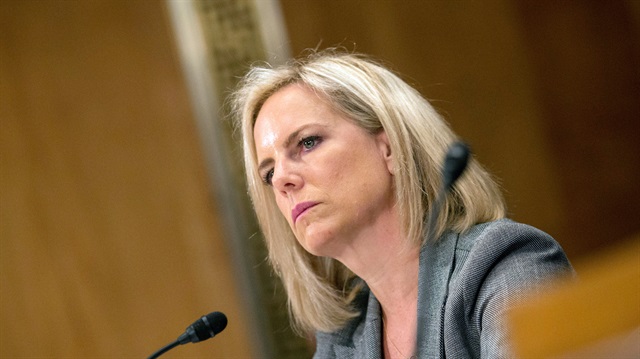
Homeland Security Secretary Kirstjen Nielsen, testifies before a Senate Homeland Security and Government Affairs Committee hearing on "Threats to the Homeland" at the Dirksen Senate Office Building in Washington, U.S., October 10, 2018.
China is waging an unprecedented campaign to influence American public opinion ahead of November congressional elections and presents the greatest long-term counterintelligence threat to the United States, U.S. security officials said on Wednesday.
Senators on the Homeland Security Committee questioned Homeland Security Secretary Kirstjen Nielsen and FBI Director Christopher Wray about President Donald Trump's assertion that China is interfering in U.S. elections and asked whether Beijing poses a larger threat to the country than Moscow.
Nielsen told the panel there were two types of threats to American election security from other nations: hacking or disruption of election infrastructure, which includes voter registration lists or voting machines, and influence campaigns.
"China absolutely is on an unprecedented - or exerting unprecedented effort to influence American opinion," Nielsen said. "We have not seen to date any Chinese attempts to compromise election infrastructure."
The U.S. Justice Department said on Wednesday it had arrested and indicted a spy for China's Ministry of State Security on charges of economic espionage and attempting to steal trade secrets from several U.S. aviation and aerospace companies.Chinese operative Xu Yanjun was detained in Belgium in April after a Federal Bureau of Investigation probe and extradited to the United States on Tuesday. The Washington Post reported he was lured to Belgium by U.S. agents.The FBI called it an unprecedented extradition and said the indictment showed the direct oversight of China's government in economic espionage against the United States.The charges come as Washington increases pressure on Beijing over its trade policies and alleged theft of U.S. intellectual property.Cybersecurity experts said the arrest was another sign of the escalating trade tensions between the two countries, adding they had seen increasing espionage by Beijing for business advantage."China is actively engaging in targeted and persistent intrusion attempts against multiple sectors of the economy, including biotech, defense, mining, pharmaceutical, professional services, transportation and more," said CrowdStrike Chief Technology Officer Dmitri Alperovitch.A U.S. Department of Justice statement said Xu, a deputy division director for the State Security Department of China's Jiangsu province, targeted several U.S. aerospace companies, including GE Aviation, a subsidiary of General Electric Co .It described another unnamed firm as "one of the world's largest aerospace firms, and a leading manufacturer of commercial jetliners and defense, space and security systems," and a third as a leader in unmanned aerial vehicle technology.GE Aviation has supplied engines for large Boeing Co and Airbus SE aircraft, and is working on a new generation of engines for commercial planes and heavy-lift military helicopters.The indictment against Xu said he targeted aviation firms since around December 2013. It also said he made contact with experts working for the firms and recruited them to travel to China, often for the initial purpose of delivering a university presentation and paying their costs and a stipend."This unprecedented extradition of a Chinese intelligence officer exposes the Chinese government's direct oversight of economic espionage against the United States," the statement quoted Bill Priestap, the FBI's assistant director for counterintelligence, as saying.John Demers, the assistant U.S. attorney general for national security, said the case was not an isolated incident."It is part of an overall economic policy of developing China at American expense," he said. "We cannot tolerate a nation stealing our firepower and the fruits of our brainpower."In Beijing, foreign ministry spokesman Lu Kang called the accusations a "pure fabrication"."We hope the American side can justly, and in accordance with the law, safeguard the legal rights of the Chinese national," Lu told a regular news briefing on Thursday.Xu's lawyers did not immediately respond to requests for comment.The maximum penalty for conspiracy and attempt to commit economic espionage is 15 years, while that for conspiracy and attempt to steal trade secrets is 10 years.The Ministry of State Security is China's intelligence and security agency and is responsible for counterintelligence, foreign intelligence and political security.Cybersecurity experts said former U.S. President Barack Obama and Chinese President Xi Jinping had reached an understanding in 2015 on cyber espionage, but the agreement appeared be withering away.Chris Painter, the former U.S. State Department official who negotiated the agreement, said in a Twitter post it was "not surprising that now the relationship has deteriorated, so has the agreement."Late last month, the Department of Justice reported the arrest of a Chinese citizen in Chicago on charges he covertly worked for a high-ranking Chinese intelligence official to help try to recruit engineers and scientists, including some who worked as U.S. defense contractors.NBC News on Tuesday quoted U.S. officials as saying a professor at a top cancer research center in Houston facing child pornography charges was also under scrutiny for alleged economic espionage for China. 
US says China spy charged with trying to steal aviation secrets
Wray went farther when asked whether China posed a larger threat than Russia, whose activities during the 2016 presidential election are the subject of a wide-ranging federal investigation that includes whether Moscow cooperated with the Trump campaign to sway the vote.
"China in many ways represents the broadest, most complicated, most long-term counterintelligence threat we face," affecting every sector of the U.S. economy, Wray said.
"Russia is in many ways fighting to stay relevant after the fall of the Soviet Union. They're fighting today's fight. China's is fighting tomorrow's fight."
Trump last month accused China of seeking to meddle in the Nov. 6 congressional elections, saying Beijing did not want his Republican Party to do well because of his pugnacious stance on trade.
International Monetary Fund Managing Director Christine Lagarde said on Thursday that she believes Chinese authorities are trying to maintain growth and stability in the face of a trade conflict with the United States, but added that this is a "complicated" balancing act."The Chinese authorities are certainly looking at options, I would think, in order to maintain a level of growth that would keep the economy under control, and we are seeing recent decisions from the PBOC to that effect," Lagarde said during a discussion at the IMF and World Bank annual meetings in Bali."I think that it's a complicated equation, where they have to both use the flexibility that is available, but at the same time be very attentive to their fiscal position," she added.
IMF chief says China faces balancing act as it seeks to maintain growth
"China has been attempting to interfere in our upcoming 2018 election, coming up in November. Against my administration," Trump told a U.N. Security Council meeting.
Trump made no reference to suspected Russian meddling in the 2016 election and provided no evidence for his allegation about China, which Beijing immediately rejected.
Responding to the comments at a regular news briefing in Beijing on Thursday, Chinese Foreign Ministry spokesman Lu Kang said maintaining healthy bilateral ties was in the best interests of people in both countries. He also urged the United States to take actions that benefit the relationship, rather than the opposite.
Trump has been skeptical of Russian meddling in the U.S. election and has repeatedly denied his campaign worked with Moscow to put him into the White House. He has drawn criticism from Democrats and his fellow Republicans that he is ignoring a threat to American democracy.
U.S. intelligence officials have said Russia has used widespread influence campaigns, including on social media, that target elections and has tried to hack and steal information from American candidates and officials.
Russia has repeatedly denied the allegations.