

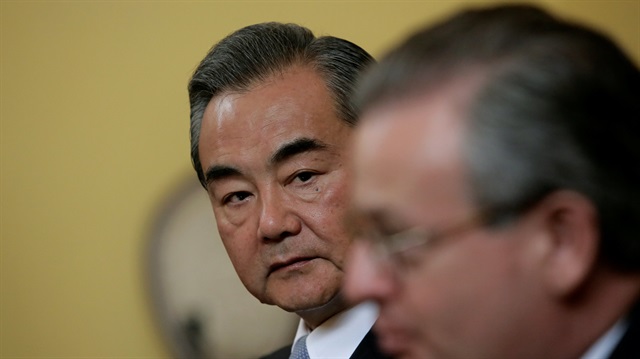
China's Foreign Minister Wang Yi
China's foreign ministry on Tuesday said that Beijing's position on the North Korean issue is consistent and that it acts in a responsible manner.
North Korea on Monday announced the arrival of the UN humanitarian chief, who claimed it is a "crucial time" for his visit as he issued a reminder that 10 million people -- 40 percent of the North's population -- require aid.Pyongyang's state-run KCNA news agency did not provide specific details of the trip by Under-Secretary-General for Humanitarian Affairs and Emergency Relief Coordinator Mark Lowcock, but this is the first visit to North Korea by an official in his position since 2011.According to a statement by the UN Office for the Coordination of Humanitarian Affairs, Lowcock is set to remain in the reclusive nation until Thursday.His agenda includes meetings with government officials, humanitarian partners and people receiving aid "to better understand the humanitarian situation".Lowcock himself lamented Monday that "the world has largely overlooked the massive humanitarian crisis" in North Korea, despite heightened interest in the country due to last month's summit between Chairman Kim Jong-un and U.S. President Donald Trump."The world needs to act now to help improve the everyday lives of millions of people who are suffering," Lowcock wrote in an opinion piece for CNN.As well as calling for ways to overcome obstacles that have hampered aid for the North due to global sanctions, he urged countries to be generous.In April, humanitarian agencies working in North Korea requested US$111 million to support 6 million particularly vulnerable North Koreans this year, but just over 10 percent of the target has been met so far.
North Korea welcomes UN aid official
Ministry spokeswoman Hua Chunying made the comments at a regular briefing after U.S. President Donald Trump suggested China might be interfering in U.S.-North Korea talks.
Trump suggested on Monday that China might be seeking to derail U.S. efforts aimed at denuclearizing North Korea, but said he was confident that North Korean leader Kim Jong Un would uphold a pact the two agreed on last month.
Chinese President Xi Jinping on Tuesday pledged a package of $20 billion in loans, and about $106 million in financial aid, to Middle East nations, as part of what he called an "oil and gas plus" model to revive economic growth in the region.Beijing has ramped up engagement in the Middle East in recent years as Arab nations play an important role in Xi's signature Belt and Road foreign policy plan for strong trade routes linking China with central and southeast Asia.China to offer aid of $15 mln to PalestineDevelopment was key to resolving many security problems in the Middle East, Xi told a gathering with representatives of 21 Arab nations in the Chinese capital."We should treat each other frankly, not fear differences, not avoid problems, and have ample discussion on each aspect of foreign policy and development strategy," he said.China would offer aid worth 100 million yuan ($15 million) to Palestine to support economic development, besides providing a further 600 million yuan ($91 million) to Jordan, Lebanon, Syria and Yemen, he added.A consortium of banks from China and Arab nations, with a dedicated fund of $3 billion, will also be set up, he said.Chinese province considers incentives for couples to have more childrenIt was unclear what the relationship between the bank consortium, financial aid and the overall loan package would be.The loans will fund a plan of "economic reconstruction" and "industrial revival" that would include cooperation on oil and gas, nuclear and clean energy, Xi said.He urged "relevant sides" to respect the international consensus in the Israel-Palestine dispute, and called for it to be handled in a just manner, so as to avoid regional disruption.China, which traditionally played little role in the Middle East conflicts or diplomacy, despite its reliance on the region for energy supplies, has been trying to get more involved in resolving long-standing disputes.China says it sticks to a policy of "non-interference" when offering financial aid and deals to developing countries, which, coupled with development, can help resolve political, religious and cultural tension.It applies this pattern of economic support, as well as a strict security regime, to its restive western region of Xinjiang. But rights groups have criticised the approach, saying the clampdown has further stoked, not eased, tension between the Muslim Uighur minority and the ethnic Han majority.
China's Xi pledges $20 bln in loans to revive Middle East