

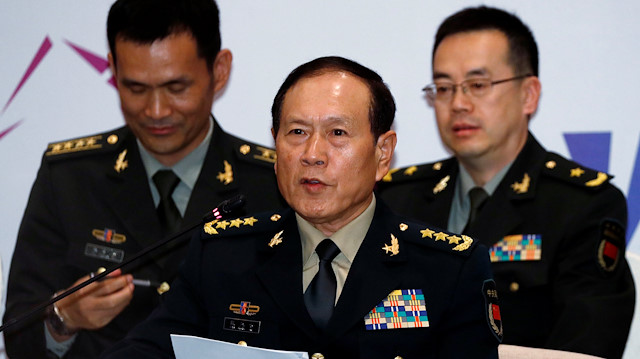
China's Minister of National Defence Wei Fenghe (C)
China's army will take action "at any cost" to foil attempts to separate the self-ruled island of Taiwan, which Beijing claims as its own, the country's defence minister said on Thursday.
Beijing has been infuriated by recent U.S. sanctions on its military, one of a growing number of flashpoints in ties with Washington that include a bitter trade war, Taiwan and China's increasingly muscular military posture in the South China Sea.
On Monday, the United States sent two warships through the Taiwan Strait in the second such operation this year and the latest in a series of gestures made by the White House in support of democratic Taiwan.
"The Taiwan issue is related to China's sovereignty and territorial integrity and touches upon China's core interests," Chinese Defence Minister Wei Fenghe said at the opening of the Xiangshan Forum in Beijing, which China styles as its answer to the annual Shangri-La Dialogue security forum in Singapore.
Japan's prime minister travels to Beijing on Thursday for his first formal bilateral summit with Chinese leaders in seven years as the Asian rivals seek to build on a thaw in ties against a backdrop of trade friction with Washington.China has stepped up its outreach to Japan and others as it has locked horns over trade with the United States.Japan, worried about China's growing naval power, is keen for smooth economic ties with its biggest trading partner. It must manage that rapprochement without upsetting its key security ally, the United States, with which it has trade problems of its own.Prime Minister Shinzo Abe, who returned to power in 2012 when Sino-Japanese ties were in tatters due to a feud over East China Sea islands, has met Chinese President Xi Jinping many times since their first chilly conversation in 2014 on the sidelines of a regional summit in Beijing.China, Malaysia, Thailand start joint military drillBut his meeting with Xi on Friday will be the first full-scale Sino-Japanese summit since 2011."Through this visit, I want to raise relations between the two countries to a new level," Abe said ahead of his departure.Abe will meet Premier Li Keqiang on Thursday and attend a reception to mark the 40th anniversary of a peace and friendship treaty. Both sides hope more visits will follow."If Xi promises to come to Japan next year, that would be very big," said Kiyoyuki Seguchi, research director at the Canon Institute for Global Studies in Tokyo."If that is realised, the improvement in Japan-China relations will accelerate."A slew of agreements are expected, from a currency swap arrangement and a new dialogue on innovation and intellectual property protection to better communication between their militaries.Japan also hopes for progress toward implementing a 2008 agreement on jointly developing gasfields in disputed waters, and wants China to ease import limits on produce from areas affected by the 2011 Fukushima nuclear disaster.A business forum on private sector cooperation in third countries is expected to yield some 50 non-binding agreements, including one on a project in Thailand, a Japanese government source said.China may be hoping that Abe makes a positive statement about its Belt and Road initiative, a vehicle to fund and build transport and trade links in more than 60 countries.'STRATEGIC TARGETS'The Belt and Road project has come under fire for saddling poor nations with debt through big projects that are not economically viable. China rejects the criticism.Japanese participation could help the initiative's image and allay fears of debtor nations, officials say.But Japanese defence officials are wary of its military implications, and Tokyo is pushing its Free and Open Pacific Strategy to promote trade and infrastructure in Asia, Africa and the Middle East.Japan also wants to ensure any joint projects with China are transparent, open and fiscally sound, officials said."We're ready to discuss tangible cooperation in third countries, but ... we think we do not need to label this cooperation with some 'initiative'," a Japanese foreign ministry official said.In a symbol of China's economic rise, Japanese Foreign Minister Taro Kono said this week Japan was ending its development assistance to China, after halting the bulk of aid more than a decade ago. Instead, they will seek ways to help others.Despite the thaw, mistrust persists.War-time history still rankles, with China often complaining that Japan has not fully atoned for its occupation of parts of China before and during World War Two.Japan is wary of China's military spending and its dominance of the South China Sea, through which much of Japan's trade flows.A recent survey showed 86 percent of Japanese had a “bad image” of China."Abe will try to develop relations," said Akio Takahara, a China specialist at the University of Tokyo."But at the end of the day, if strategic targets are different, we won't be able to establish a stable relationship."
China, Japan seek warmer ties against backdrop of US trade friction
"On this issue, it is extremely dangerous to repeatedly challenge China's bottom line. If someone tries to separate out Taiwan (from China), China's army will take the necessary actions at any cost."
China-Taiwan relations have deteriorated since the island's President Tsai Ing-wen, of the independence-leaning Democratic Progressive Party, swept to power in 2016.
Beijing, which has never renounced the use of force to bring Taiwan under its control, has also viewed U.S. overtures toward the island with alarm, such as a new de facto embassy there and passage of a law to encourage visits by U.S. officials.
Armies of China, Malaysia and Thailand held their first joint military drill on Wednesday in Malaysia.The Aman Youi 2018 (Peace and Friendship 2018) drill began in Malaysian coastal city Port Dickson.Vice-admiral at Malaysian Armed Forces, Syed Zahiruddin Putra, said that the drill will contribute to the defense units in the fields of humanitarian aid, disaster management, naval security and the fight against terror.Chinese Lt. Gen. Ma Yiming said the military drill displays the participating countries' mutual aim for peace and friendship.The Chinese army attended the exercise with 693 military staff, one destroyer and frigate, while the Malaysian army joined with 592 military staff, two frigates and two helicopters.Thailand, observer of the drill, sent personnel to participate in the battle plan as well as the drill management.The exercise will end on Oct. 29.China and Malaysia had their first ever joint military drill in 2014 to develop ties.
China, Malaysia, Thailand start joint military drill
China's military ties with the United States are important and sensitive, Wei said, adding that China will never give up an inch of its territory.
Beijing opposed displays of strength and provocation in the South China Sea by "nations from outside the region" carried out under the pretence of protecting freedom of flight and navigation, he added.
The world's two largest economies needed to deepen high-level ties so as to navigate tension and rein in the risk of inadvertent conflict, U.S. Defense Secretary Jim Mattis told his Chinese counterpart last week.
Mattis saw firsthand last month how mounting Sino-U.S. friction can undermine military contacts, when Beijing upended plans for him to meet Wei in October.
China has been angered by the U.S. sanctions on its military for buying weapons from Russia, and by what Beijing sees as stepped-up U.S. support for democratic Taiwan, which it claims as sacred territory.
China has also expressed concern after U.S. President Donald Trump said Washington would withdraw from a landmark Cold War-era treaty that eliminated nuclear missiles from Europe because Russia was violating the pact.
China is not a party to that treaty, but Trump has also suggested Beijing's military strength played a role in his decision, which China has described as "completely wrong".