

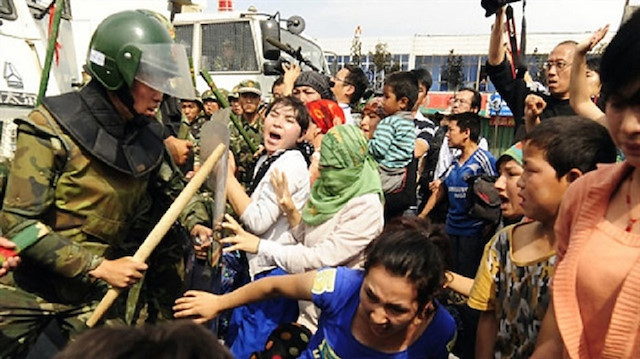
File photo
China on Tuesday rejected Western countries' criticism of suspected mass detention of Uighurs in Xinjiang province, saying that the allegations were "seriously far away from facts". "We will not accept politically-driven accusations from a few countries that are fraught with biases," Le Yucheng, Chinese vice minister of foreign affairs, told the U.N. Human Rights Council.
The minister spoke at the end of a debate on China's rights record, in which delegations from Britain, France, Germany and the United States voiced deep concern about what China says are vocational training camps.
Western countries including Canada, France and Germany called on China on Tuesday to close down detention camps, which activists say hold 1 million Uighurs and other Muslims.At a debate at the U.N. Human Rights Council in Geneva -- which reports on human rights in each U.N. member state every five years and is reviewing China's record this week -- Beijing said it protected the freedoms of ethnic minorities.But one after another, Western countries spoke out against what they described as a deterioration in China's human rights since the last review, especially over its treatment of Muslims in the western province of Xinjiang.Beijing should "halt massive imprisonment" and "guarantee freedom of religion and belief, including in Tibet and Xinjiang," France's ambassador Francois Rivasseau said. Germany called for an end to "all unlawful detention including unconstitutional mass detention of Uighurs and other Muslims in Xinjiang."Security spending soars in China's troubled Xinjiang region: reportCanada's envoy Rosemary McCarney said Ottawa was "deeply concerned by credible reports of mass detention, repression and surveillance of Uighurs and other Muslims in Xinjiang."Canada recommends that China release Uighurs and other Muslims who have been detained arbitrarily and without due process for their ethnicity or religion," she said. Similar statements were made by diplomats from Australia and Japan.In his opening speech, Le Yucheng, China's vice minister for foreign affairs, made no mention of the allegations of mass detentions."We protect the rights of ethnic minorities in accordance with law, all 55 ethnic groups are represented in the National Congress and Chinese Communist Party," he said.A United Nations panel of human rights experts said on Aug. 10 it had received many credible reports that 1 million ethnic Uighurs in China were being held in what resembles a "massive internment camp that is shrouded in secrecy."China has said in the past that Xinjiang faces a threat from militants and separatists. It rejects all accusations of mistreatment and denies mass internment, although Chinese officials have said some citizens guilty of minor offences were being sent to vocational centres to work.Around 1,000 Tibetan and Uighur protesters from around Europe protested outside the U.N. headquarters in Geneva during the debate.
West calls on China to close Uighur detention camps
Spending on security-related construction tripled in 2017 in China's far western region of Xinjiang, where Beijing is accused of detaining as many as one million ethnic Uighurs and other Muslims, an academic analysis of government expenditure found.Beijing says its "vocational training centres" in Xinjiang camps teach employment skills and legal knowledge aimed at curbing religious extremism.The report published on Monday by U.S. think-tank the Jamestown Foundation examined government budget data and found spending on security-related construction in Xinjiang rose last year by nearly 20 billion yuan ($2.90 billion), or 213 percent."Xinjiang's budget figures do not reflect increased spending on vocational education ... as the region ramped up camp construction; nor do they reflect an increase in criminal cases handled by courts and prosecutors," said the report's author, Adrian Zenz, an anthropologist at the European School of Culture and Theology in Germany.Activists urge deep scrutiny of China at UN rights gathering this week"Rather, they reflect patterns of spending consistent with the construction and operation of highly secure political re-education camps designed to imprison hundreds of thousands of Uyghurs with minimal due process."It also found that despite the purported large "vocational training" campaign, employment outcomes had not markedly improved, according to Xinjiang's own official employment figures.Whatever training the facilities do provide, Zenz said, it appeared it was not administered or paid for by the vocational education system.The Xinjiang government and the State Council Information Office, which doubles as the Communist Party's spokesman's office, did not immediately respond to requests for comment.On Tuesday, foreign ministry spokeswoman Hua Chunying said she did not personally know how much Xinjiang's security expenditure was.Speaking at a daily news briefing, she asked whether Jamestown had also looked into how much money the Xinjiang local government had spent "developing the economy and improving lives".Reports of mass detentions and strict surveillance of ethnic Uighurs and other Muslims have prompted the United States to consider sanctions against officials and companies linked to accusations of human rights abuses.After initial blanket denials, Chinese officials said in recent weeks they were not enforcing arbitrary detention and political re-education across a network of secret camps, but rather that some citizens guilty of "minor offences" were sent to vocational centres to provide employment opportunities.While prison expenditure doubled between 2016 and 2017, spending on prosecution on criminal suspects was largely flat, Zenz said, indicating it was likely that few of the so-called criminals involved only in minor offences were put on formal trial.China's record will be examined by the U.N. Human Rights Council on Tuesday, the first time since 2013, in a regular review expected to focus on its treatment of ethnic minorities, especially Uighurs and Tibetans. 
Security spending soars in China's troubled Xinjiang region: report