

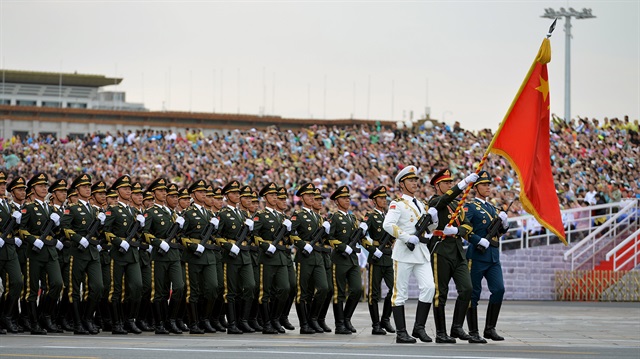
China's People's Liberation Army (PLA)
Anti-China forces are behind criticism of policies in the far western region of Xinjiang, the Chinese foreign ministry said on Tuesday, after a U.N. panel aired accusations that a million ethnic Uighurs may be held in internment camps there.
China has said Xinjiang faces a serious threat from terrorists and separatists who plot attacks and stir up tension between the mostly Muslim Uighur minority who call the region home and the ethnic Han Chinese majority.
During the past two years, authorities have dramatically stepped up security and surveillance there, likened by critics to near martial law conditions, with armed police checkpoints, reeducation centres, and mass DNA collection.
Members of a United Nations human panel reviewing China's rights record have said they received credible reports that 1 million ethnic Uighurs are held in what resembles a "massive internment camp that is shrouded in secrecy".
The "ulterior motives" of anti-China forces were behind the "unfounded" slandering of the country's anti-terrorism measures, Foreign Ministry spokesman Lu Kang said in a statement, however.
"Any defamatory rumours are futile," Lu said, adding that the situation in Xinjiang was stable with communities of all ethnicities getting along harmoniously, and economic development enjoying good momentum.
"People of all ethnic groups in Xinjiang cherish the current situation of living and working in peace and happiness."
China has never officially confirmed the existence of detention centres in Xinjiang, but its treatment of Uighurs, as well as accounts of its use of relatives in China as leverage to silence a vocal diaspora, have spurred an international outcry.
China officially guarantees freedom of religion, but in recent years officials nervous about the possibility of radicalisation and violence have tightened controls in heavily Muslim areas.
China's policy of "Sinification" of religion has increasingly alarmed many in other Muslim groups, who fear the government is widening strict curbs in Xinjiang to additional Muslim areas, such as the region of Ningxia and Gansu province.
In the crackdown, the government has banned religious education for young people in mosques, ordered that the call to prayer over loudspeakers be silenced in some places, and sought to stamp out what it sees as Arab elements in mosques.
Massively stepped-up security in China's restive far western region of Xinjiang has helped prevent "great tragedy", a state-run newspaper said on Monday, in the country's first response to a critical United Nations report on the situation there.A U.N. human rights panel said on Friday that it had received many credible reports that 1 million ethnic Uighurs in China are held in what resembles a "massive internment camp that is shrouded in secrecy".China has said that Xinjiang faces a serious threat from terrorists and separatists who plot attacks and stir up tensions between the mostly Muslim Uighur minority who call the region home and the ethnic Han Chinese majority.UN says it has credible reports China holds million Uighurs in secret campsHundreds have died in unrest there in recent years.In joint editorials in its Chinese and English versions, the widely-read Global Times tabloid said criticism of the rights record in Xinjiang was aimed at stirring trouble there and destroying hard-earned stability.China's security presence there has prevented Xinjiang from becoming another Syria or Libya, it added."There is no doubt that the current peace and stability in Xinjiang is partly due to the high intensity of regulations. Police and security posts can be seen everywhere in Xinjiang," the paper wrote."But it's a phase that Xinjiang has to go through in rebuilding peace and prosperity and it will transition to normal governance."Maintaining peace and stability there is in the basic interest of people in Xinjiang and all of China, it added.UN: China holds million Uighurs in secret camps"The turnaround in Xinjiang's security situation has avoided a great tragedy and saved countless lives, thanks to powerful Chinese law and the strong ruling power of the Communist Party of China," the paper wrote."What the West has been hyping has destroyed numerous countries and regions. When the same evil influence was spreading in Xinjiang, it was decisively curbed."Xinjiang has "no room for destructive Western public opinions", and all steps must be taken to ensure its stability, it said."Peace and stability must come above all else. With this as the goal, all measures can be tried. We must hold onto our belief that keeping turmoil away from Xinjiang is the greatest human right."China's Foreign Ministry has not yet responded to a request for comment on the United Nations report.
China has prevented 'great tragedy' in Xinjiang: state-run paper
A United Nations human rights panel said on Friday that it had received many credible reports that 1 million ethnic Uighurs in China are held in what resembles a "massive internment camp that is shrouded in secrecy."Gay McDougall, a member of the U.N. Committee on the Elimination of Racial Discrimination, cited estimates that 2 million Uighurs and Muslim minorities were forced into "political camps for indoctrination" in the western Xinjiang autonomous region."We are deeply concerned at the many numerous and credible reports that we have received that in the name of combating religious extremism and maintaining social stability (China) has changed the Uighur autonomous region into something that resembles a massive internment camp that is shrouded in secrecy, a sort of 'no rights zone'," she told the start of a two-day regular review of China's record, including Hong Kong and Macao.China has said that Xinjiang faces a serious threat from separatists who plot attacks and stir up tensions between the mostly Muslim Uighur minority who call the region home and the ethnic Han Chinese majority.A Chinese delegation of some 50 officials made no comment on her remarks at the Geneva session that is scheduled to continue on Monday.The U.S. mission to the United Nations said on Twitter that it was "deeply troubled by reports of an ongoing crackdown on Uighurs and other Muslims in China.""We call on China to end their counterproductive policies and free all of those who have been arbitrarily detained,” the U.S. mission said.The allegations came from multiple sources, including activist group Chinese Human Rights Defenders, which said in a report last month that 21 percent of all arrests recorded in China in 2017 were in Xinjiang.Earlier, Yu Jianhua, China's ambassador to the United Nations in Geneva, said it was working towards equality and solidarity among all ethnic groups.But McDougall said that members of the Uighur community and other Muslims were being treated as "enemies of the state" solely on the basis of their ethno-religious identity.More than 100 Uighur students who returned to China from countries including Egypt and Turkey had been detained, with some dying in custody, she said.Yemhelhe Mint Mohamed, a panel member, referred to "arbitrary and mass detention of almost 1 million Uighurs" and asked the Chinese delegation, "What is the level of religious freedom available now to Uighurs in China, what legal protection exists for them to practice their religion?"Panelists also raised reports of mistreatment of Tibetans in the autonomous region, including inadequate use of the Tibetan language in the classroom and at court proceedings."The U.N. body maintained its integrity, the government got a very clear message," Golok Jigme, a Tibetan monk and former prisoner living in exile, told Reuters at the meeting.UN: China holds million Uighurs in secret camps
UN says it has credible reports China holds million Uighurs in secret camps
A United Nations human rights panel said on Friday that it had received many credible reports that 1 million ethnic Uighurs in China are held in what resembles a "massive internment camp that is shrouded in secrecy."Gay McDougall, a member of the U.N. Committee on the Elimination of Racial Discrimination, cited estimates that 2 million Uighurs and Muslim minorities were forced into "political camps for indoctrination" in the western Xinjiang autonomous region."We are deeply concerned at the many numerous and credible reports that we have received that in the name of combating religious extremism and maintaining social stability (China) has changed the Uighur autonomous region into something that resembles a massive internship camp that is shrouded in secrecy, a sort of 'no rights zone'," she told the start of a two-day regular review of China's record, including Hong Kong and Macao.China has said that Xinjiang faces a serious threat from Islamist militants and separatists who plot attacks and stir up tensions between the mostly Muslim Uighur minority who call the region home and the ethnic Han Chinese majority.A Chinese delegation of some 50 officials made no comment on her remarks at the Geneva session that is scheduled to continue on Monday.The U.S. mission to the United Nations said on Twitter that it was "deeply troubled by reports of an ongoing crackdown on Uighurs and other Muslims in China.""We call on China to end their counterproductive policies and free all of those who have been arbitrarily detained,” the U.S. mission said.The allegations came from multiple sources, including activist group Chinese Human Rights Defenders, which said in a report last month that 21 percent of all arrests recorded in China in 2017 were in Xinjiang.Earlier, Yu Jianhua, China's ambassador to the United Nations in Geneva, said it was working towards equality and solidarity among all ethnic groups.But McDougall said that members of the Uighur community and other Muslims were being treated as "enemies of the state" solely on the basis of their ethno-religious identity.More than 100 Uighur students who returned to China from countries including Egypt and Turkey had been detained, with some dying in custody, she said.Fatima-Binta Dah, a panel member, referred to "arbitrary and mass detention of almost 1 million Uighurs" and asked the Chinese delegation, "What is the level of religious freedom available now to Uighurs in China, what legal protection exists for them to practice their religion?"Panelists also raised reports of mistreatment of Tibetans in the autonomous region, including inadequate use of the Tibetan language in the classroom and at court proceedings."The U.N. body maintained its integrity, the government got a very clear message," Golok Jigme, a Tibetan monk and former prisoner living in exile, told Reuters at the meeting. 
UN: China holds million Uighurs in secret camps