

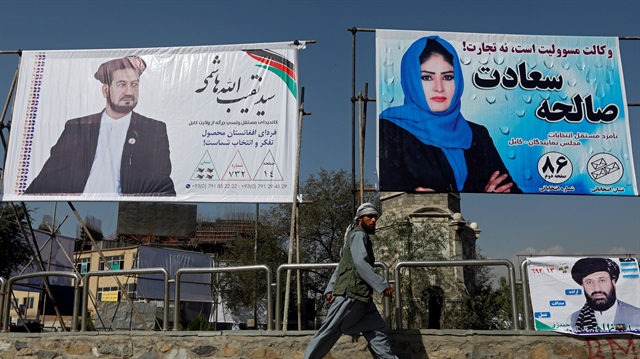
An Afghan man walks in front of election posters of parliamentarian candidates installed on the first day of elections campaign in Kabul, Afghanistan September 28, 2018.
Electoral campaign for Afghanistan's long-due parliamentary elections, scheduled for Oct. 20, began on Friday.
Main roads, markets and other public places in the capital Kabul and all other major urban centers have been painted with colorful posters, banners and hoardings of the candidates.
In line with the rules chalked out by the country’s election commission announced on Tuesday, candidates for the Wolesi Jirga (lower house) can campaign till October 18, two days before the scheduled polls.
It has also set limits for financial resources a candidate can utilize for the campaign. Each candidate in the capital Kabul can spend no more than AFN 2.12 million [approximately $27,725 ] on the posters, media advertisement and other campaign maneuvers.
Syed Hafeezullah Hashimi, spokesman for the commission, told Anadolu Agency the electoral body is committed to holding fair and free elections on time, and the candidates’ campaigns are being monitored for possible violations that could result in disqualification.
The election commission has directed public sector employees and security officials to remain neutral and committed to fair and timely elections.
Earlier this week, a coalition of main political parties, Grand National Alliance of Afghanistan, end its protest and boycott of the proposed polls upon the government’s assurance to utilize biometric verification of voters for the polls.
Afghans are set to go to polls for the 249-seat lower house of parliament for a five-year term on Oct. 20. As per the election commission figures, over nine million voters, including three million women, are eligible to cast their votes.
Representatives from the Taliban met an Afghan government delegation in Saudi Arabia this week to discuss security ahead of next month's parliamentary elections and a limited prisoner release, three Taliban officials said.The meeting comes less than a month before voters are due to go to the polls on Oct. 20 to elect a new Afghan parliament, a process which has been hampered by fears of attacks on polling stations and campaign rallies.Ensuring the election passes off smoothly and without violence has been a top priority for the Afghan government and its international partners."They requested us to help them conduct peaceful elections," said one of the Taliban leaders.Russia says Taliban ready to attend Afghan peace talks in Moscow"The Afghan delegation has agreed with us on the release of prisoners," he said, adding that some prisoners facing minor charges had already been released and officials had divided up others into three categories, depending on their importance, for future release.Both President Ashraf Ghani's office and the U.S. State Department declined to comment. No comment was available from Zabihullah Mujahid, the Taliban's main spokesman.The Taliban, who regard the internationally recognised Afghan government as an illegitimate regime imposed by foreign powers, have generally insisted on negotiating only with the United States but there have been regular unofficial contacts.Earlier this year, Washington dropped its refusal to talk with the Taliban, saying the United States would be willing to participate in Afghan-led peace talks and U.S. and Taliban delegations met for talks in Doha, Qatar, in July.Fair polls key to peace, security in Afghanistan: UNThe meeting in Saudi Arabia came after plans for another meeting with American officials broke down over U.S. demands for a three-month ceasefire, the Taliban representatives said, speaking on condition of anonymity."Some of our senior people were not in the favour of holding talks with the Afghan government as until now we were calling them puppets and refused to meet them," said one senior Taliban leader in Qatar."But our proposed meeting with the Americans failed to take place due to certain reasons," he said.The officials said U.S. demands for a ceasefire was something the leadership could not agree to. As a result, no formal meeting was held although there were informal contacts."Our agreement for holding the meeting was only to discuss prisoner exchange and the removal of our people from the UN black list so they can travel," said one senior Taliban leader from the movement's political office in Qatar.
Taliban meets Afghan officials in Saudi Arabia ahead of election