

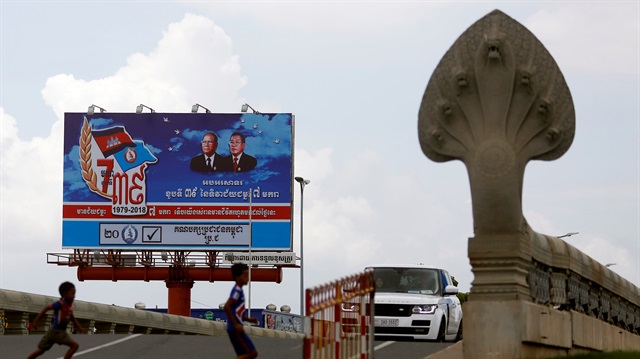
A poster of the Cambodian People's Party (CPP) is seen at Koh Pich island in Phnom Penh, Cambodia.
The ruling Cambodian People's Party (CPP) will form a new government within 60 days, its spokesman said on Tuesday, two days after a general election that critics called neither free nor fair, after the main opposition was disbanded last year.
King Norodom Sihamoni will invite all of parliament's new members-elect to a meeting to be held within 60 days of the July 29 vote, said ruling party spokesman Sok Eysan.
"After the meeting, a government will then be formed ... there will be a new cabinet," Sok Eysan told Reuters.
"It will be between September 25th and 26th."
Exiled former opposition leader Sam Rainsy called Sunday's election a farce.
Prime Minister Hun Sen's ruling Cambodian People's Party (CPP) said on Monday it had won all 125 parliamentary seats up for grabs in a general election a day earlier that critics said was neither free nor fair.Cambodia woke to another chapter of rule by strongman Hun Sen a day after an election that was heavily criticised by rights groups, the United States and other Western countries."The CPP won 77.5 percent of the votes and won all the parliamentary seats," CPP spokesman Sok Eysan told Reuters by telephone. "The other parties won no seats."The White House said it would consider steps, including an expansion of visa restrictions placed on some Cambodian government members, in response to "flawed elections" in which there was no significant challenger to Hun Sen.Critics say the election was a backward step for democracy in Cambodia following the dissolution last year of the main opposition Cambodian National Rescue Party (CNRP) and the jailing of its leader, Kem Sokha, on treason charges.Former CNRP president Sam Rainsy, who lives in exile, said the election was a "hollow" victory for Hun Sen, a former Khmer Rouge commander who has ruled Cambodia for nearly 33 years. The United States has imposed visa curbs on some Cambodian government members over a crackdown on critics and levied sanctions in June on a high-ranking official close to Hun Sen.The European Union has threatened Cambodia with economic sanctions.White House Press Secretary Sarah Sanders said in a statement Sunday's vote "failed to represent the will of the Cambodian people"."The flawed elections, which excluded the country's principal opposition party, represent the most significant setback yet to the democratic system enshrined in Cambodia’s constitution," Sanders said. The election campaign was marred by threats from national and local leaders, she said. "The United States will consider additional steps to respond to the elections and other recent setbacks to democracy and human rights in Cambodia, including a significant expansion of the visa restrictions announced on December 6, 2017," Sanders said.Government spokesman Phay Siphan said the White House statement was an attempt to intimidate Cambodia."This is against the Cambodians who went to vote to decide their own fate," Phay Siphan told Reuters.Even as the West criticised the process, Hun Sen still has one important ally, China, which offered warm congratulations for a smooth election.China has poured billions of dollars in development assistance and loans into Cambodia through bilateral frameworks and its Belt and Road initiative to build a new Silk Road."I believe that the Cambodian parliament election is an internal matter for Cambodia," Foreign Ministry spokesman Geng Shuang told a daily news briefing in Beijing on Monday."We hope that the international community can provide constructive help for Cambodia to remain stable and achieve development."Voter turnout for Cambodia election 80.49 pct'Death of democracy'CNRP Deputy Director of Foreign Affairs Monovithya Kem told a news conference in Jakarta on Monday the party welcomed the White House statement and hoped others would follow suit.The CNRP also called on the international community to reject the result of the election."29 July 2018 marked the death of democracy in Cambodia, a dark new day in recent history," said CNRP vice president Mu Sochua. "The result announced by the CPP and the National Election Committee must be fully rejected by the international community."Newspaper headlines in Cambodia on Monday greeted Hun Sen's victory."CPP Dominates Election: Unofficial results show ruling party will increase its majority in the National Assembly," said the pro-government Khmer Times newspaper.Some independent media were targeted by Hun Sen and his allies in a pre-election crackdown.More than 82 percent of those registered to vote cast a ballot, according to the National Election Committee. Turnout was 90 percent in the 2017 local election and 69.61 percent in the previous general election in 2013.Polling stations visited by Reuters in the capital, Phnom Penh, were quiet on Sunday and some voters said they voted because not doing so would land them in trouble.The CNRP had called on voters to boycott the election but authorities warned anyone doing so would be seen as a traitor.At the Kapkor Market in Phnom Penh, Meas Sinuon, 60, said she was pleased with Sunday's result."This government has done good things already," she said as she shopped for groceries. "But I want the new government to do more to help the people."Another voter, a Phnom Penh tuk-tuk driver who declined to be identified, described the result as "same".Unofficial election results are expected in mid-August. 
Cambodian PM's party claims election rout, opposition sees 'death of democracy'
"It was a farce, a sham election, it doesn't represent the will of the people," Sam Rainsy told Reuters during an interview at his Paris apartment.
The CPP has said it won all 125 parliamentary seats up for grabs in an election heavily criticized by rights groups, the United States and other Western countries.
As Western nations cool ties with Cambodia, regional powerhouse China remains a close ally. By far the biggest investor in Cambodia, it is also its biggest trade partner and has voiced support for the general election.
China's foreign ministry on Monday said it hoped the international community would remain supportive of Cambodia.
Referring to Prime Minister Hun Sen, who has been in power for more than three decades, Sam Rainsy said China was the "only backer of such a totalitarian regime".
More than half-a-million spoilt ballots in Cambodia's general election represent a protest against the vote that critics have called a sham, the opposition and an analyst said on Monday.Prime Minister Hun Sen's ruling Cambodian People's Party (CPP) has said it won all 125 parliamentary seats up for grabs at Sunday's election, held without the main opposition Cambodia National Rescue Party (CNRP), which was dissolved by a court, and had its leader, Kem Sokha, jailed on treason charges.As many as 594,843 votes, or 8.4 percent, of the 7.64 million votes cast, were invalid and spoiled, figures from the National Election Committee showed.By comparison, spoiled ballots in the last election, in 2013, comprised just 1.6 percent of the total.Voter turnout for Cambodia election 80.49 pctPolls close in Cambodia election, PM Hun Sen set to extend rule"It is a significant vote of disapproval of this particular election and an act of defiance of the unlawful coercion on voters to go to vote," Cambodia-based political analyst Lao Mong Hay told Reuters."A cunning yet legitimate protest against the powerful."Government spokesman Phay Siphan said the large number of invalid votes showed an anti-election trend."They are anti-election and the Cambodian People's Party," Phay Siphan told Reuters.During Sunday's vote counting in Phnom Penh, the capital, a Reuters journalist saw numerous ballots that had been ticked all over, while other ballots were left blank.Nineteen little-known parties contested against the ruling party, but none are particularly critical of it or the government.Exiled leaders of the CNRP had called for a boycott of the vote, prompting the government to warn that anyone who did not participate would be seen as a "traitor"."We praise the courage of all voters who came out to mark their strong message by spoiling their ballots as their way of rejecting the sham election and those who stayed home and kept their fingers clean," CNRP vice president Mu Sochua told Reuters, referring to the ink-mark that denotes a vote cast.Rights groups accused the CPP of coercing citizens to vote for the ruling party, leaving many no choice but to spoil their votes in protest.The White House said it would consider steps, including wider visa curbs on some members of the Cambodian government, in response to the "flawed elections".
Spolit Cambodian ballot papers seen as protest over 'sham' election
Critics call the election a step backward for democracy, following last year's dissolution of the main opposition Cambodian National Rescue Party (CNRP) and the jailing of its leader, Kem Sokha, on treason charges.
"The lack of genuine electoral competition and the absence of an inclusive political process mean that the 29 July election is not representative of the democratic will of the Cambodian electorate, and therefore its outcome lacks credibility," the European Union said in a statement.
Opposition members had urged voters to boycott the election. Invalid and spoiled ballots accounted for 8.4 percent of the 7.64 million cast, representing a protest against the election, the opposition and an analyst have said.
The White House said it would consider steps, such as an expansion of visa restrictions placed on some government members, in response to the "flawed" elections.
The United States has imposed visa curbs on some Cambodian officials over the crackdown and levied sanctions in June on a high-ranking official close to Hun Sen.
Still, the government appeared unruffled on Tuesday.
It will work to ensure economic growth and fight corruption, said its spokesman, Phay Siphan.
"Good governance, keeping high economic growth and peace and social stability are the goals for the new government," he told Reuters.