

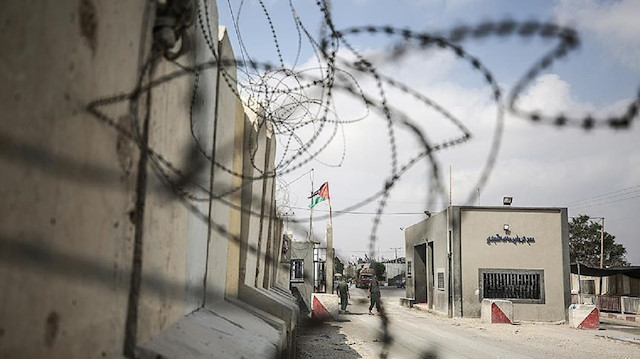
File photo
The head of Israel’s internal security service Shin Bet has described the prevailing calm in the occupied West Bank as “deceiving”, according to Israeli daily Haaretz on Tuesday.
"The situation on the Palestinian front has been very unstable over the past year," Nadav Argaman told the Foreign Affairs and Defense Committee in the Knesset (Israel’s parliament).
He claimed that Palestinian group Hamas, which rules the Gaza Strip, was trying to carry out attacks “with directions from Lebanon”.
A Palestinian girl was shot in an alleged stabbing attempt in the occupied city of East Jerusalem on Tuesday, according to Israeli police.Police said a girl carrying a knife had attempted to stab civilians and soldiers near a police station in Jerusalem.“Police border police responded to attempted stabbing attack next to petrol station near Mishor Adumim settlement,” police spokesperson Micky Rosenfeld said in a statement.“The attacker was shot and neutralized,” he said.No injuries were reported among Israelis.There was no comment from Palestinian authorities on the incident.On Monday, Israeli forces shot and injured a Palestinian man in an alleged stabbing attempt in the West Bank city of Hebron.Israel’s new favorite: OmanIsrael arrests 19 Palestinians in West Bank raidsIsraeli army wounds iconic Palestinian protester
Israeli police shoot Palestinian girl in Jerusalem
The Shin Bet chief claimed that Israeli authorities had thwarted 480 attacks and arrested 219 Hamas cells, going on to say that these numbers "attest to the extent of terrorism beneath the surface."
Tension has been high across the Palestinian territories since December when U.S. President Donald Trump unilaterally recognized Jerusalem as the capital of Israel.
Jerusalem remains at the heart of the Middle East conflict, with Palestinians hoping that East Jerusalem -- occupied by Israel since 1967 -- might eventually serve as the capital of an independent Palestinian state.
Israeli Prime Minister Benjamin Netanyahu's visit to Oman, which Tel Aviv does not have diplomatic relations with, reignited the debate about the future of ties between Gulf states and Israel, and thereby the impact this would have on the Palestinian issue. Previously, Yıtzhak Rabin and Shimon Peres, also former leaders of Israel, visited Oman in 1994 and 1996, but Netanyahu's visit in late October drew far more attention.Reshaping the Middle EastThroughout history, the Middle East has never before been through such a tumultuous period. The current Middle East is essentially trying to be reshaped today. That is why the relationship developed between actors is now more important than ever. That is why, during U.S. President Donald Trump’s first trip to the Middle East after his election, he stated that it was time for new alliances. The countries and actors that formed a rapport and those that drifted apart must therefore be evaluated carefully.Iran and Palestine are principal mattersThere are two matters that have dominated the international agenda of the Middle East for the past two years. These issues have been held under the spotlight more than the civil war that has ravaged Syria for more than seven years. The first is whether Iran is a threat, and the second is how the lack of a solution in the Palestine-Israel conflict will shape the future. These matters are so deep that even Jamal Khashoggi, who was slain in Istanbul, is not free from these discussions. Because just before his murder, Khashoggi stated that viewing Iran as the main source of the conflicts in the Middle East caused a serious problem and that the pains experienced today were caused by this. According to Khashoggi, the basis of many of the arguments in the Middle East were based on the Israel-Palestine matter.Israel arrests 19 Palestinians in West Bank raidsIs Oman a mediator?There is a rapprochement between Arab countries and Israel that is growing each day in the reshaping Middle East. Saudi Arabia opened its airspace to Israeli airplanes, Arab leaders held secret meetings with Netanyahu on the sidelines of the UN General Assembly, and finally the Sultan of Oman hosted Netanyahu despite lack of diplomatic relations between the two countries. Another issue that needs to be noted is that Netanyahu’s visit came just days after Palestinian President Mahmoud Abbas paid a three-day visit to Oman. This situation indicates that Oman is taking on the mediator role. However, this situation should not be explained through mediation alone. It is necessary to recognize that this rapprochement means that the statements which Israel has made over the years regarding improving ties with Arab countries have now been actualized, more than ever before. Israel is legitimizing these moves made based on the common enemy, Iran. In a period where especially the U.S. has demonized Iran, Israel seeks to expand the rift between Muslims by expending chaos in the region.Israel benefitsMuslim communities of the Middle East are entrenched in serious chaos and conflict. Many Muslim countries like Libya, Yemen and Syria are ravaged by war. Despite conducting elections nearly a year ago, Iraq and Lebanon have not been able to form a strong government. Many Muslim countries, such as Saudi Arabia, the United Arab Emirates, Iran, and Egypt, have drawn themselves into a number of problems by becoming directly or indirectly involved in the civil wars of their neighbors. In addition to all this chaos, countries have engaged in an arms race by establishing coalitions against each other. When a common enemy is formed, Israel enters these alliances and makes serious gains. While Middle Eastern countries are polarizing among each other in order to overcome the chaos they live in, Israel emerges victorious.Israeli army wounds iconic Palestinian protesterArab nations silencedIsrael opted to maximize its own interests in the region after the Trump administration stepped in. Netanyahu’s Oman visit must be evaluated in this light. With the U.S. withdrawal from the nuclear agreement signed in the Obama period, Iran once again became the enemy and began to be perceived as a threat by Middle Eastern states. The fact that Iran is seen as a threat does not only distance the Palestinian issue from the global agenda but also strengthens the position of Israel in this conflict. Washington’s recognition of Jerusalem as Israel’s capital and opening the rights and earnings of refugees to debate can be counted as great victories for Israel during its conflict with Palestine. To pull the U.S. to its side and spread fear among Arab countries by declaring Iran as the common enemy are perhaps the clearest gains of Israel in terms of silencing criticism of its own invasion policies. However, Israel is not just content with these gains, but is also making investments for the future. Oman is one of these investments.Israel is trying to influence OmanOman’s distance from many clashes, especially in the Middle East, makes it a frontrunner for the role of mediator. Oman played a key role in the nuclear treaty with Iran and made a significant contribution to the deal. From this perspective, Oman is expected to become a mediator as the U.S. has lost this role. Israel is trying to direct Oman, which is likely to assume the role of mediator in the Palestinian-Israeli negotiations, by keeping a grip on it.Iran accuses Israel of failed cyber attackSowing the seeds of harmony or chaos?Netanyahu’s visit was widely covered by Gulf media outlets, and it was evaluated as being significant in terms of Middle Eastern peace. On the contrary, Iranian media, which has good ties with Oman, portrayed the trip as a new seed of chaos. Iranian media stated that this visit would spark conflict and corruption among Muslim countries, and underlined that the Palestinian issue would be overshadowed by these visits and relations. Rather than evaluating this visit as part of an alliance against Iran or as part of such an effort, the Iranian press interpreted it more in the light of the Palestinian issue.Diplomatic success for IsraelIsraeli press evaluated the visit as a strategic move. During the same week, three visits made to Gulf countries at ministerial and prime ministerial levels were highlighted as a diplomatic success. In particular, the symbolic meaning of the recitation of the Israeli national anthem during sporting activities in the United Arab Emirates was noted. Netanyahu's visit to an Iranian friend - Oman - was dubbed as another step in the isolation of Iran and also labeled as important for the continuation of peace and stability in the Middle East.Israel razes Bedouin structures in West Bank
Israel’s new favorite: Oman
Israeli forces detained 19 Palestinians in overnight raids across the occupied West Bank, according to the Israeli military on Tuesday.The individuals were arrested for “suspected involvement in popular terrorist activities”, the army said in a statement, without elaborating on the nature of these activities.The Israeli army frequently carries out wide-ranging arrest campaigns across the occupied West Bank on the pretext of searching for “wanted” Palestinians.According to Palestinian figures, some 6,500 Palestinians continue to languish in Israeli detention facilities, including scores of women and hundreds of minors.Israeli army wounds iconic Palestinian protester
Israel arrests 19 Palestinians in West Bank raids
Israeli soldiers wounded a young Palestinian man Monday whose photo has become recognized worldwide as a symbol of Palestinian resistance.The photo, which went viral on social media and attracted the attention of the world’s media, was taken by Anadolu Agency photojournalist Mustafa Hassona during a demonstration demanding the lifting of Israel’s blockade of the Gaza Strip.With a Palestinian flag in one hand and a slingshot poised in the other, the photo of 22-year-old Aid Abu Amr amid black smoke mirrors Eugene Delacroix’s 1830 artistic representation of the French Revolution titled "Liberty Leading the People" with revolutionaries being led by a woman bearing a French flag and a bayoneted musket.Abu Amr was taking part in protests at the northern Gaza border against Israel’s land, air and sea blockade when Israeli troops intervened.During the intervention, Abu Amr was wounded in the leg by live bullets.For the last seven months, Palestinians in Gaza have been staging regular demonstrations along the Gaza-Israel buffer zone to demand the right to return to their homes in historical Palestine, from which they were driven in 1948.They also demand an end to Israel’s 12-year blockade of the Gaza Strip, which has gutted the coastal enclave’s economy and deprived its two million inhabitants of many basic commodities.Since the rallies began on March 30 this year, more than 200 Palestinians have been killed and thousands more injured by Israeli troops deployed along the other side of the buffer zone.Iran accuses Israel of failed cyber attackIsrael razes Bedouin structures in West BankIsrael arrests 17 Palestinians in West Bank
Israeli army wounds iconic Palestinian protester