

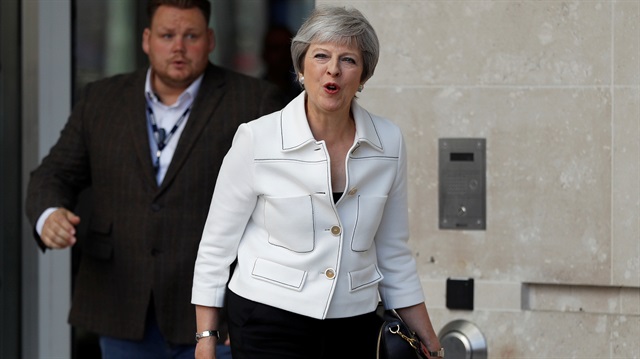
Britain's Prime Minister, Theresa May
British Prime Minister Theresa May warned her divided party on Sunday that there may be "no Brexit at all" if they wrecked her plan to forge a close relationship with the European Union after leaving the world's biggest trading bloc.
"My message to the country this weekend is simple: we need to keep our eyes on the prize," May wrote on Facebook. "If we don't, we risk ending up with no Brexit at all."
Israeli Prime Minister Benjamin Netanyahu said on Sunday that he discussed Syria and Iran with U.S. President Donald Trump ahead of the latter's meeting in Helsinki with Russian President Vladimir Putin.Moscow is the big-power ally of Syrian President Bashar al-Assad, whose advances against opposition areas close to the Israeli frontier worry the Netanyahu government. The Russians are also regular interlocutors with Iran, an adversary of Israel and the United States that has forces fighting alongside Assad in Syria.In remarks to the Israeli cabinet, Netanyahu said that in a phone conversation on Saturday he and Trump discussed "security and diplomatic issues arising from regional developments, chiefmost among them, of course, Syria and Iran".Israeli PM threatens military action against HamasNetanyahu said he thanked Trump for his tough stance against Iran. The U.S. president, Netanyahu said, "reiterated with sharp clarity his commitment to the security of Israel and his willingness to help Israel in various realms".Trump meets Putin in the Finnish capital on Monday.Last week, Netanyahu flew out to Moscow for talks with Putin that focused on Israel's demand that Iranian forces leave Syria.
Netanyahu, Trump discuss Syria, Iran ahead of Helsinki summit
Linking the fate of Brexit to her own survival in such an explicit way indicates just how precarious May's position remains after her government was thrust into crisis and U.S. President Donald Trump publicly criticised her Brexit strategy.
With less than nine months to go before the United Kingdom is due to leave the EU on March 29, 2019, the country, the political elite and business leaders are still deeply divided over what form Brexit should take.
British Prime Minister Theresa May on Sunday said U.S. President Donald Trump had previously advised her to sue the European Union as part of her Brexit strategy, revealing a piece of advice Trump said last week she had ignored."He told me I should sue the EU," May told BBC television. "Sue the EU. Not go into negotiations - sue them." UK PM May doing 'fantastic' job on Brexit, says Trump, promising trade dealTrump says relationship with UK is 'very, very strong'
UK PM May says Donald Trump told her to sue the EU over Brexit
By warning that Brexit itself is in danger, May is sending a blunt message to the dozens of hardline Brexiteers in her party that if they sink her premiership then they risk squandering the victory of an EU exit that they have dreamed about for decades.
Some pro-Brexit Conservatives fear that a deal could emerge that leaves Britain tightly bound to EU rules and represents a Brexit in name only.
The British government has also stepped up planning for a so called "no deal" Brexit that could spook financial markets and dislocate trade flows across Europe and beyond.
Turkey is persistently continuing its fight against the Fetullah Terrorist Organization (FETÖ).Turkey declared a state of emergency on July 20, 2016 following a failed coup attempt perpetrated by FETÖ on July 15. The state of emergency is due to be lifted next week. In the two years since the putsch, a total of 32 statutory decrees were issued and FETÖ terrorists who had infiltrated state institutions were purged.As a result, close to 125,000 public servants have been dismissed. In addition to this, many associations and foundations were shut down, and police and military officers with connections to FETÖ were also dismissed.Erdoğan to march in commemoration of second July 15 anniversaryMost dismissals from police forceThe most dismissals following the failed July 15 coup attempt were from the police force. Together with the Decree No. 701 recently published, a total of 38,056 people have been discharged within the Ministry of Interior. Additionally, 34,393 people were dismissed from the National Education Ministry, 14,633 from the Turkish Armed Forces (TAF) and 4,836 from the Board of Judges and Prosecutors.Approximately 5,000 of those who were dismissed from their posts returned to their jobs following decisions by the State of Emergency Commission.Turkish representations abroad mark July 15Nearly 300 coup casesFollowing the putsch, 289 cases were opened across Turkey - 56 in Ankara and 53 in Istanbul, and the captured FETÖ putschists were put on trial. A total of 9,690 defendants have stood in front of a judge as result of these cases.Also, the medals of former national soccer players Hakan Şükür and Arif Erdem were revoked.Galeri: Bosnia releases balloons to commemorate martyrs of Turkey's failed coupAt least 250 people were martyred and nearly 2,200 injured in the July 15 failed coup which was perpetrated by the Fetullah Terrorist Organization (FETÖ), led by ringleader Fetullah Gülen, who lives in self-imposed exile in Pennsylvania.Gülen pursued a long-running campaign to overthrow the Turkish government through the infiltration of state institutions, particularly the military, police and judiciary, forming what is commonly known as the parallel state.
Turkey’s great struggle against FETÖ
May has repeatedly said Brexit will happen and has ruled out a rerun of the 2016 referendum, although French President Emmanuel Macron and billionaire investor George Soros have suggested that Britain could still change its mind.
Seeking to strike a balance between those who want a smooth Brexit and those who fear staying too close to the EU's orbit, May sought the approval of senior ministers for her plans on July 6.
After hours of talks at her Chequers country residence she appeared to have won over her cabinet, but just two days later David Davis resigned as Brexit secretary, followed by her foreign minister, Boris Johnson, the next day.
Donald Trump's portrayal of NATO as an alliance in crisis has raised concern that the U.S. president's nagging criticism might erode U.S. public support and risk America's commitment to collective defence, diplomats said.Allies emerged confused and shaken from a two-day NATO summit in which Trump harangued them over perceived under- spending on defence, accused Germany of being a prisoner to Russian energy and prompted an emergency meeting of leaders trying to contain the fallout from the unexpected tirade at one session.NATO diplomats complained that the drama around Trump's forthright comments had overshadowed big decisions that the allies took in areas from defence spending to new weapons and strategies to address Russia's efforts to destabilise the West through cyber and covert attacks."There was a gap between the Trumpian-generated idea that there is some kind of crisis and the reality that this was one of the most substantial summits for years," one senior NATO diplomatic source told Reuters.Having questioned the value of NATO in tweets throughout the summit, Trump later told reporters that the 29-member military alliance "was not doing what they were supposed to be doing" until he came to Brussels and that he was "extremely unhappy" until his intervention.Then he claimed "total credit" for increases in defence spending, although they were in fact agreed in 2014, and warned that "NATO is helping Europe more than it is helping us," in language that did not make a public case for unity.However, the summit also agreed on a new training mission for Iraq, an invitation for Balkan state Macedonia to join NATO and more funding for troops in Afghanistan.While Trump did let the 79-point summit declaration go through, his assertion that "I've taken over a lot of bad hands and I am fixing them," at the end of the summit left the impression there were serious problems at NATO, diplomats said.NATO may now need its friends in the U.S. Congress and in the Republican and Democratic parties to speak out more to prevent permanent damage to alliance's image in the United States, they said.The U.S. Senate overwhelmingly approved a motion in support of NATO on the eve of this week's summit, and former U.S. Secretary of State John Kerry called for more."Enough," the Democrat said of Trump's style at the summit. "This isn't good for the United States and there are people across the aisle - as the Senate vote yesterday clearly showed - who know it and need to say it," Kerry said on Twitter.PERCEPTION, REALITYThe summit decisions, agreed by all 29 allied governments, won hardly any sustained public attention and the underlying unity was undercut by Trump's claims he had won new pledges in defence spending, forcing the French and Italian leaders into denials that dominated post-summit news conferences.He reiterated that claim in Britain on Friday."The concern is that this is not just noise to disregard, because perception is reality and this president may be with us for another six years," the senior source said.NATO, founded in 1949 to contain a military threat from the Soviet Union, relies on the United States' military superiority to face down a host of threats on Europe's borders, including a resurgent, nuclear-armed Russia and militant attacks.A commitment to defend each other is the bedrock of the alliance and any suggestion that the United States would not come to Europe's aid because, as Trump has suggested, they owe "massive" sums, could be a blow to its deterrence."President Trump has not taken damaging actions against NATO, but his words are damaging," said Adam Thomson, a former British ambassador to NATO and now director of the European Leadership Network think-tank in London.Having lambasted NATO for failing to reach a target of 2 percent of national income on defence, Trump told fellow leaders in Brussels he would prefer a goal of 4 percent, similar to U.S. levels, and then claimed victory for forcing countries to move.He also said he expected an easier meeting with Russian President Vladimir on Monday in Helsinki in remarks that contrast with the West's accusations that Moscow is seeking to undermine European democracies.NO MORE SUMMITS?One option aired by diplomats is to scrap regular NATO summits altogether and return to the era of the 1980s, when such leaders-level gatherings were less common and when much of the decision-making was taken by defence and foreign ministers.But Thomson said that was not realistic. "You cannot ignore Trump, he will find a way to make himself heard."Some European officials feel strongly that NATO should be more confident in calling out Trump's mis-statements about the alliance.Trump's claims that the United States pays for 90 percent of European security and NATO are incorrect, NATO data shows.While U.S. defence spending makes up 70 percent of combined allied governments' military budgets, just 15 percent of U.S. expenditure is spent in Europe on NATO-related defence.Washington pays about 22 percent of the running cost of NATO, including the headquarters and commonly-funded equipment such as AWACS surveillance planes.Trump has also claimed Germany and others owe money to the United States and NATO, but allied contributions are voluntary and there are multiple budgets.At 3.5 percent, the United States' own annual defence spending is below the 4-percent-of-GDP level that Trump has said it is, NATO figures show. 
Trump's portrayal of NATO in crisis carries risks for alliance
May called on Sunday for the country to back her plan for "friction-free movement of goods", saying it was the only option to avoid undermining the peace in Northern Ireland and preserving the unity of the United Kingdom.
"SUE THE EU"
Davis, writing in the Sunday Times, said it was an "astonishingly dishonest claim" to say there is no worked-out alternative to May's plan. He said her plan would allow EU regulations to harm British manufacturers.
"Be in no doubt: under the government's proposal our fingers would still be caught in this mangle and the EU would use it ruthlessly to punish us for leaving and handicap our future competitiveness," Davis said.
Despite Wednesday's sentencing of a key suspect, many questions remain unanswered about the murders of the neo-Nazi terrorist group NSU, the chief of Germany’s domestic intelligence agency has admitted.In an interview with daily Tagesspiegel on Saturday, intelligence chief Hans-Georg Maassen said that in addition to his agency, the police, the judiciary, and parliamentary commissions had also worked hard over the past several years to shed light on the murders.“Unfortunately it has not been possible to answer all the questions. Many things are still in the dark concerning the NSU murders,” he said.Maassen made no comment on heavy criticism by opposition parties accusing his agency, the BfV, of trying to cover up the possible role of its officials or informants in the murders by destroying secret files on the National Socialist Underground (NSU).The shadowy NSU killed 10 people, including eight Turkish immigrants and one Greek as well as a police officer, between 2000 and 2007, but the murders had long remained unresolved.After a five-year trial, a Munich court last week handed a life sentence to Beate Zschaepe, the main suspect still alive, and lighter sentences to four other suspects who provided support to the terrorist group.Maassen said he had hoped that the NSU trial could provide answers to many questions, and put an end to conspiracy theories.“Despite all the efforts, we still don’t know much about their motives, why they killed these individuals," he said."Why didn’t the perpetrators claim responsibility for these crimes? Why did a video claiming responsibility for the murders only appear after [Zschaepe's collaborators] Mundlos and Bohnhardt killed themselves?”- Accusations of racismThe German public first learned of the group's existence and its role in the murders in 2011, when two members -- Uwe Mundlos and Uwe Bohnhardt -- died after an unsuccessful bank robbery and police found guns and extreme-right literature in their apartment.During the five-year trial, Zschaepe, the only surviving member of the group, declined to cast any light onto the NSU and tried to lay the blame on her two late colleagues.The scandal surrounding the neo-Nazi NSU has led to criticism of police and security agencies, and accusations of institutional racism in Germany.Until 2011, Germany’s police and intelligence services ruled out any racial motive for the murders and instead treated immigrant families as suspects, questioning them over alleged connections with organized crime and drug traffickers.While recent revelations have shown that the BfV had dozens of informants who had contacts with the NSU suspects, officials insisted that they had no prior information about the NSU terror cell or its suspected role in the killings.However, authorities in the central German state of Hesse recently decided to keep a number of documents under seal for 120 years, prompting further speculation of possible NSU ties.
German spy chief: Neo-nazi NSU murders still in dark
Steve Baker, a senior lawmaker who served as a deputy to Davis in the Brexit ministry before resigning with his boss, said May had presided over a "cloak and dagger" plot to undermine Brexit.
May's position was further undermined by Trump who said in an interview published in Rupert Murdoch's Sun newspaper on Friday that her proposals would probably kill off any chance of a post-Brexit trade deal with the world's biggest economy.
May on Sunday revealed that Trump had previously advised her to sue the EU rather than enter into an exit negotiation with the bloc.
"He told me I should sue the EU," she told BBC television. "Sue the EU. Not go into negotiations - sue them."
Turkish President Recep Tayyip Erdoğan penned a letter to the families of the July 15 veterans and martyrs on the 2nd anniversary of the failed coup attempt orchestrated by the Fetullah Terrorist Organization (FETÖ).Fearless march “With pride and excitement, our country today celebrates July 15 Democracy and National Unity Day. I express gratitude on behalf of our country and nation to all our injured veterans who fearlessly marched forward that night for our homeland, sovereignty and future,” the letter penned by President Erdoğan read.Erdoğan will later visit Istanbul's July 15 Martyrs' Bridge and the nearby Monument of Martyrs unveiled last year to honor those who lost their lives while resisting the putsch.The Fetullah Terrorist Organization (FETÖ) orchestrated the defeated coup of July 15, 2016 in Turkey, which left 250 people martyred and nearly 2,200 injured.FETÖ is also behind a long-running campaign to overthrow the state through the infiltration of Turkish institutions, particularly the military, police, and judiciary.Turkey’s great struggle against FETÖErdoğan to march in commemoration of second July 15 anniversaryA promise of a brighter of future aheadIn his letter, Erdoğan said that the nation not only protected the country from a coup attempt by safeguarding its sovereignty and future against FETÖ traitors who came out against it with tanks, helicopters and weapons, but that they simultaneously protected it from an occupation attempt. “With God’s help, the prayers of the oppressed and destitute, and our nation’s courage, the blare of bullets fired by jets on that dark night was turned into a promise of even more brighter days to come for our country and nation thanks to the sacrifice of veterans such as yourselves,” the letter continued.Our struggle continuesThe letter sent to the martyrs’ families also read: “The significance of July 15 for those who lost their children, spouses, siblings and loved ones that night is, without a doubt, much more different and special. We look to our martyrs’ relatives as living monuments of sacrifice who said, “When it comes to the homeland, the rest is details. As state and nation, we full well know that no matter what we do, we will never be able to repay our debt to our martyrs’ relatives.”Galeri: Turkey commemorates martyrs of failed July 15 coup
Erdoğan pens letter to families of July 15 martyrs
Though Trump later contradicted his comments by then promising a great U.S. trade deal, the president made clear his admiration for the 54-year-old Johnson, who Trump said would one day make a great British prime minister.
Steve Bannon, Trump's former adviser, was even quoted by Britain's Daily Telegraph as saying that it was now time for Johnson to challenge May for her job.
"Now is the moment," The Telegraph quoted Bannon, Trump’s former strategist and a key player in his 2016 election campaign, as saying.
"If Boris Johnson looks at this... There comes an inflection point, the Chequers deal was an inflection point, we will have to see what happens," Bannon said.
TENSIONS IN PARLIAMENT
Johnson, the face of the Brexit campaign for many has remained silent in public since he warned in his resignation letter on July 9 that the "Brexit dream" was being suffocated by needless self-doubt.
When asked on Sunday if she would stand if a Conservative Party leadership contest was triggered, May declined to directly answer saying: "I am in this for the long term."
The extent of the danger to May from rebels in her party will become clearer over the course of two debates in parliament this week.
Pro-Brexit lawmakers are expected to use a debate on Monday on customs legislation to try to force her to harden up her Brexit plan, while a debate on trade on Tuesday will see pro-EU lawmakers push for even closer ties with the bloc.
Brexiteer rebels are unlikely to have enough support in parliament to win a vote, but the debate will show how many in May's party are prepared to vote against her at a time when some are looking to gather the numbers needed to challenge her leadership.
If May does clinch a Brexit deal with EU leaders, lawmakers could still vote it down.
Voting down a divorce deal so late in the process would trigger a major political crisis in Britain which would then be on course to crash out without any formal Brexit arrangements for trade, immigration and security.