

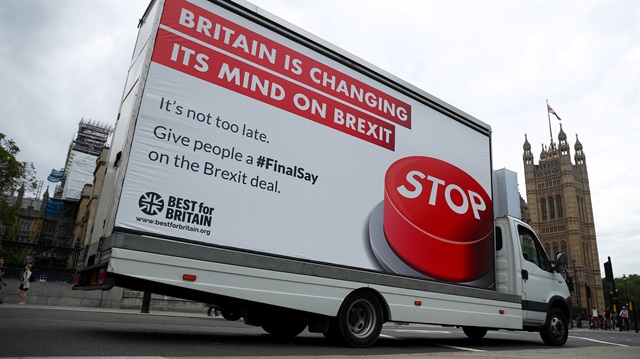
A van with a campaign poster about Brexit is driven around Parliament Square in London, Britain September 4, 2018.
British voters would vote 59-41 to stay in the European Union if given the option after a six-point swing away from Brexit, an opinion poll showed on Wednesday, the highest recorded support for EU membership in such a survey since the 2016 referendum.
In the June 23, 2016 referendum, 17.4 million voters, or 51.9 percent of the votes cast, backed leaving the EU while 16.1 million voters, or 48.1 percent of votes cast, backed staying. Many opinion polls were wrong about the result.
Polling showed 59 percent of voters would now vote to remain in the bloc, versus 41 percent who would vote to leave. The findings were published in an academic-led report on Wednesday by research bodies NatCen and The UK in a Changing Europe.
That is the highest recorded support for 'remain' in a series of five such surveys since the 2016 referendum and a large reversal of the actual 52-48 percent vote to leave.
Former Bank of England governor Mervyn King said the United Kingdom was probably heading towards a 'Brexit in name only' because the British political elite had been so incompetent in negotiating an exit from the European Union.The United Kingdom is due to leave the European Union on March 29, yet little is clear: There is, so far, no full exit deal, rivals to Prime Minister Theresa May are circling and some lawmakers are pushing for a rerun of the 2016 referendum.King, a supporter of Brexit, said it beggared belief that such a major economy should be talking of stockpiling food and medicines."We haven't had a credible bargaining position," King, who ran the Bank of England from 2003 to 2013, was quoted as saying by the BBC.King said the UK would probably find itself with Brexit in name only, dubbed BRINO, which he said was the worst of all worlds, the BBC reported.Brexit in name only would leave Britain closely linked to the EU after leaving, a state Brexiteers say would leave it subject to EU rules but unable to reap the benefits of a full divorce.With just under seven months left before the UK is due to leave the EU, the country, its politicians and its business leaders remain deeply divided over Brexit.Recent opinion polls show voters think May is handling the process badly and there may be a slight move towards support for staying in the EU."Both camps feel that they haven't got what they wanted," King said, adding that the failure of Britain to provide a united front in negotiations was shocking."The EU has been united, has been clear, has been patient and it's the UK that's been divided without any clear strategy at all for how to get to where we want to go." 
Former Bank of England chief says UK heading for 'Brexit in name only'
The author of the report, polling expert John Curtice, added a note of caution, saying that their panel of interviewees reported they had voted 53 percent in favour of remain in the original vote - a higher proportion than the actual vote.
"Nevertheless, this still means that there has apparently been a six-point swing from Leave to Remain, larger than that registered by any of our previous rounds of interviewing, and a figure that would seemingly point to a 54 percent (Remain) vote in any second referendum held now," Curtice said in the report.
Britain is due to leave the EU on March 29, 2019 but has yet to secure an exit agreement to define future relations with Brussels and manage the economic impact of ending over four decades of integration with the world's largest trading bloc.
The government has ruled out holding a second referendum.
Britain must step up contact with members of the European Union to try to get a Brexit deal as talks to leave the bloc enter a "crucial and intense phase", Prime Minister Theresa May agreed with her ministers on Tuesday.Her spokesman told reporters that at a meeting of her cabinet of top ministers, her Brexit and foreign ministers said her plans to leave the bloc had received a "warm and positive" response during visits to EU capitals over the summer."The PM and ministers agreed on the importance of continued engagement with member states as the talks enter a crucial and intense phase," the spokesman said.Weak pound, higher commodity stocks boost Britain's FTSE 100PM May says Britain will not compromise over Brexit planEU, Britain talk up chances of autumn Brexit deal
Britain must press EU members to help get Brexit deal: May
The survey interviewed 2,048 subjects between June 7 and July 8. That means the survey does not fully reflect any change in opinion brought about by the publication of Prime Minister Theresa May's negotiating strategy, published in early July.
That negotiating strategy has split May's party at every level and drawn heavy criticism from both Brexit supporters and those who want to retain close ties to the EU.
Nevertheless, the poll shows voters thought the negotiations were going badly even before the publication of May's so-called Chequers plan.
The most senior official in Britain's Brexit ministry said on Tuesday he was confident that plans were in place for the possibility of Britain leaving the European Union without a deal."What I am confident is that there are plans in place," Philip Rycroft, Permanent Secretary at the Department for Exiting the European Union (DExEU), told a committee of lawmakers in parliament."They are at a level of detail which satisfies the team at DEXEU ... we are constantly monitoring those plans to make sure they are kept up to date." 
Senior UK Brexit ministry official says confident plans in place for 'no-deal' Brexit
"Both Remain and Leave supporters have become markedly more critical of how both the UK government - especially - and the EU - somewhat less so - have been handling the negotiations," Curtice said. "They have also become markedly more pessimistic about how good a deal Britain will get."
Curtice said the results of the polling showed that the most influential factor over whether voters will support the conclusion of the negotiations is their perception of its economic effect rather than the details of any deal.