

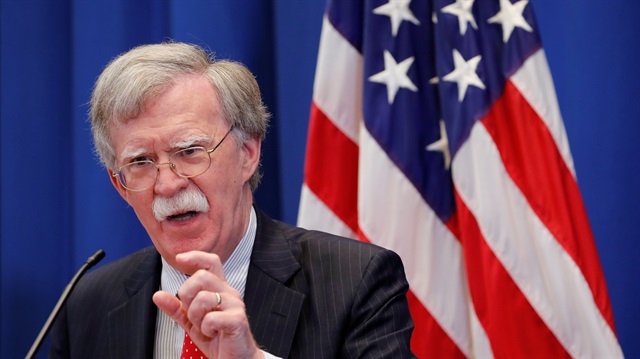
U.S. National Security Advisor John Bolton
U.S. President Donald Trump's national security adviser John Bolton said on Friday that U.S. sanctions against Russia would remain in place until Moscow changes its behaviour.
Speaking at a news conference in Kiev, Bolton added he had told Ukrainian President Petro Poroshenko that Moscow should not meddle in Ukraine's presidential vote next year.
Washington has imposed economic sanctions against Russia over its alleged meddling in the 2016 U.S. presidential election. Moscow denies the allegations.
John Bolton also said that Washington would not weigh in on an idea to swap territory between Serbia and Kosovo following Belgrade’s idea of settling a dispute that has hindered both Serbia's and Kosovo's ambitions to join the European Union by redrawing the border between the country along ethnic lines.
"Ukraine had made progress in its efforts to join the North Atlantic Treaty Organisation (NATO), but that it still had more work to do", he added.
Bolton said it was important to resolve the Ukraine crisis and that it would be dangerous to leave the situation as it is in Crimea and eastern Ukraine where Moscow has backed separatists in a conflict against Kiev.
Russian Deputy Foreign Minister Sergei Ryabkov said that all options were on the table when it came to Moscow's possible response to a new round of U.S. sanctions, the Interfax news agency reported on Friday.Ryabkov was also cited as saying that Moscow had not yet noted any signs that the United States was ready to normalise relations.Moscow had also noted attempts by Washington to revise tentative agreements reached by President Vladimir Putin and President Donald Trump at last month's Helsinki summit, Interfax cited Ryabkov as saying. Russia says unidentified helicopters provide arms to Daesh, TalibanTurkish, Russian top diplomats to meet in MoscowRussia's Lavrov to meet Saudi counterpart on Aug 29EU unlikely to heed British call for more Russia sanctions'Russia will not stop rocket engine exports to US'
Russia says all options on table for response to US sanctions
As U.S. President Donald Trump searches for new schemes to reduce the country’s foreign trade deficit and national debt by waging an economic war on countries by imposing unfair tariffs under the pretext of his “America First” campaign, reports have surfaced that his next target is the funds of Arab countries.Arab countries, primarily Saudi Arabia, the United Arab Emirates (UAE), Kuwait and Bahrain, currently have $4 trillion in U.S. and U.K. banks.A large amount of these funds belongs to Saudi and the UAE, with the revenues of petrol and natural gas directly transferring into U.S. banks.Specialists evaluated the situation and stated that Trump, who has waged an economic war against many countries, including China, Turkey and Iran, is now planning to seize the petrodollars of Gulf countries.Deposits not questionedSpeaking to Yeni Safak daily, Cevahir Holding Chairman of the Board of Directors Yusuf Cevahir stressed, “The U.S. does not question the source of the money that comes from Gulf countries deposited into U.S. banks. However, when companies in Gulf countries want to withdraw money from U.S. banks, they are immediately faced with the questions regarding the "money source." This situation has been like this since the September 11 attacks. As long as oil revenues stay in the U.S., there is no problem. They only allow cash flow in the case of purchases of supplies and equipment from the U.S. Many Saudi companies have had mortgages currently because the U.S. does not allow cash withdrawals. Therefore, many projects in Saudi Arabia have come to a standstill because of the troubles these companies face. He also stressed that the companies in Saudi’s $500 billion mega-city NEOM project face the same difficulties.“This situation shows that countries such as Saudi Arabia, UAE, Kuwait and Bahrain work together with the U.S. in a chain of command.”Trump could declare seizure at any momentDirector of Istanbul University’s Banking Research Center Kadir Tuna in his turn stated that the possibility of seizing Arab funds has never been so strong.“Economic ties between the U.S. and Saudi Arabia and the UAE is far beyond than a usual investor and banker relationship. In terms of international banking, the fact that such large amounts of money are being held in U.S. banks for years is an unusual situation.“This situation cannot be defined with international law. Saudi Arabia has an extraordinary tie to the U.S. Trump, at any moment, can officially declare that he has seized the money,” he said.9/11 compensationAccording to reports, a number of Saudi assets and foundations will face large compensation lawsuits by the insurance companies of the families of victims of the 9/11 attacks under the pretext of supporting al-Qaeda.Washington is said to be leveraging the 9/11 court decision in an attempt to seize Saudi assets in the U.S. which will put the oil-rich kingdom’s investments there at risk.Aramco public offering ‘called off’ Saudi Arabia also called off plans for the domestic and international listing of state oil giant Aramco, billed as the biggest stock flotation in history, four senior industry sources said on Wednesday, according to Reuters. This was interpreted as a bid to protect Saudi stocks from being seized by the U.S. However, the Saudi government early Thursday issued a statement denying the reports. “The government remains committed to the initial public offering of Saudi Aramco, in accordance with the appropriate circumstances and appropriate time chosen by the Government,” Energy Minister Khalid al-Falih said in a statement released on Saudi Press Agency.Trump says the Gulf has nothing but moneyTrump had planned to target Arab funds since before his election. In a speech in Florida during his election campaign in 2016, he stated that the Gulf “has nothing but money.”“We want to do safe zones in Syria. I will get the Gulf states, who are not doing much, believe me. The Gulf states have nothing but money. I’m going to get them to pay. We owe 19 trillion, we’re not paying for it. Don’t forget, without us, the Gulf states won’t exist,” he said.
'Trump could seize Arab funds at any moment'
Italian bond yields rose on Friday after a brief move lower in early trade following a report that Trump had offered Italy to help with its public debt, while worries about trade and U.S. politics pulled other euro zone bond yields marginally higher.Asian risk assets and Wall Street posted small overnight losses after trade talks between the United States and China ended with no breakthrough and further tariffs on $16 billion worth of each country's goods were introduced on Thursday.Strategists struggled to make sense of Il Corriere della Sera's report that Trump had told Italian Prime Minister Giuseppe Conte at a meeting in Washington in July that the United States was ready to help Italy with its debt next year."This is clearly dominating headlines this morning and it probably explains the pop at the open, but traders who look into the details of this should be quick to fade the move," said Commerzbank's head of rates strategy Christoph Rieger."I would be cautious though as the U.S. has no sovereign wealth fund and neither the U.S. Treasury nor the Fed have any mandate for such interventions."Matt Cairns, rates strategist at Rabobank, said that it was more likely that the United States will look to boost investment in the Italian economy, possibly in infrastructure projects."That would benefit from the new government’s planned, favourable tax regime aimed at boosting foreign investment in the Italian economy," he said.The yield on Italy's benchmark 10-year government bonds dropped two basis points to 3.08 percent in early trade. The benchmark had been one of the best performing in the euro zone in the first half of the week, with yields falling from 3.14 percent on Monday to reach lows of 2.937 percent on Wednesday.The bid for Italian debt, which offers one of the highest yields in the euro zone, was caused as much by the lack of negative news flow, according to Cairns, as it was by Moody’s decision to postpone a ratings review on the sovereign.Markets will listen closely to a speech by Federal Reserve Chairman Jerome Powell later on Friday after minutes from the U.S. central bank's most recent meeting showed that further interest rate hikes are likely soon.But the anticipation of Powell's speech barely moved U.S. Treasuries on Thursday as expectations that the Fed will hike rates in September remained stable.German bunds remain off recent lows after Eurozone PMIs failed to excite yesterday. Recent data has shown all sectors of the German economy grew in the second quarter.Trump offered Italy help to fund public debt next year
Italian govt bond yields rise from early drop after reports of help from Trump
El Salvador's switching of diplomatic ties to China from Taiwan was a "grave concern" to the United States, a White House statement said, after the self-ruled island lost its latest ally to Beijing earlier this week.The statement, issued late on Thursday night from Washington, said El Salvador's decision to discontinue diplomatic relations with Taipei will have implications for decades. It also said the United States will continue to oppose China's destabilisation of the cross-strait relationship and political interference in the Western hemisphere."Around the world, governments are waking up to the fact that China’s economic inducements facilitate economic dependency and domination, not partnership," the statement said.Democratic Taiwan vowed earlier this week to fight China's "increasingly out of control" behaviour after El Salvador became the third country this year to switch allegiance to China from Taiwan. China urges US to correctly view establishment of ties with El Salvador
US says El Salvador's decision to discontinue diplomatic ties with Taiwan 'a grave concern'