

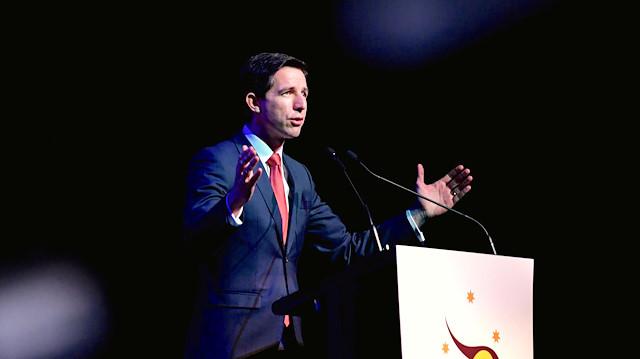
Australia's Trade Minister Simon Birmingham
Australia's trade minister will travel to China on Sunday, in a sign that political tensions between the two countries may be easing.
Simon Birmingham, the first senior Australian government official to visit China in a year, will attend the China International Import Expo, or CIIE, seen as an attempt by Beijing to allay foreign concern about its trade practices.
Relations between Australia and the world's No.2 economy have been at low ebb over accusations of China's influence in Australia's media, universities and politics and its use of loans to build leverage over poorer South Pacific island nations.
Australia is to help Papua New Guinea (PNG) develop a navy base, Prime Minister Scott Morrison said on Thursday, the latest Australian action to protect its interests in the Pacific in the face of a more assertive China.Australia has for decades enjoyed largely unrivalled influence in the Pacific but China has in recent years turned its attention to a region blessed with abundant natural resources.PNG said this year China was interested in funding the re-development of a navy base on Manus Island, an offer that diplomatic sources said worried Australia and its Western allies.Morrison said in a speech in Sydney Australia would fund the project.TPP to take effect following Australia’s ratification"I will formally commit to a joint initiative to develop the base on Manus Island," Morrison said.PNG's navy is made up largely of patrol boats and landing craft.Morrison did not say if Australia's navy would have access to the base.He also did not say how much Australia would spend on the base. Australia has in the past used its foreign aid budget to fund similar security projects in the region.Australia must assess security threats in 5G network: spy chiefAustralia said this year it will use part of a record allocation of aid for PNG to lay an undersea internet cable, assistance aimed at shutting out Chinese telecom giant Huawei Technologies Co Ltd amid national security concerns.Competition in the Pacific shows little sign of abating."Australia was particularly worried about China funding the port ... in a strategically important region," said a Western diplomat who declined to be identified as he is not authorised to speak to the media. 
Australia to help PNG build a navy base to fend-off China
In August, Australia banned Huawei Technologies Co Ltd from supplying equipment for a 5G mobile network citing national security risks, a move the Chinese telecoms gear maker criticised as being "politically motivated".
China, however, remains Australia's top goods and services trading partner, accounting for 24 percent, or A$183.4 billion ($132 billion), of total trade in 2017, according to data from the Department of Foreign Affairs and Trade.
Birmingham said in a statement on Saturday that Australia's "high-level" delegation, which includes representation from state and territory governments, "reflects our ongoing commitment to our relationship with China".
Australia has become the sixth country to ratify Trans-Pacific Partnership (TPP) on Wednesday.According to Japan’s Kyodo news agency, Australian Prime Minister Scott Morrison said the agreement was "one of the most comprehensive and ambitious" in the country's recent history, and New Zealand was notified of the completion of domestic procedures."It will help support Australian businesses to grow and see annual benefits of up to 15.6 billion Australian dollars [$11.1 billion] to our national economy by 2030," the Kyodo quoted Morrison as saying.The pact, officially the Comprehensive and Progressive Agreement for Trans-Pacific Partnership, will come into force 60 days after the completion of necessary domestic procedures in at least six signatories.As Australia ratified the agreement, it is expected to be implemented as of Dec. 30.After the U.S. President Donald Trump withdrew his country from the deal in January 2017, the remaining 11 parties, which constitutes 13 percent of the world's economy, signed the revised pact in March 2018.Japan, Canada, Mexico, Singapore and New Zealand had ratified the deal earlier.The agreement, which will provide tax cuts in agricultural and industrial products, will facilitate the companies' overseas business.Other signatories -- Vietnam, Malaysia, Brunei, Peru and Chile -- have yet to ratify the TPP.
TPP to take effect following Australia’s ratification
The minister's press office said the hope is that Birmingham will meet with his Chinese counterpart, Commerce Minister Zhong Shan while in Shanghai.
Later in the week, Birmingham will visit Hong Kong where he is expected to meet with Secretary for Commerce and Economic Development Edward Yau, "to move forward negotiations on the Australia-Hong Kong Free Trade Agreement".
Chinese President Xi Jinping is expected to open the CIIE with a speech on Monday. No officials from the United States, China's top trading partner, will attend, although leaders from 18 countries and thousands of foreign companies will be present.
Australia must restrict some firms from providing equipment for its 5G mobile communications network because it is such critical infrastructure, the head of the domestic intelligence agency said, helping to explain why China's Huawei was banned.Australia expanded its national security rules in August to include telecommunication equipment suppliers, an order that prevented Huawei Technologies Co Ltd from participating in the country's forthcoming domestic broadband network.Australia said the decision was needed as some companies answer to foreign governments, an assertion that soured bilateral relations between Canberra and China.Protestors rally in Australian cities to end offshore refugee detention"5G technology will underpin the communications that Australians rely on every day, from our health systems and the potential applications of remote surgery, to self-driving cars and through to the operation of our power and water supply," Mike Burgess, director-general of the Australian Signals Directorate, said in rare public comments late on Monday."A potential threat anywhere in the network will be a threat to the whole network," he said in a speech that did not mention Huawei or any other firms by name.A spokesman for Huawei did not immediately respond to requests for comment. The company has previously denied it answers to Beijing.Australia slaps sanctions on Myanmar army top brassWestern intelligence agencies have raised concerns for years that Huawei, the world's largest maker of telecommunications network gear, is beholden to the Chinese government, raising the risk of espionage.The United States in August restricted access for Huawei and compatriot ZTE Corp to its lucrative market for similar reasons.Australia previously banned Huawei from providing equipment for its fibre-optic network and moved to block it from laying submarine cables in the Pacific.Although widely expected, the move added to tensions in bilateral ties as Canberra had previously accused China of meddling in its domestic politics, which soured trade ties. 
Australia must assess security threats in 5G network: spy chief