

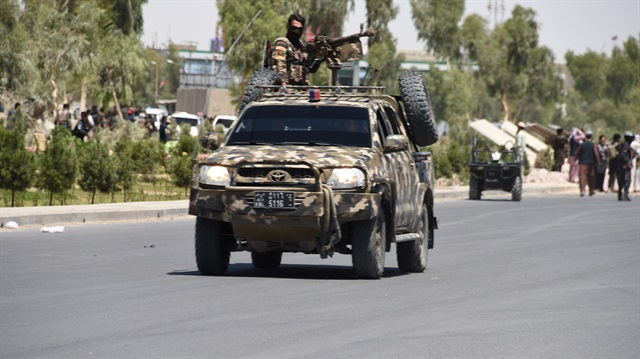
File photo
At least four civilians, including three women and a child, were killed in Afghanistan's restive Kandahar province on Friday following an air raid, according to a local official.
Provincial police spokesman Zia Durrani told Anadolu Agency that the Taliban caused the casualties by firing at a wedding party in the Maruf district after coming under air raid by security forces.
"The foreign forces targeted two vehicles of the Taliban in Khogyani area of the district, but they escaped and tried to hide in a wedding party, and from there the rebels and the security forces exchanged fire," he said.
Pakistan's key religious leaders have assured an Afghan government-sponsored peace council that they will do their part to help end Afghanistan’s decades-long conflict."We assured the Afghan delegation that we are ready to play a role in bringing peace to Afghanistan," Maulana Sami-ul-Haq, head of Jamiat Ulema-e-Islam, told Anadolu Agency by phone Thursday.A seven-member delegation of the Afghan High Peace Council headed by Maulvi Attaullah Lodin met with Maulana Sami-ul-Haq in Islamabad and sought his help in restoring peace to the country.Haq suggested that the Afghan delegation sit with the Taliban and pave the way for removing mistrust and holding direct peace talks. But the Afghan delegation asked Haq to play a role and convince the Taliban to hold direct talks with the Afghan government.Haq is also head of “Darul Uloom Haqqania”, a religious seminary in the town of Akora Khattak in northwestern Khyber Pakhtunkhwa province, and is believed to have influence on the Afghan Taliban as many of their key leaders have studied there."I offered my madrassa Haqqania [as a venue] so the Afghan peace council delegation could sit down with the Taliban for face-to-face talks," said Haq, adding he will extend the same offer to the Taliban.Delegation meets with JI chiefThe Afghan delegation also met with Siraj ul Haq, the head of the country's mainstream religious-political party Jamaat-e-Islami (JI), and sought his support in restoring peace in Afghanistan. "We believe that peace in Afghanistan is essential for the peace of the whole region and we always stand with our Afghan brothers and support the sovereignty, stability, peace and progress of Afghanistan," Siraj ul Haq told Anadolu Agency.He urged all Afghan groups to work together to bring peace to their country and compel foreign forces to leave.Taliban reactionTaliban spokesman Zabihullah Mujahid declined to comment on the Afghan peace council delegation’s meetings with Pakistani religious leaders.However, in a statement issued on Sept. 29, Mujahid asked Afghan and Pakistani religious scholars to refrain from participating in conferences on the war in Afghanistan in Islamabad and Kabul."We call on all sincere scholars to boycott these conferences and not become victims of American strategies and intelligence plots," he said in the statement.On Sept. 15, during Pakistani Foreign Minister Shah Mehmood Qureshi’s visit to Kabul, the two countries agreed to hold conferences of religious scholars in Islamabad and Kabul to bring the Taliban to the negotiating table.Pakistan had brokered the first round of direct talks between the fragile Afghan government and Taliban in Islamabad in July 2015. The process broke down when the Taliban announced the death of their long-time leader Mullah Omar, triggering a bitter power struggle within the group.Chances for a resumption of the stalled process dimmed further after Mullah Omar’s successor, Mullah Mansour, was killed in a U.S. drone strike in 2016 in Pakistan near the Afghan border.Since then, several attempts have been made with little success to resume the stalled peace process by a four-nation group comprising Pakistan, Afghanistan, the U.S. and China.
Pakistani religious leaders to work for Afghan peace
Durrani confirmed a child and three women were killed in the incident, while seven more women and another child were wounded.
The NATO-led Resolute Support Mission in Afghanistan has not commented on the incident yet. The Taliban claims the civilians were killed due to the air raid.
Last month, the UN in Afghanistan expressed serious concerns over surging civilian casualties in airstrikes.
In a statement, the United Nations Assistance Mission in Afghanistan (UNAMA) said 353 civilian casualties including 149 deaths and 204 injured were documented in the first six months of 2018 from aerial strikes, a 52 percent increase from the same period in 2017.
The UNAMA attributed 52 percent of all civilian casualties from aerial attacks to the Afghan Air Force, 45 percent to international military forces, and the remaining three percent to unidentified pro-government forces.
Afghan officials have reacted angrily to speculation that foreign military contractors could take over training and advising the Afghan armed forces, following a renewed push by the founder of private military contractor Blackwater.Erik Prince, whose company came to prominence during the war in Iraq, has been lobbying officials about his proposal to privatise parts of U.S. military operations in Afghanistan for more than a year.On a recent visit to Kabul, he lobbied several Afghan political figures and gave interviews to media outlets including Tolo News, Afghanistan's largest television station, as well as the New York Times, to discuss the plan.President Ashraf Ghani, approaching presidential elections in April, has repeatedly rejected the proposal and on Thursday his national security adviser issued a statement condemning what he called a "destructive and divisive debate"."Under no circumstances will the Afghan government and people allow the counterterrorism fight to become a private, for-profit business," the statement said.In August, U.S. Defense Secretary James Mattis also rebuffed the idea, saying: "When Americans put their nation's credibility on the line, privatizing it is probably not a wise idea."Afghan officials say that any move to replace U.S military advisers with private contractors would further undermine government legitimacy and fuel Taliban accusations that the war was being conducted for the benefit of foreign interests.Speaking half seriously, one senior security official said recently: "If they did that, even I would join the Taliban".Prince, a former U.S. Navy SEAL whose sister Betsy De Vos serves as Education Secretary in President Donald Trump's administration, would have retired Special Forces troops from the United States and allied nations embed with Afghan forces, replacing U.S. and NATO military advisers.The plan was originally broached last year as Trump was considering a new strategy for Afghanistan but it was not adopted and instead, Washington ordered thousands more U.S. troops to be sent to boost existing forces.The United States currently has some 14,000 troops in Afghanistan, serving in the NATO-led Resolute Support training and advisory mission as well as in separate counter-terrorism operations against militant groups like Islamic State.Under the strategy announced just over a year ago, the extra troops and greatly increased air strikes against the Taliban are intended to force the insurgents to the negotiating table.A brief ceasefire in June raised hopes of a possible breakthrough with the Taliban but progress towards any kind of peace deal has since been slow and fighting has continued with increasing Afghan military casualties, raising questions about the success of the strategy.Trump has since been reported to be unhappy about the lack of progress, prompting fears among some diplomats that he could reverse course and order U.S. troops out of Afghanistan, a move that would risk a collapse of the Western-backed government.
Afghan government rejects proposals to privatise war