

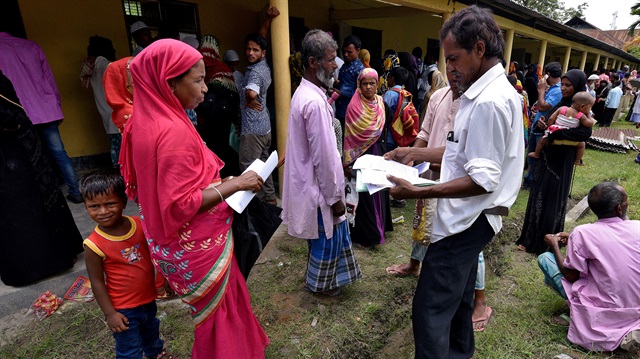
Villagers wait outside the National Register of Citizens (NRC) centre to get their documents verified by government officials, at Mayong Village in Morigaon district, in the northeastern state of Assam, India.
More than 4 million people in the northeastern state of Assam fear they will be stripped off their citizenship after their names were excluded from a list the Indian government published on Monday.
The National Register of Citizens (NRC) list is unique to Assam. It was first tabulated in 1951, four years after independence from British rule, to distinguish Indian citizens from illegal migrants from bordering Bangladesh, which was then part of Pakistan.
In 2015, the government began a process of updating the list. The new list includes only those people or their descendants who entered India till midnight of March 24, 1971, when Bangladesh became an independent state.
The first draft of the list published on Monday leaves out 4 million people, said officials.
Most of the people excluded from the list are Muslims, raising fears among the community that they are being targeted unfairly by the Hindu nationalist government.
In order to prevent communal violence the state government has beefed up security.
Authorities have asked people to maintain peace arguing that everyone will get a chance to plead their case.
Addressing a press conference in the state capital Guwahati, Registrar General of India, Sailesh said that the process of filing objections would begin on Aug. 30 and continue till Sept. 30.
Satyendra Garg, a senior Home Ministry official, who was also present at the media briefing, said no one would be sent to detention camps.
Assam Chief Minister Sarbananda Sonowal tweeted on Sunday: “I reiterate that no genuine Indian citizen will be devoid of their citizenship rights. So no one should panic after publication of the final draft of NRC...”
Indian Parliament on Monday saw protests by several opposition parties. The parliament’s Raja Sabha, council of states, had to be adjourned twice following uproar by opposition parties over the matter.
Home Minister Rajnath Singh in a statement issued in New Delhi on Monday said: “This is only a draft and not the final NRC."
All India United Democratic Front, a political party which represents the minorities, especially the Muslims, has expressed shock at the outcome.
"At the moment we are appealing to the people to maintain peace and harmony. We are law abiding citizens. But we will definitely approach the court," AIUDF general-secretary Aminul Islam told Anadolu Agency.
Thirty-six years after losing his parents, sister and a four-year-old daughter in one of India's worst sectarian massacres, Abdul Suban says he is still trying to prove he's a citizen of the Hindu-majority nation.Suban is one of hundreds of thousands of Bengali-speaking Muslims categorised as "doubtful voters", who will not find their names in a National Register of Citizens (NRC) the northeastern border state of Assam will release on Monday."If the government has decided to brand us foreigners what can we do?" said the 60-year-old. "NRC is trying to finish us off. Our people have died here, but we will not leave this place."Suban was seated with his wife at their house a few hundred metres from a vast paddy field where, in 1983, scores of people were chased down and killed by machete-armed mobs intent on hounding out Muslim immigrants. He survived by running as hard as he could and hiding behind a bush for days.Work on the citizens' register has accelerated under the government of Prime Minister Narendra Modi's Hindu nationalist Bharatiya Janata Party (BJP).With an eye on the 2019 national election, the BJP's Hindu-first campaign has become more strident, critics say, playing to its core base with divisive programmes such as the citizenship test in Assam, already a tinderbox of ethnic and religious tensions.Elsewhere in the country's northern heartland, lynchings of Muslim cattle traders have risen under Modi in the country where many Hindus consider cows sacred, further deepening social divides.The BJP has denied the lynchings have any connection with it being in power. Modi has at least twice publicly spoken out against cow vigilantes.MASS GRAVESeveral other survivors of the "Nellie Massacre", which killed around 2,000 people from more than a dozen villages, gave accounts of burying bodies in a mass grave now partly under water.They said they hoped the release of the NCR list on Monday would not spark further violence. Security has been tightened across Assam.The citizenship test is the culmination of years of often violent agitations by Assamese demanding the removal of outsiders they accuse of taking jobs and cornering resources in the state of 33 million, known for its tea estates and oil fields."The NRC is extremely important to make the Assamese people feel protected," said Santanu Bharali, the legal adviser to the BJP chief minister of Assam."It's a moral victory. The ethnic Assamese always maintained the presence of foreigners and this will prove that."But the opposition Congress party and rights activists say the government is misusing the register to target even legal Indian Muslim citizens who have traditionally voted for non-BJP parties. The BJP and NRC authorities have repeatedly denied the allegations."COMMUNAL POLITICS"To be recognised as Indian citizens, all residents of Assam had to produce documents proving that they or their families lived in the country before March 24, 1971.Suban said both he and his father were born in Assam, and showed Reuters a soiled yellow document that showed his father's name in the list of voters in Assam for 1965, before the cut-off date. The local border police declined to discuss individual cases, but said not all documents furnished by suspected illegal immigrants were valid.Hundreds of thousands of people fled to India from Bangladesh during its New Delhi-backed war of independence from Pakistan in the early 1970s. Most of them settled in Assam, which has a near-270 km (165-mile) border with Bangladesh.The migrants included many Hindus, but Modi has issued orders stating that no Hindu or members of other minorities from Pakistan or Bangladesh would be considered an illegal immigrant even if they entered the country without valid documents before 2014."BJP's only aim is to do communal politics, including through the NRC," Congress lawmaker Ripun Bora said.The BJP said the NRC was monitored by the country's top court and there was no question of discriminating on the basis of religion.Following an outcry from rights groups over possible harassment of Muslims in Assam, Interior Minister Rajnath Singh said that the NRC exercise was being carried out in an impartial and transparent manner.Singh also reiterated that people finding their names missing from the list could raise objections and appeals, and said that they would not be thrown into detention centres.Rivals say that as Modi's government faces disillusionment for failing to deliver on jobs and prosperity, it will step up religious mobilisation across the country.FEAR IN THE COUNTRYSIDEThe first draft of the NRC, released on Dec. 31, confirmed the citizenship of 19 million people, leading to jubilation for some and heartbreak among others.The NRC office, however, told the Supreme Court this month that 150,000 people from the first list, a third of them married women, would be dropped from the next one, mainly because they provided false information or gave inadmissible documents.Political activists in Assam say most of those are Bengali-speaking Muslims. NRC chief Prateek Hajela, whose office has processed 66 million documents and spent nearly $180 million in the whole NRC process, declined comment on the religion of people who would be removed from the register."We are doing an exercise that is unprecedented and if there are course corrections which are required to be done, we will need to do that," said Hajela, who is guarded round-the-clock by a team of police.Hajela said that most of Assam's 126,000 so-called doubtful voters, and an estimated 150,000 of their descendants, would be excluded from the NRC in accordance with a court order.One of them is Nellie farmer Suban's son Nabi Hussain, 28, who said he has voted in two Indian elections but now fears arrests."We are scared," said Hussain, his wife looking on from their mud-coated bamboo house, their nine-month-old daughter in her arms. "Terrible things happened to our family once, we don't want a repeat." 
Muslim survivors of Indian massacre shaken by citizenship test
All critical personal data on people in India should be processed within the country, a government panel said on Friday.The recommendation comes at a time when data breaches are becoming common globally and there is heightened scrutiny by governments on how companies handle user data.The panel, headed by former Supreme Court judge B.N. Srikrishna, also presented a draft bill that will go before parliament designed to enhance data protection. The legislation could affect how global companies store data in India.The panel said "personal data determined to be critical" will be subject to the requirement of being processed "only in India", according to its 213-page report released on Friday."The central government should determine categories of sensitive personal data which are critical to the nation," the panel said, adding that there will be a prohibition against cross-border transfer of such data.The panel recommendations were keenly awaited by U.S. trade groups and global technology companies, who fear any stringent data localisation directive by the government could alter their business models and raise costs.Nehaa Chaudhari, a technology policy expert at Indian law firm TRA, said the recommendation was strong as it showed the government wanted to see some kind of data localized."They seem to be conscious of the threat of data breaches," Chaudhari said. "The devil here is the detail, we will need to know what is critical personal data."U.S. trade groups, representing companies such as Visa , Mastercard and American Express, have been protesting against an Indian central bank directive which said in April that all payments data should be stored locally within six months.Asked about how financial data should be stored, Srikrishna said at a press briefing that the Reserve Bank had "jumped the gun", adding that a new data protection law will "override" all other notifications and regulations on data storage.The government panel also recommended setting up a "data protection authority", an agency which would look at enforcement and implementation of the new data protection law.India has in recent months become increasingly conscious of the risk of data breaches.The government on Thursday said it had asked its federal police to probe misuse of Facebook user data by Cambridge Analytica, a political consultancy which was earlier this year accused of improperly using data of 87 million Facebook users."It is suspected that Cambridge Analytica may have been involved in illegally obtaining data of Indians which could be misused," the IT minister said.
Panel proposes 'India only' policy for critical data
India has proposed a ban on plastics, polluting factories and construction around its 17th-century monument to love, the Taj Mahal, a government document showed, in a bid to stave off pollution that is turning the structure yellow and green.The white marble mausoleum is located around 210 km (130 miles) from the capital New Delhi in the northern city of Agra, which the World Health Organization rated in May as the world's eighth-most polluted.In a draft document submitted to the Supreme Court on Tuesday, authorities in Uttar Pradesh state, where Agra is located, said they would ban all plastics, switch to electric and hydrogen vehicles, and boost the green cover within the precincts of the Taj, to fight pollution."Replacing present-day lawns with tree cover as existed originally will increase the biomass," the document read.This step would reduce water consumption to maintain the surrounding garden and boost the water table, besides trapping dust to reduce pollution, the draft added.India's Supreme Court is driving the campaign to protect the country's most famous monument, built by the Mughal emperor Shah Jahan for his wife Mumtaz Mahal.The document was submitted after the justices, in a fit of anger during a hearing two weeks ago, demanded that authorities either restore the structure or tear it down.One of the seven wonders of the world, the Taj Mahal is flanked by a garbage-strewn river and is often enveloped by dust and smog from belching smokestacks and vehicles.Environmentalists and historians have long warned about the risk of soot and fumes from factories and tanneries dulling the monument, which also faces attack from insects that stain its marble."There have been various studies, various plans, but they have not been implemented in right earnest in a coordinated manner," said Divay Gupta, an official of the non-profit Indian National Trust for Art and Cultural Heritage (INTACH).The draft proposes an integrated environmental and natural heritage management plan, with a special focus on checking air pollution, besides river and water management and conservation.
India plans to battle pollution staining the Taj Mahal yellow and green