

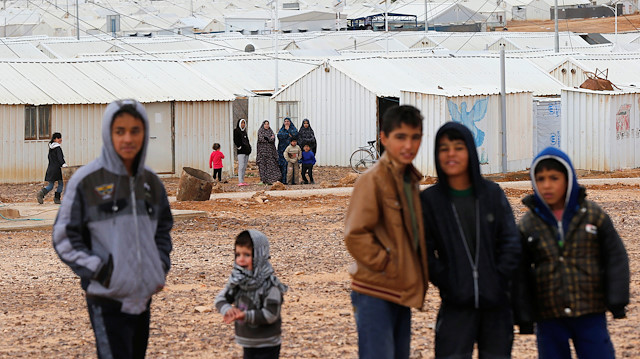
Syrian refugees look at the camera as they stand in front of their homes at Azraq refugee camp, near Al Azraq city, Jordan, December 8, 2018.
Up to a 250,000 Syrian refugees could return to their devastated homeland in 2019, while many others face problems with documentation and property that the Damascus government must help resolve, the U.N. refugee agency UNHCR said on Tuesday.
Some 5.6 million Syrian refugees remain in neighbouring countries - Turkey, Lebanon, Jordan, Egypt and Iraq - Amin Awad, UNHCR director for the Middle East and North Africa, said.
They include 1 million Syrian children born abroad whose foreign birth certificates the Assad government has agreed to recognise, he said.
Some 37,000 refugees have returned to Syria this year, UNHCR figures show. They went mainly to the governorates of Deraa, Damascus and Homs, Awad said.
"Now, by and large, the war has ended. We have a few pockets (of hostilities), including Idlib, as you know that there is a negotiated ceasefire and a de-escalation zone," Awad told a news briefing.
The Syrian regime has imprisoned thousands of women and children, who are subjected to systematic torture and assault. Some of the women who survived these inhumane Syrian prisons were hosted in Turkey’s Istanbul as part of an event organized by 10 nongovernmental organizations, including the Humanitarian Relief Foundation (IHH).Two of these women who use the pseudonyms Zehra and Juri recounted the details of the horrors they faced in an interview with Yeni Şafak daily.Inmates prefer death over prisonZehra said she was attacked by regime troops while she was taking necessities to a family in need. “I spent one year in prison. I was subjected to every kind of cruelty and torture. They electrocuted me after tying my hands behind my back. They took pleasure in rape and violence. It got so bad I wanted to die,” she added.US-led coalition defends strike on hospital in SyriaAbandoned by their own families“When I got out of the prison, my troubles didn’t end. I was ashamed because of what happened to me. It is especially difficult for Syrian women. They threatened our lives so that we would stay away [from our families and friends]. The hardest part was being rejected by our families and loved ones,” Zehra said.Regime prisons are a “real hell” “I was arrested in Lattakia and taken to an air force intelligence questioning center. The two months I spent there were the longest two months of my life. I was subjected to the worst abuse and torture. It was a real hell. I love photography and have been taking photos for 17 years. Like everyone else, I too had a normal life. Then all of this happened. I managed to come here, but many of my family members are still in Syria. I can only talk to them on the phone and am constantly worried about them,” Juri said.Syria has been locked in a vicious civil war since early 2011, when the Assad regime cracked down on pro-democracy protests with unexpected ferocity. Hundreds of thousands of civilians have been killed or displaced in the conflict, mainly by regime airstrikes targeting opposition-held areas. ‘Turkish op in the east of the Euphrates is PKK’s worst nightmare’Turkey hosts over 3.6 mln Syrians under 'temporary protection' status: Interior MinisterIn Turkey, disabled Syrian girl's dreams come true
Syrian regime prisons are a ‘real hell’ and inmates prefer death, say survivors
"As the situation in Syria improves some of these refugees are making the journey home," he said. "We are forecasting, in what we call phase one, up to 250,000 Syrians go back in 2019. That figure can go up and down according to the pace with which we are working and removing these obstacles to return."
The most important obstacles to return are documentation for the refugees and their property and homes, Awad said.
"Then there are issues related to conscription, there are issues related to amnesty for those who deserted the army. These are drivers that would basically keep people away, they are obstacles."
Other hindrances include mines and unexploded ordnance, and it will require a huge demining operation to clear agricultural and civilian areas, Awad said.
The UNHCR appealed to donors for $5.5 billion on Tuesday to support neighbouring countries in providing health, water, sanitation, food, education, and psycho-social support to Syrian refugees.
"Their living conditions have deteriorated as their existence in exile prolongs. They have been borrowing money, they are indebted and a lot of them are living below the poverty line, 70 to 80 percent of them are living below the poverty line in their host communities or countries," Awad said.
"We are asking donors to stay the course," he added.
The U.S.-led coalition against Daesh on Monday defended striking a hospital in eastern Syria.The Combined Joint Task Force - Operation Inherent Resolve (CJTF-OIR) said in a press release that Daesh terrorists used Hajin Hospital in Deir ez-Zor province as a platform to engage partner forces on Sunday."By these actions, ISIS caused the hospital to lose its protected status afforded by the Law of Armed Conflict by using a facility otherwise protected under the Geneva Conventions," said the coalition, using an alternate name for Daesh.Maj. Gen. Patrick Roberson, CJTF-OIR Commanding General, said the terrorist organization "has no regard for human life”."As we close in on them, they are getting more and more desperate and are hiding behind the safety of mosques, hospitals and other protected sites," said Roberson.In a briefing, Pentagon spokesman Col. Rob Manning said using hospitals is "unacceptable", which he said was a "standard tactic" used by the Daesh terror group.Manning said U.S. forces came under fire from the hospital. He had yet to comment on the casualties from the hospital strike.In October, several mosques were targeted by the coalition in Hajin, which left dozens of residents dead.
US-led coalition defends strike on hospital in Syria