

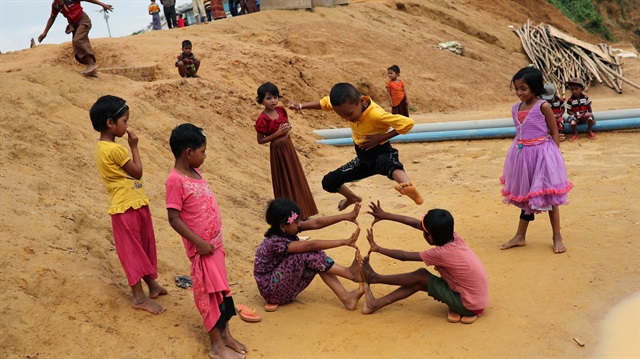
Rohingya refugee children plays in the Balukhali refugee camp in Cox's Bazar, Bangladesh
UNICEF on Thursday called for investment in Cox's Bazar refugee camps to protect the next generation of Rohingya Muslims.
UNICEF released a report on Thursday urging for a concerted effort to build a new foundation for the rights and opportunities of Rohingya children over the longer term.
The report, titled "Futures in the balance: Building hope for a generation of Rohingya children", was released to mark one year since the start of the influx of Rohingya fleeing state persecution in the western Rakhine state of Myanmar.
UNICEF Bangladesh representative Edouard Beigbeder said in a statement that investment in education for Rohingya children was desperately needed to prepare them for the future of their community.
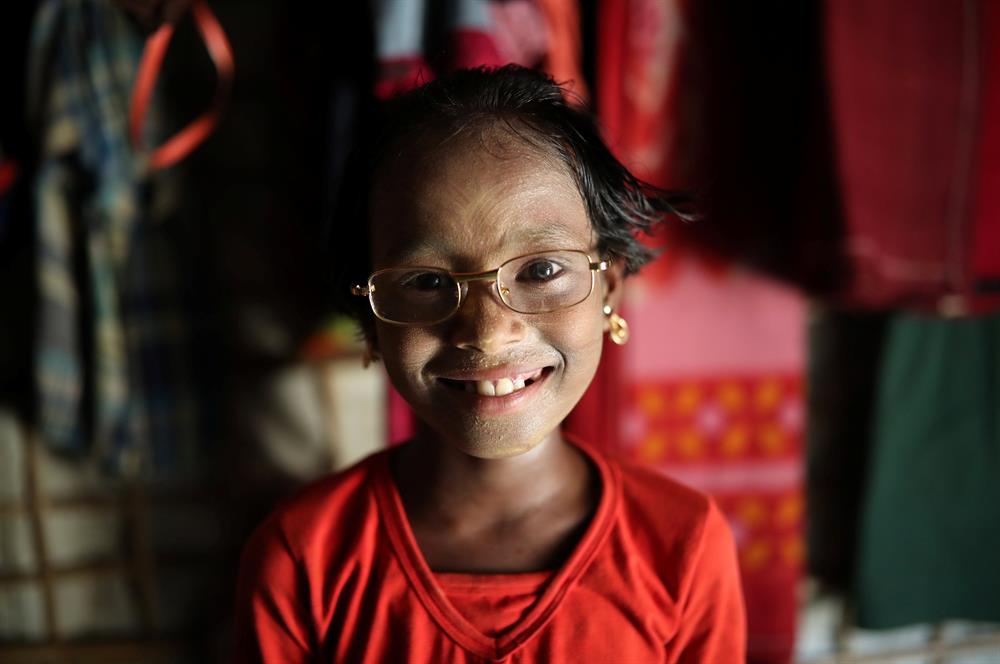
“If we don’t make the investment in education now, we face the very real danger of seeing a ‘lost generation’ of Rohingya children, children who lack the skills they need to deal with their current situation, and who will be incapable of contributing to their society whenever they are able to return to Myanmar,” said Beigbeder.
Children in the refugee camps “face a bleak future, with few opportunities to learn, and no idea when they might return home,” UNICEF warned in the report.
It called on the international community to invest “in supporting quality education and life-skills for all Rohingya children, especially girls and adolescents who it says are at risk of being excluded”.
A UN spokesman on Wednesday called for "effective access" for humanitarian aid organizations to enter into Myanmar's Rakhine state, where thousands of Rohingya Muslims faced persecution from security forces."Substantial progress is urgently needed in granting effective access for aid organizations and addressing the root causes of the crisis, including freedom of movement, safety, and a pathway to citizenship for all communities," Stephen Dujarric, the spokesman for UN chief Antonio Guterres, said at a press conference, as Saturday will mark the first anniversary of the Myanmar violence.Since Aug. 25, 2017, more than 750,000 refugees, mostly children and women, have fled Myanmar and crossed into Bangladesh after Myanmar forces launched a crackdown on the minority Muslim community, according to Amnesty International.More than 24,000 Rohingya Muslims have been killed by Myanmar’s state forces since August 2017, said a new report by Ontario International Development Agency.Dujarric said humanitarian access in northern Rakhine was severely limited, denying life-saving support to those in need, adding that the UN was "standing ready to go where we have effective access, but this has not yet been granted by the government."He said the UN was "deeply worried" about the situation in Rakhine, where some 660,000 are in need across Rakhine state, including 176,000 in northern Rakhine.Stating that most aid organizations that have been working in northern Rakhine state for years have still not been able to resume programs and services for Rohingya population."We continue to receive reports of violence, more than 11,000 new refugees arrived in Bangladesh between January and June of this year," he added.The Rohingya, described by the UN as the world's most persecuted people, have faced heightened fears of attack since dozens were killed in communal violence in 2012.The UN documented mass gang rapes, killings -- including of infants and young children -- brutal beatings, and disappearances committed by security personnel.In a report, UN investigators said such violations may have constituted crimes against humanity.Turkey at forefront of giving aid to Rohingya refugeesRohingya returnees tortured by Myanmar police: HRWTurkish charity to distribute meat among RohingyaRohingya Muslims struggle against famine as world watches silentlyRohingya returnees tortured by Myanmar police: HRW
UN complains of impeded access into Myanmar's Rakhine
Rohingya refugees celebrated Eid Al-Adha after fleeing Myanmar’s state persecution last year at camps in southeastern Cox's Bazar on Wednesday, with many praying for a chance to safely return to their homes.In his special Eid prayer at a makeshift mosque at the Jamtoli refugee camp, cleric Sajjad Hossain said: "Oh Almighty! Give us the opportunity to go back to our own land with dignity and safety."Around 1,000 Rohingya Muslims attended the special prayer who all wished to return back to their homeland home as Myanmar citizens.Hossain, 60, said he used to be the head of the Nawapara Hemaetul Islam Madrasah in Buchidawng in Myanmar’s Rakhine State before he was forced to flee to Bangladesh with his surviving family members following a brutal military crackdown on the Rohingya on Aug. 25 last year.Turkey at forefront of giving aid to Rohingya refugeesThe cleric, who is a father of seven children, told Anadolu Agency said he had been unable to say his Eid al-Adha prayers and carry out the animal sacrifice ritual for the last four consecutive years in Myanmar due to government restrictions."We demand our repatriation as Rohingya but in the name of repatriation they took us to Myanmar several times where we were tortured and again sent back to Bangladesh," Hossain said, recalling the repatriation processes since 1978."We demand the same does not happen again," he said.Last year, the governments of Bangladesh and Myanmar said they had agreed over the repatriation of Rohingya, promising to start the process within three months; however, no concrete steps were taken on the issue since then.Rohingya returnees tortured by Myanmar police: HRWThe lack of progress was criticized by international rights groups which also highlighted the safety issues confronting Rohingya wishing to return to Myanmar.Another Rohingya survivor Abdul Aziz, 45, told Anadolu Agency that during Eid he had prayed for his 18-year-old daughter, Sufia, who was shot in the head and killed by the Myanmar army.Turkish charity to distribute meat among RohingyaMyanmar must ensure safetyDespite the horrors he faced in Myanmar, he said he wished to return to his “motherland safely"."We don't want to come back to Bangladesh once we are repatriated," Aziz said.He urged the Myanmar government to return their properties as well as guarantee their safe repatriation."We want to go back as Rohingya," Aziz added.Since Aug. 25, 2017, more than 24,000 Rohingya Muslims have been killed by Myanmar’s state forces, according to the Ontario International Development Agency (OIDA).Rohingya Muslims struggle against famine as world watches silentlyIn its recent report titled Forced Migration of Rohingya: The Untold Experience, OIDA increased the estimated number of murdered Rohingya up to 23,962 (± 881) from the Doctors Without Borders figure of 9,400.More than 34,000 Rohingya were also thrown into fire while over 114,000 others were beaten, the OIDA report said, adding that 17,718 (±780) Rohingya women and girls were raped by Myanmar army and police. Over 115,000 Rohingya houses were also burnt down and 113,000 others were vandalized, it added.According to Amnesty International, more than 750,000 Rohingya refugees, mostly children and women, have fled Myanmar and crossed into Bangladesh after Myanmar forces launched a crackdown on the minority Muslim community.The Rohingya, described by the UN as the world's most persecuted people, have faced heightened fears of attack since dozens were killed in communal violence in 2012.The UN documented mass gang rapes, killings -- including of infants and young children -- brutal beatings, and disappearances committed by Myanmar state forces. In its report, UN investigators said such violations may have constituted crimes against humanity.
Rohingya in Bangladesh pray to return home during Eid
Only 140,000 out of half a million Rohingya children in the camps had been enrolled in 1,200 learning centers as of July 2018, according to UNICEF.
“However, there was no agreed curriculum, classrooms were often overcrowded and lacked basic water and other facilities,” it added.
The report also called on the Myanmar government to ensure education for Rohingya children who still live in the Rakhine state demanding it also to protect the Rohingya minors.
The UN body pointed out that “a lasting solution to the crisis of the Rohingya requires addressing the situation inside northern Rakhine”.
A leading human rights group said on Tuesday that international monitoring was vital in the repatriation of thousands of Rohingya Muslims as Myanmar authority has tortured and imprisoned returnees from Bangladesh.Since Aug. 25, 2017, more than 750,000 refugees, mostly children and women, have fled Myanmar and crossed into Bangladesh after Myanmar forces launched a crackdown on the minority Muslim community, according to Amnesty International.More than 24,000 Rohingya Muslims have been killed by Myanmar’s state forces since August 2017, said a new report by Ontario International Development Agency. Myanmar has promised a safe return to the Rohingya refugees but the latter have expressed doubt about their safety. New York-based Human Rights Watch said on Tuesday that “the reality is that Rohingya who go back still face the persecution and abuses they were forced to flee” despite the promised by the Myanmar government.“The torture of Rohingya returnees puts the lie to Myanmar government promises that refugees who return will be safe and protected,” said HRW’s deputy Asia director Phil Robertson.HRW said in a statement that three Rohingya men and three boys said Myanmar’s border guard police "repeatedly interrogated them at gunpoint [...]".The officers used stress positions; beatings with fists, sticks, and rods and burning and electric shock to force them to confess to an affiliation with Arakan Rohingya Salvation Army (ARSA), it said.HRW said they were among 58 Rohingya returnees who, according to statement of the State Counselor Aung San Suu Kyi’s Office, Myanmar President Win Myint pardoned.“The treatment of these Rohingya refugees should be a warning sign to those who believe the Myanmar authorities are ready to ensure safe returns,” Robertson said. “Myanmar has a long way to go before it can demonstrate it is serious about making the necessary reforms for voluntary, safe, and dignified returns.”The Rohingya, described by the UN as the world's most persecuted people, have faced heightened fears of attack since dozens were killed in communal violence in 2012.The UN documented mass gang rapes, killings -- including of infants and young children -- brutal beatings, and disappearances committed by security personnel.In a report, UN investigators said such violations may have constituted crimes against humanity.Turkish charity to distribute meat among RohingyaRohingya Muslims struggle against famine as world watches silentlyMyanmar army killed over 24,000 Rohingya: reportThe Rohingya lists: refugees compile their own record of those killed in MyanmarMyanmar seeks removal of 'national' tag in Rohingya IDs
Rohingya returnees tortured by Myanmar police: HRW
In 2018, the agency appealed for $28.2 million for its work on education for Rohingya refugees. Just over 50 percent of that sum has been received so far.
Saturday, Aug. 25 will mark a year since more than 750,000 Rohingya refugees, mostly children and women, have fled Myanmar and crossed into Bangladesh after Myanmar forces launched a crackdown on the minority Muslim community, according to Amnesty International.
Myanmar’s persecuted Rohingya minority continues to struggle against famine, disease and lack of access to clean water in sprawling camps in neighboring Bangladesh as the Muslim world remains silent in the face of their plight, exacerbated by an unsparing monsoon season that batters their flimsy improvised shelters.Turkey tops list of donors Turkey leads the list of most generous countries that donated humanitarian aid since the start of the Rohingya crisis, providing close to $850 million in aid through its agencies, followed by Qatar, Lebanon and Bangladesh as the world continues to turn a blind eye to the plight of hundreds of thousands of Muslims who have to struggle with famine amid shortages of drinking water.Absent from the list are global superpowers such as the U.S., failing to provide direct humanitarian assistance to Rohingya Muslims.Myanmar army killed over 24,000 Rohingya: reportThe Rohingya lists: refugees compile their own record of those killed in MyanmarChildren are the biggest victims Rohingya children living in sprawling camps in neighboring Bangladesh remain among the most vulnerable as famine continues to claim lives while the world watches on in silence. Children routinely have to struggle with finding clothes to cover their tiny bodies as they walk barefoot for miles in the rain and mud in the midst of an unsparing monsoon season that exacerbated their plight under recurring food shortages and lack of proper shelters.Galeri: Rohingya Muslims struggle against famine as world watches silentlySince Aug. 25, 2017, more than 750,000 refugees, mostly children and women, have fled Myanmar and crossed into Bangladesh after Myanmar forces launched a crackdown on the minority Muslim community, according to Amnesty International.More than 40 percent of the displaced Rohingya are under age 12, according to the UN, and many others are elderly people requiring additional aid and protection.The settlements in Kutupalong and Nayapara in Bangladesh’s Cox’s Bazar district host nearly all who arrived from Myanmar.The Rohingya, described by the UN as the world's most persecuted people, have faced heightened fears of attack since dozens were killed in communal violence in 2012.The UN documented mass gang rapes, killings -- including of infants and young children -- brutal beatings, and disappearances committed by security personnel.In a report, UN investigators said such violations may have constituted crimes against humanity.
Rohingya Muslims struggle against famine as world watches silently
More than 24,000 Rohingya Muslims have been killed by Myanmar’s state forces since then, according to the Ontario International Development Agency (OIDA).
The Rohingya, described by the UN as the world's most persecuted people, have faced heightened fears of attack since dozens were killed in communal violence in 2012.
The UN documented mass gang rapes, killings -- including of infants and young children -- brutal beatings, and disappearances committed by Myanmar state forces. In its report, UN investigators said such violations may have constituted crimes against humanity.