

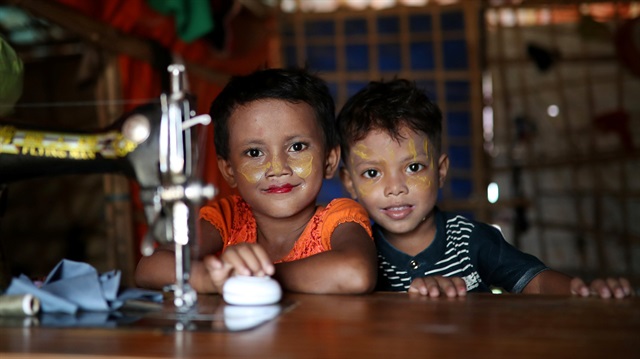
Rohingya refugee children pose for a picture in their makeshift tent in the Balukhali refugee camp in Cox's Bazar, Bangladesh
Rohingya children and youths in Bangladesh refugee camps are in need of education, a spokesperson for the United Nations Educational, Scientific and Cultural Organization (UNESCO) said Friday.
“We are concerned about losing a generation. Young people especially have limited opportunities to get an education here,” Alastair Lawson Tancred told journalists in Cox’s Bazar, a district in southeastern Bangladesh where Rohingya Muslims fleeing persecution by the Myanmar army live.
Tancred said more than half of the roughly 1 million Rohingya staying in the camps are children, most of which are under 17 years old.
The UN Children's Fund (UNICEF) aims to provide education for children aged 9-14 in the camps, he added.
- Rohingya Persecution
Since Aug. 25, 2017, nearly 24,000 Rohingya Muslims have been killed by Myanmar’s state forces, according to a report by the Ontario International Development Agency (OIDA).
More than 34,000 Rohingya were also thrown into fires, while over 114,000 others were beaten, said the OIDA report, titled "Forced Migration of Rohingya: The Untold Experience".
Some 18,000 Rohingya women and girls were raped by Myanmar’s army and police and over 115,000 Rohingya homes were burned down and 113,000 others vandalized, it added.
According to Amnesty International, more than 750,000 Rohingya refugees, mostly children, and women, fled Myanmar and crossed into Bangladesh after Myanmar forces launched a crackdown on the minority Muslim community in August 2017.
The Rohingya, described by the UN as the world's most persecuted people, have faced heightened fears of attack since dozens were killed in communal violence in 2012.
The UN has documented mass gang rapes, killings -- including of infants and young children -- brutal beatings and disappearances committed by Myanmar state forces. In a report, UN investigators said such violations may have constituted crimes against humanity.
The U.N. refugee agency voiced deep concern on Friday for the safety and security of seven Rohingya men deported from India to Myanmar, saying they had been denied access to legal counsel and a chance to have their asylum claims assessed.India deported the Rohingya Muslim men on Thursday, raising fears of further repatriations among those sheltering in refugee camps in the country and concern that those returned faced the risk of abuse at the hands of Myanmar authorities."UNHCR continues to seek clarification from the (Indian) authorities on the circumstances under which these individuals were returned to Myanmar," spokesman Andrej Mahecic told a news briefing in Geneva.India deports seven Rohingya despite global concernHe had no information on the whereabouts of those deported to Myanmar, where separate U.N. rights investigators have accused the military of committing mass murders and rapes with "genocidal intent" and ethnic cleansing.The Myanmar government has rejected most allegations of atrocities made against the security forces by refugees. It has built transit centres for refugees to return, but U.N. aid agencies say it is not yet safe for them to do so."What is worrying in the context of this return is hundreds of thousands of Rohingya people have fled from Myanmar over recent decades," Mahecic said, noting they included 720,000 who fled to Bangladesh from a military crackdown in August 2017.ASEAN urges Myanmar to give inquiry into Rakhine violence full powers"Current conditions in Myanmar's Rakhine state are not conducive for safe, dignified and sustainable return of stateless Rohingya refugees," he added.UNHCR aid workers on Friday began to assess conditions in three Rakhine townships, following a limited assessment last month in 23 villages where they found that "the Muslim communities are not allowed to move freely", Mahecic said. "Fear and mistrust are the prevalent sentiments there now."A year ago, Myanmar government troops led a brutal crackdown in Rakhine in response to attacks by the Arakan Rohingya Salvation Army (ARSA) on police posts and a military base.U.N. investigators said the military action, which included the torching of villages, was "grossly disproportionate to actual security threats".
UN concerned at fate of 7 Rohingya deported by India
India on Thursday deported seven Rohingya Muslims to Myanmar, hours after the country’s top court refused to stop the government from deporting them.The immigrants were detained in 2012 and since then they were kept at the Silchar central prison in Cachar district of Assam, the northeastern state of India.“They have been handed over to Myanmar authorities at 1.30 p.m. local time [8800GMT]...,” S Ibomcha Singh, a police official, told Hindustan Times.Earlier, the Supreme Court of India had allowed the deportation of the Rohingya, saying they were found by the competent court as illegal immigrants and have been accepted by their country of origin as citizens.According to the daily, an intelligence report states that there are about 32 Rohingya, including 15 minors, at detention camps in Assam.UNHCR requested permission to access the Rohingya in Assam, but its request was not accepted.ASEAN urges Myanmar to give inquiry into Rakhine violence full powersConcernsThe UN refugee agency’s India office expressed concern over Indian government decision to deport Rohingya.The current conditions in Myanmar’s Rakhine state, which the Muslim minority group fled, are “not conducive for the safe, dignified and sustainable returns for Rohingya,” the office told The Wire, an India news website.On Tuesday, E. Tendayi Achiume, United Nations’ special rapporteur on racism said: “Given the ethnic identity of the men, this is a flagrant denial of their right to protection and could amount to refoulement,”“The Indian government has an international legal obligation to fully acknowledge the institutionalized discrimination, persecution, hate and gross human rights violations these people have faced in their country of origin and provide them the necessary protection," she added.Amnesty International's India office also voiced concern on Twitter, saying: "SC [Supreme Court] refuses to stop govt's decision to expel 7 Rohingya men to Myanmar today. The human rights situation in Myanmar has deteriorated completely. Returning them to Myanmar puts them at grave risk of serious human rights violations violates customary international law."The European Rohingya Council (ERC), an Amsterdam-based Rohingya rights group, also called on India to immediately stop deportation of Rohingya.Canada revokes honorary citizenship of Myanmar leaderRohingya PersecutionSince Aug. 25, 2017, nearly 24,000 Rohingya Muslims have been killed by Myanmar’s state forces, according to a report by the Ontario International Development Agency (OIDA).More than 34,000 Rohingya were also thrown into fires, while over 114,000 others were beaten, said the OIDA report, entitled "Forced Migration of Rohingya: The Untold Experience".Some 18,000 Rohingya women and girls were raped by Myanmar’s army and police, and over 115,000 Rohingya houses were burned down and 113,000 others vandalized, it added.According to Amnesty International, more than 750,000 Rohingya refugees, mostly children and women, fled Myanmar and crossed into Bangladesh after Myanmar forces launched a crackdown on the minority Muslim community in August 2017.The Rohingya, described by the UN as the world's most persecuted people, have faced heightened fears of attack since dozens were killed in communal violence in 2012.The UN has documented mass gang rapes, killings -- including of infants and young children -- brutal beatings, and disappearances committed by Myanmar state forces. In a report, UN investigators said such violations may have constituted crimes against humanity.
India deports seven Rohingya despite global concern