

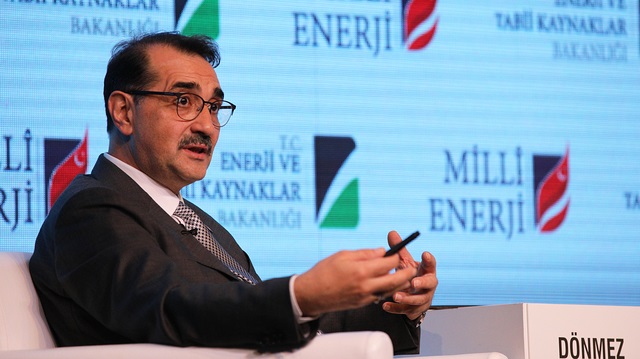
Fatih Donmez
A Turkish energy exploration ship will continue to operate in the Mediterranean Sea, the energy minister said on Friday, after Ankara said the navy stopped a Greek frigate from harassing the ship due to territorial disputes.
Turkey, Greece and Cyprus's internationally recognised Greek Cypriot government have long disputed their overlapping claims of jurisdiction for offshore oil and gas research in the Mediterranean.
"Turkish Petroleum's exploration ship will continue its activities in line with Turkey's rights," Energy Minister Fatih Donmez told reporters in the western coastal province of Izmir, referring to the state-owned oil company.
Turkey's foreign ministry said on Thursday that the navy had stopped a Greek frigate from harassing the Turkish Petroleum ship in the Mediterranean Sea, calling on Greece to avoid further escalation in the region.
Greece has denied it harassed the frigate.
Turkey warned Greece against actions that could spark tensions in the Mediterranean in a press release issued by the Foreign Ministry on Thursday.The statement was released in response to one issued by the Greek Foreign Ministry on Wednesday saying that a Turkish ship would conduct unauthorized seismic research in the Mediterranean.“The press statement issued yesterday by the Greek Ministry of Foreign Affairs is completely baseless in terms of international law. Greece's insistence on unrealistic allegations will have no other result than damaging bilateral relations and regional stability,” the Turkish Foreign Ministry said.“We recommend Greece to abstain from acts that would cause an escalation in the Mediterranean region,” it added.
Turkey warns Greece against acts that would cause tensions in Mediterranean
The head of the Turkish parliament’s Foreign Affairs Committee on Wednesday said his country sees Cyprus as the most important issue.Volkan Bozkir’s remarks came at the meeting of members of parliament's foreign affair committee with the Foreign Minister of Turkish Republic of Northern Cyprus (TRNC) Kudret Ozersay in capital Ankara."Any progress in Cyprus pleases us and if any problem arises there, we feel sorrow,” Bozkir said.Ozersay, for his part, said the TRNC has been isolated from the world.New developments in East Mediterranean energy"I want to honestly emphasize that we will continue to shape up our foreign policy together with Turkish Republic," he said.Cyprus was divided into a Turkish Cypriot state in the north and a Greek Cypriot administration in the south after 1974 military coup was followed by violence against the island’s Turkish people, and Turkey’s intervention as a guarantor power.There has been an on-and-off peace process over recent years, the latest failed initiative having taken place in Crans-Montana, Switzerland in July 2017 under the auspices of guarantor countries Turkey, Greece and the U.K., collapsing earlier this year.
Turkey sees Cyprus as most important issue: MP
Many news outlets have reported that Cyprus and Egypt will soon sign an agreement to construct an underwater pipeline from the former's offshore Aphrodite gas field to the latter's facilities for liquefied natural gas (LNG). The project is politically supported by the European Union, which would be the target market for LNG shipments. The pipeline is estimated to cost between $800 million and $1 billion, but gas would not start flowing until 2022.In February of this year, Eni and Total announced that they had found gas in the Calypso offshore block, a field now estimated to be about the size of the giant Zohr field in Egypt's offshore. Three days after that, Turkish military vessels stopped an Eni drill ship that was on its way to drill in Block 3 of Cyprus's Exclusive Economic Zone (EEZ), southeast from Famagusta, in a region where Greek Cypriot and Turkish Cypriot maritime claims overlap.The Aphrodite field is in Block 12, part of which is claimed by Turkey, but not the sector where the gas field is located. But Block 6, to the southwest of Limassol, also became a conflict point, because parts of those waters are claimed both by Cyprus and by Turkey itself.Turkey does not recognize Cyprus's EEZ because it is not a party to the United Nations Convention of the Law of the Sea (UNCLOS) Treaty. Earlier this year, Egypt said it would confront Turkey if it does not respect the 2013 Cypriot-Egyptian agreement that delimited their respective EEZs in accordance with UNCLOS. That agreement gives Egypt access to a sector of the East Mediterranean that is indicated to be of interest in connection with the 2015 discovery of the Zohr gas field.The tension comes after the collapse, in summer of last year, of the intercommunal talks on Cyprus, and in anticipation of the possibility of their resumption. Indeed, at the end of September, Southern Cyprus's President Nicos Anastasiades meets U.N. Secretary General Antonio Guterres in New York. Turkish Cypriot leader Mustafa Akıncı will also have his own bilateral meeting with Guterres.Meanwhile, Turkey intends to begin drilling soon, starting in its own waters, but probably in maritime areas of Cyprus's claimed EEZ later. For example, according to one report, if Exxon begins drilling in Block 10, then Turkey may begin drilling in Block 8. Paradoxically, this may make the intervention by Turkish military vessels, regarding third-party drilling as in the past, in fact less likely.As if in compensation for that, the Turkish naval forces have recently proposed establishing a naval base in Cyprus, although the location has not publicly been identified. At almost the same time, Cyprus and France have made progress towards a framework agreement by which the French Navy could be hosted in Larnaca.That development is more related to France's recently-increased military presence in the East Mediterranean, in connection with Syria. Nevertheless, it is not without implications for the military stakes over the gas fields in the region.At the same time, the EastMed gas pipeline continues to make progress on the drawing-boards even if prospects about its eventual implementation remain doubtful. A trilateral meeting among the heads of state of Cyprus, Greece, and Israel continued the discussions of this project for a pipeline from the region that would eventually land gas not only in Greece but also in Italy.Israel believes it has another 2 trillion cubic meters of natural gas awaiting discovery, more than twice the amount already proven in the remarkable Leviathan and Tamar discoveries. However, foreign firms are in general hesitant to explore Israeli possibilities out of fear of alienating Arab countries with which they have long-standing relations.Such fears seem increasingly out of date at a time when an effective strategic entente exists among Israel and certain prominent Arab states, for example over the Syrian question. Indeed, although certain companies decline formally to even meet with Israel over energy development, others such as Exxon Mobil, Total, and Woodside Petroleum are now engaging in advanced talks.Israel's offshore resources also likely include several billion barrels of oil. It will moreover put about 20 offshore blocks on auction this autumn, and has recently changed regulations, allowing export by foreign companies of greater quantities of the natural gas that they may produce.Indeed Noble, which discovered the Tamar and Leviathan fields almost ten years ago, is one of two companies (Delek is the other) that will be supplying natural gas to Egypt, partly with an eye on the same underutilized LNG processing plants that look to be importing from Cyprus as well. 
New developments in East Mediterranean energy