

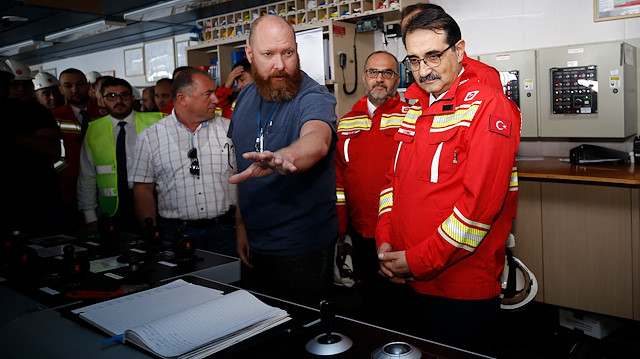
Turkish Energy and Natural Resources Minister Fatih Donmez poses for a photo as he visits to inspect the Fatih Drill Ship before it starts to operate.
A Turkish ship will start drilling for oil and gas in the Mediterranean on Wednesday, Energy Minister Fatih Dönmez said, a move that could create tensions with neighbouring Cyprus and Greece over jurisdiction.
Attempts to tap gas and oil in the eastern Mediterranean, along with a dispute over Greece's maritime borders, have recently caused friction between Athens and Ankara.
Turkey and the internationally recognised Greek Cypriot government in Cyprus have overlapping claims of jurisdiction for offshore oil and gas research in the eastern Mediterranean, a region thought to be rich in natural gas.
Speaking at a ceremony for the launch of the drilling ship "Fatih", Dönmez said it would begin drilling at the Alanya-1 borehole, located 100 kilometres (60 miles) off the southern province of Antalya and 60 kilometres off Antalya's Alanya district.
Speaking amid disputes with Greece over energy exploration in the eastern Mediterranean, Turkey on Friday said it would “continue to act in line with the equitable principles and all relevant special circumstances” in delimiting maritime jurisdiction.“On the delimitation of maritime jurisdiction areas, Turkey will, as it has to date, continue to act in line with the equitable principles and all relevant special circumstances,” Foreign Ministry spokesman Hami Aksoy said in response to question over a previous Greek Foreign Ministry statement.Turkey says it will not tolerate shift in Greek maritime border“In this vein, there is no advice that we would take from Greece over the delimitation techniques within the framework of international law,” Aksoy added.Last week, Turkish naval vessels blocked a Greek warship harassing a Turkish seismic and drilling vessel in the eastern Mediterranean.Turkey has consistently contested the Greek Cypriot administration’s unilateral drilling activity in the Eastern Mediterranean, saying Turkish Cypriots have equal rights to the resources in the area.Projects in Aegean 'not possible' without Turkey: Min.
Turkey to uphold ‘equitable principles’ in Eastern Med
"Turkey has set its main goal as independence in energy," Dönmez said. "We don't have an eye on others' resources, our only issue is to present to our people the riches within our territory."
The first borehole will be some distance from the disputed territory, which lies further south and around Cyprus.
Turkey is almost completely reliant on imports to meet its energy needs and the lira's tumble against the dollar this year has driven up that cost, putting pressure on energy companies to raise prices for consumers.
To meet more of its needs domestically, Turkey recently announced a tender for operation rights of three new solar power plants and privatised seven coal fields. It also opened a new refinery to reduce dependence on imported oil products.
Turkey warned Greece on Tuesday it would not tolerate a shift in the Greek maritime border, a few days after Athens said it planned to extend its territorial waters to 12 miles to the west of the country.Territorial waters are a sensitive issue between the two neighbours, who are separated by the Aegean Sea. Turkey and Greece have been at odds over their respective continental shelves for decades.Turkey has previously warned it could not preclude military action to defend its interests.Former Greek Foreign Minister Nikos Kotzias, who resigned last week, said on Saturday that Athens planned to extend its territorial waters in the Ionian Sea, which flanks the west coast of the country. The planned measure would not affect the Aegean region, off Greece's eastern and southern coasts.Turkey summons Greek ambassador in AnkaraTurkey's foreign ministry, however, said that it had noted statements from Athens of plans for the gradual expansion of Greek territorial waters."It is not possible to tolerate steps where there is no bilateral agreement on the Aegean where the two countries have mutual shores," Foreign Ministry spokesman Hami Aksoy said in a statement.The statement recalled a 1995 declaration of Turkey's parliament which had authorised action, not excluding military action, to safeguard Turkish interests."(Parliament's) declaration...dated 8 June 1995 has the necessary political warning in this context and it still maintains its validity today," the statement added.That view had been conveyed to Greece's ambassador in Turkey, it said.As a signatory to the U.N. Convention of the Law of the Sea, Greece has said it can extend its territorial waters to 12 miles from its coast from six miles at present, though it has not sought to do so in waters stretching towards Turkey.Greece and Turkey are at loggerheads over matters ranging from sea boundaries to air space jurisdiction and the ethnically-divided eastern Mediterranean island of Cyprus.The long frozen Cypriot conflict has come into sharper focus after the discovery of natural gas in the sea around Cyprus, and attempts by its internationally-recognised government to licence oil majors for exploration. Verbal sparring over jurisdiction is common; last week, Turkey accused Greece of harassing a Turkish research vessel in the area. Greece denied this.The leaders of the two Cypriot sides, Greek Cypriot Nicos Anastasiades and Turkish Cypriot Mustafa Akinci, are due to have talks in Nicosia, Cyprus's partitioned capital, on Oct. 26.It will be their second meeting since the collapse in July 2017 of negotiations to end a conflict dating to Turkey's 1974 occupation of northern Cyprus in response to a brief Greek-inspired military coup. 
Turkey says it will not tolerate shift in Greek maritime border
Dönmez said on Tuesday that Turkey was also very close to buying another drilling ship.
Turkey warned Greece last week to stay out of its activities in the eastern Mediterranean, heralding a potential showdown with Cyprus.
North Cyprus, which is supported by Turkey, says any offshore wealth also belongs to them, as partners in the establishment of the Cyprus republic in 1960.
Greek Cypriots, who run the island's internationally recognised government, say any future benefits of gas finds will eventually be shared by all Cypriots.
The island was split in 1974 after a Turkish intervention triggered by a brief Greek-inspired coup. Countless peacemaking endeavours have failed, and offshore wealth has increasingly complicated peace negotiations even though Greek Cypriots say that matter is not up for discussion.
Turkish drilling vessel Fatih sets off for its first deep drilling project in Mediterranean Sea on October 30, 2018 near Alanya district of Antalya.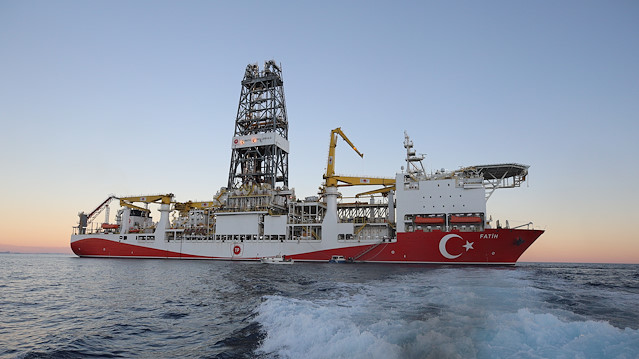
Turkish drilling vessel sets off for its first deep drilling project in Mediterranean