

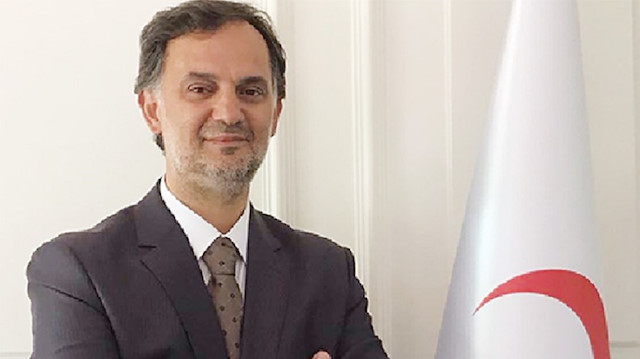
İbrahim Altan
A Turkish aid organization said that they were ready to handle any possible migration wave that would come from east of the Euphrates River after Turkey launches its planned anti-terror operation in the region.
“We have finalized our preparations to meet the nutritional needs of any migration wave and to support their sheltering needs. Our teams are ready to ship [them] to the region,” Ibrahim Altan, head of Turkish Red Crescent, told Anadolu Agency.
In his speech in Turkey's Mediterranean resort city of Antalya, Altan said the agency displays the Turkish government’s soft power by reaching every part of the world to help people in need.
“We did all these works during Operation Euphrates Shield, in [northwestern Syria’s] Afrin and Idlib, and we provided necessary shipments [of migrants] to the regions,” he said.
On Wednesday, Erdogan said that within days Turkey would launch an operation in Syria, east of the Euphrates, near Turkey’s borders, to clear the region of PKK/YPG terrorists.
Altan added that efforts to meet nutrition and shelter needs of people in Afrin and Idlib regions were ongoing.
The YPG/PKK terror group continues to pose a threat to Turkish territories using the internal conflict in Syria as an opportunity.The terrorist organization, which occupied a 480-kilometer (298 miles) of land on Turkey-Syria border, recently increased its activities against Turkey.In the last three years, Turkey came under many harassment fires by the terrorists.Their efforts to carry out terror activities inside Turkey have been prevented by successful operations of security forces, who seized large amounts of explosives in border cities such as Hatay, Kilis, Gaziantep, Mardin and Sanliurfa.- Operation Olive Branch dealt heavy blow to YPG/PKKThe Operation Olive Branch, which was conducted by Turkish Armed Forces in Afrin, ended the terror group YPG/PKK’s presence in northwestern Syria.The terrorists targeting civilians in Hatay and Kilis provinces killed seven people, while injuring 113 others by rockets and mortars they fired as Turkey started operation in the region.During the operation, terrorists carried out rocket and mortar attacks 60 times on Hatay, and 34 times on Kilis.The terrorists also targeted a mosque in Kilis, and caused the death of two civilians.Many houses, vehicles and shops were damaged in the residential areas in the two provinces, which came under the terror attacks.- Harassment fires on police stationsIn 2015-2017, the YPG/PKK conducted 12 attacks on border posts in Hatay and Kilis, and martyred two soldiers, and injured another.In April 2017, the terrorists attacked a tank with a howitzer in Sanliurfa province. Turkish forces responded the attack, which caused no loss of lives.During the same period, the YPG/PKK terrorists attacked border posts in Mardin five times. Three soldiers were slightly injured, while security forces destroyed terror targets in a response.In January 2018, the terrorists also targeted border posts in Mardin’s Nusaybin district with harassment fires for two days in a row. No loss was reported in the attacks.- Plans to drown cities in bloodEight Syrian suspects carrying 146 kilograms (321 pounds) of explosives were captured as they tried to enter Turkey from the YPG/PKK-occupied region of Syria in July 2017.One of the terrorists confessed in his testimony that they had buried some of the explosives in soil after covering them with powdered chili pepper to prevent detector dogs from finding them.In August 2018, security forces seized 25 kilograms (55 pounds) of explosives from a vehicle travelling from Hatay to Gaziantep. More explosives of 5 kilograms (11 pounds) were also found in a raid at homes of the terrorists.Last month, a terrorist, who entered Turkey from YPG/PKK-controlled Tal Abyad region and learned to have been trained to be a suicide bomber, was captured in Gaziantep.Over 247 kilograms (544 pounds) of explosives were also seized from a vehicle during controls in Mardin province. The terrorists, who brought the explosives into Turkey, were preparing to carry out attacks in metropolitan cities of the country.Eight anti-personnel rocket launcher ammunition headers, nine propelling cartridges and 67 Kalashnikov rifle magazines belonging to the YPG/PKK terrorist organization were found in the Bulamacli village of Kilis.In 2016-2018, five tunnels, measuring 35 meters (114 feet) by 400 meters (1,312 feet), were found by security forces in Mardin’s Nusaybin district. The tunnels heading to Syria’s Kamisli region were destroyed by security forces.
YPG/PKK terrorists continue to pose threat to Turkey
Humanitarian assistance for Rohingya
Recalling the activities of the Turkish Red Crescent, locally known as “Kizilay”, for Rohingya Muslims since 2012, he said teams were deployed in Bangladesh, where a large number of Rohingya sought refuge, escaping the persecution in Rakhine State of Myanmar.
Noting that they were providing Rohingya with hygienic supplies, Altan said they were especially working on women.
“We are educating them to read and write,” he said.
Altan said that they also continued to provide humanitarian assistance to Rohingya community in Pakistan and Turkey.
“We have enough budget in Myanmar for Rohingya. Our people is so generous in this regard,” he said.
The Rohingya, described by the UN as the world's most persecuted people, have faced heightened fears of attack since dozens were killed in communal violence in 2012.
On Thursday, the U.S. House of Representatives overwhelmingly passed legislation, labeling as “genocide” Myanmar’s ongoing crimes against Rohingya population.
Since Aug. 25, 2017, nearly 24,000 Rohingya Muslims have been killed by Myanmar’s state forces, according to a report by the Ontario International Development Agency (OIDA).
More than 34,000 Rohingya were also thrown into fires, while over 114,000 others were beaten, said the OIDA report, titled "Forced Migration of Rohingya: The Untold Experience."
Some 18,000 Rohingya women and girls were raped by Myanmar’s army and police and over 115,000 Rohingya homes were burned down and 113,000 others vandalized, it added.
According to Amnesty International, more than 750,000 Rohingya refugees, mostly children, and women, fled Myanmar and crossed into neighboring Bangladesh after Myanmar forces launched a crackdown on the minority Muslim community in August 2017.
The UN has documented mass gang rapes, killings -- including of infants and young children -- brutal beatings, and disappearances committed by Myanmar state forces. In a report, UN investigators said such violations may have constituted crimes against humanity.
As Turkey prepares to launch an anti-terror operation east of the Euphrates River, Syrians living in the southeastern Turkish province of Sanliurfa have started hoping of the day when they will return to their homeland.On Wednesday, President Recep Tayyip Erdogan said that within days Turkey would launch an operation in Syria, east of the Euphrates, near Turkey’s borders, to clear the region of PKK/YPG terrorists.Speaking to Anadolu Agency, Vail Abut, a resident of Syria’s Tal Abyad living in Turkey’s Akcakale district, said he is pleased by Erdogan’s statement regarding the expected military operation.“We expect Turkish army to clear the region, located east of the Euphrates, of terrorists as soon as possible. The day, when our soil is cleared of terrorists, we would return to our homes with Allah’s will,” Abut said.Dozens of people in Tal Abyad had to flee to Akcakale district of Sanliurfa province due to the pressure and violence of YPG/PKK terror group. They have been living in Turkey for around three years.Abut said his relatives near Raqqah were ready to give support to the operation expected to be launched by the Turkish military.Hamed Halit, another Tal Abyad resident, also voiced his support for the planned operation.“We are ready to extend support to them [Turkish military], if they need it after the launch of the operation,” Halit said.“YPG/PKK terror group seized our homes and lands by force. We’ve started dreaming of returning to our home with [Turkish president] Recep Tayyip Erdogan’s statement.”“Only Erdogan defends our rights,” he said.Previously, Turkey launched two successful anti-terror operations since 2016 to foil the formation of a “terror corridor” along Turkey’s border.In its more than 30-year terror campaign against Turkey, the PKK -- listed as a terrorist organization by Turkey, the U.S. and the EU -- has been responsible for the deaths of some 40,000 people, including women and children. The YPG is its Syrian branch.
Turkey’s planned operation gives hope to Syrians
Humanitarian crisis in Yemen
Stressing the humanitarian crisis in Yemen, Altan said there had been a serious problem in the country since 2015.
“There are 22 million vulnerable people in Yemen. Our teams are in Yemen’s Aden since around two years,” he said, adding that 17-18 regions in the country were receiving aid from Aden.
“Last year, 13,000 tons of flour and thousands of food parcels were distributed,” Altan said.
Some orphanages and houses, where elderly women stay, were also repaired, according to the head of the aid group.
A group of Yemenis were also given first aid training, he added.
Yemen has remained wracked by violence since 2014, when Shia Houthi rebels overran much of the country, including capital Sanaa and the key port city of Al-Hudaydah.
The conflict escalated in 2015 when Saudi Arabia and its Sunni-Arab allies launched a massive air campaign in Yemen aimed at rolling back Houthi gains.
The violence has devastated Yemen’s infrastructure, including health and sanitation systems, prompting the UN to describe the situation as “one of the worst humanitarian disasters of modern times.”
Turkish Foreign Minister Mevlüt Çavuşoğlu held separate meetings with Crimean Tatar leader and UN special envoy for Syria in Qatar on the sidelines of 18th Doha Forum that began on Saturday.Çavuşoğlu and Crimean Tatar leader Mustafa Abdulcemil Kirimoglu discussed the recent developments in the region and the condition of Crimean Tatars.According to some diplomatic sources, the Turkish minister told Kirimoglu that Turkey’s support to Crimean Tatars would continue.The sources, who asked not to be named due to restrictions on speaking to the media, said Cavusoglu and the UN Special Envoy to Syria Staffan de Mistura discussed the recent developments in Syria.During his stay in Doha, the Turkish foreign minister is also expected to have a bilateral meeting with his Qatari counterpart Sheikh Mohammed bin Abdulrahman bin Jassim Al Thani.The 18th Doha Forum plans to tackle various issues and challenges facing the international community.In addition to political concerns, the forum's agenda will also focus on issues pertaining to the economy, commerce, media, human rights, water and food security, energy, and the future of the Middle East.
Turkish FM meets Crimean Tatar leader, UN special envoy