

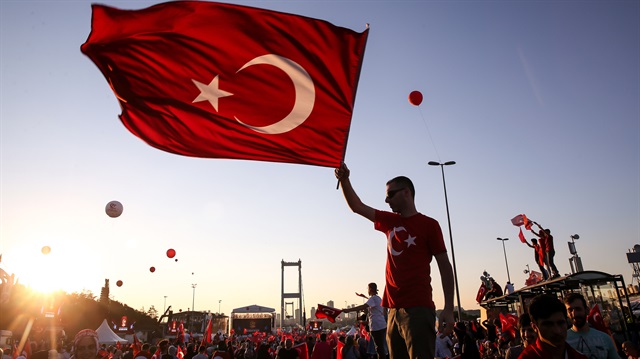
Turkey’s defeated coup bid marked across world
The second anniversary of the 2016 defeated coup in Turkey is being marked across the world with commemoration ceremonies.
A ceremony was held at Martyrs Monument in Lefkosa, Turkish Republic of Northern Cyprus, with attendance of deputies including Mehmet Demirci, Turkey's Justice and Development (AK) Party TRNC representative, embassy officials and locals.
Derya Kanbay, Turkish ambassador in Lefkosa, urged people to be careful about dangerous organizations like Fetullah Terrorist Organization (FETO). “We need to be cautious and on alert against dangerous betrayal networks," she said.
FETÖ orchestrated the defeated coup of July 15, 2016 in Turkey, which left 251 people martyred and nearly 2,200 injured.
Ankara also accuses FETÖ of being behind a long-running campaign to overthrow the state through the infiltration of Turkish institutions, particularly the military, police, and judiciary.
During a commemoration ceremony held at Turkey’s Athens Embassy, Yasar Halit Cevik, the ambassador, called on Greece to give necessary punishment to putschist Turkish soldiers, who escaped to Greece hours after the coup attempt.
A commemoration ceremony was also held at Turkey’s Consulate General in Komotini. A minute of silence was observed in remembrance of those who were martyred during the coup attempt.
Remembering Mustafa Cambaz, one of the martyrs of the coup attempt, who was born in Western Thrace, Consul General Murat Omeroglu said: “Mustafa Cambaz has been a symbol of resistance for people of Western Thrace.”
In Skopje, July 15 martyrs were commemorated in a ceremony held by Turkish Cooperation and Coordination Agency (TIKA) and Yunus Emre Institue (YEE).
Speaking during the ceremony, Turkish Ambassador Tulin Erkal Kara praised Macedonia for giving support to the Turkish government in the wake of the coup attempt and its move to shut down FETO-linked media organizations, schools, and corporations.
A photo exhibition showing Anadolu Agency’s photos on the coup night opened as part of the ceremony.
Zagreb Embassy of Turkey also hosted a commemoration ceremony. A video on FETÖ’s coup attempt was shown during the program.
“FETÖ attacked civilians on the night of July 15. We will not forget martyrs and veterans, who fought for our democracy on that night,” Mustafa Babur Hizlan, Turkey’s ambassador to Zagreb, said during his speech.
In Balkan countries like Bosnia and Herzegovina and Croatia, ceremonies were also held.
Two-hundred-and-fifty trees were planted in the memory of July 15 martyrs in the southern Bosnian city of Mostar.
Zerrin Kandemir, consul general of Turkey in Mostar, thanked Bosnia and Herzegovina for showing solidarity with Turkey in the wake of the coup attempt, during the ceremony.
Nobody was able to harm Turkey’s democracy as a result of courage and heroism, she noted.
Quran was recited in the memory of July 15 martyrs at a ceremony in the Afghan capital of Kabul, which was jointly organized by Turkey’s Maarif Foundation and Anadolu Agency.
An exhibition showing Anadolu Agency’s photos on July 15 coup attempt was also opened.
Several other countries like Krygzstan, Hungary and Sweden also hosted various ceremonies to commemorate the July 15 martyrs.
A key Fetullah Terrorist Organization (FETÖ) suspect was brought back to Turkey as part of operations against the terror group, security sources said on Sunday.Yusuf Inan, a FETÖ-linked social media expert, who fled to Ukraine after the 2016 defeated coup attempt -- was brought to the country following operations conducted by the Turkish National Intelligence Organization (MIT).Inan allegedly tried to discredit some political figures and state officials in Turkey by carrying out a perception operation on social media.He was also wanted in western Izmir province for “being a member of an armed organization".On Thursday, two more figures; Isa Ozdemir, who was apprehended in Azerbaijan, and Salih Zeki Yigit, in Ukraine, were brought to Istanbul following operations by MIT.Ozdemir and Yigit are suspected of being members of an armed terror organization.
Turkish intelligence officers last March had brought six alleged senior FETÖ members back to Turkey following operations against the terror group’s branch in the Balkans, according to security sources.
In cooperation with Kosovar intelligence, Turkey’s National Intelligence Organization (MIT) arrested the six men, who were said to be in charge of getting FETÖ members out of Turkey to go to Europe and the U.S.
FETÖ and its U.S.-based leader Fetullah Gulen orchestrated the defeated coup of July 15, 2016, which left 251 people martyred and nearly 2,200 injured.
After the attempted coup, Germany becomes safe haven for FETÖWhat happened on July 15, 2016?Turkish parliament speaker marks July 15
Key FETÖ suspect brought back to Turkey
Germany is becoming a safe haven for sympathizers and members of the Fetullah Terrorist Organization (FETO), two years after the group’s foiled coup attempt in Turkey.Around 14,000 people with suspected ties to FETO have arrived in Germany over the last two years, the country’s international broadcaster DW reported this week.Video: Turkey since the coup attempt on July 15, 2016“Germany is becoming our new hub,” a senior figure of the group said.The U.S.-based Fetullah Gulen’s shadowy group orchestrated a coup in July 2016 after a long, secretive campaign to infiltrate state institutions in Turkey. The attempted military takeover left 251 people martyred and nearly 2,200 injured.Despite Turkey’s repeated warnings, Berlin has not yet outlawed the group, arguing that they do not constitute a serious threat to Germany.What happened on July 15, 2016?As German authorities tolerated their activities, Gulenists have set up new propaganda outlets and associations in recent months to support FETO suspects who fled Turkey, local media reported.At least 1,177 Turkish citizens with diplomatic or service passports, including former soldiers, officials, and their family members, applied for asylum in Germany, the country’s immigration authority BAMF has confirmed.A Berlin-based branch of the group, Aktion für Fluchtlingshilfe, has provided support for these asylum-seekers, according to the reports.Turkish parliament speaker marks July 15Most of them were former officials and soldiers wanted by Turkey due to ongoing investigations of their suspected links to the coup attempt or FETO itself.Tolerance, tensionAnkara has long urged Berlin not to grant political asylum to former officials, and to instead return them to Turkey for a fair and transparent trial at home.Germany’s tolerance towards the group, and its reluctance to extradite FETO suspects to Turkey, has been a source of tension between the two countries.While in recent weeks German authorities made critical statements about the group and signaled a tougher stance, they have not yet taken any concrete measures.Galeri: Turkey commemorates martyrs of failed July 15 coupSeveral key figures of the group, who are among Turkey’s most-wanted terrorists, have been living in Germany, according to media reports.These include ideological forerunners of the group Abdullah Aymaz and Mehmet Ali Sengul.Adil Oksuz, a top suspect in the 2016 coup attempt, also spent some time in Germany after fleeing Turkey, according to several witnesses.The 51-year-old theology lecturer received support from the FETO network in the country.Jerusalem marks anniversary of defeated coup in TurkeyFalse imageSince the 1990s, Gulen’s shadowy group has also managed to build a large network in Germany, which is home to more than 3 million Turkish immigrants.The group owns dozens of private schools, businesses, and several media organizations, and claims to have around 70,000 followers on German soil.FETO members have tried to avoid public criticism in Germany by focusing on "interfaith dialogue" programs and sticking to “moderate” messages.Galeri: View of 15 July Martyr Bridge from the airThe group’s foundation, Stiftung Dialog und Bildung, has sought to win the trust of media, influential churches, and political institutions.Ex-FETO members, speaking to German media in recent weeks, stressed that the group has a dual structure, and despite its “democratic” and “moderate” image in public, it has a secretive and strict hierarchy controlled by its ideological leaders.
After the attempted coup, Germany becomes safe haven for FETÖ
July 15 marks the second anniversary of the defeated coup during which the Fetullah Terrorist Organization (FETO) -- a clandestine group organized under the guise of education which infiltrated state offices, especially the military, judiciary, civil service, and treasury, and which tried to take over the government -- attempted a coup in 2016.Galeri: Turkey commemorates martyrs of failed July 15 coupThe night of July 15, 2016, the coup attempt saw tanks closing down a bridge in Istanbul that connects Asia to Europe, and fighter jets and helicopters flying down over Istanbul and Ankara and bombing the presidential complex, parliament building, police and intelligence headquarters, while civilians came out to resist the coup.Then-Chief of General Staff Hulusi Akar was taken hostage by the putschists, as he said he would not support the coup bid.Turkish parliament speaker marks July 15During the defeated coup, a total of 251 people including police and civilians were martyred, and nearly 2,200 were wounded.The coup attempt, orchestrated by the Fetullah Terrorist Organization (FETO), led by the U.S.-based so-called “cleric” Fetullah Gulen, aimed at ousting President Recep Tayyip Erdogan and the government and capturing the state.In a television appearance at 11.02 p.m., then-Prime Minister Binali Yildirim said it was a revolt and they were evaluating the possibility of a coup attempt. He added: “Those who are involved in this unlawful act will pay the heaviest price."Galeri: View of 15 July Martyr Bridge from the airSpeaking to CNN Turk at 12.24 a.m., President Recep Tayyip Erdogan, said: “This incident, unfortunately, is the coup attempt of a minority within the Turkish Armed Forces. This is a revolt encouraged and used by the parallel structure (FETO) as its mastermind."The president called on the Turkish people to take to the streets in order to stop the coup-plotters.In response, people poured into the squares to protect democracy all around Turkey, especially in the capital Ankara and Istanbul, climbed on tanks, stood against guns, and defeated the heinous coup attempt.Turkish embassy in Iraq marks July 15In the legal process in the years since, in 194 cases concluded out of 289, a total of 2,381 people convicted of involvement in FETO have gotten jail terms, including 1,624 life sentences.
What happened on July 15, 2016?
Turkish President Recep Tayyip Erdoğan addressed veterans and the families of martyrs at a ceremony hosted at the Presidential Complex to mark July 15 Democracy and National Unity Day. Turkey marks the second anniversary of the defeated coup attempt, which left 251 people martyred and nearly 2,200 injured, on Sunday.“We have more opportunities to repay our debt to our martyrs. We look to our future with much more hope than we did yesterday,” Erdoğan said.“We will not allow July 15 to be forgotten, nor will we forget. The gravity of the struggle that our nation gave for its independence and future will be better understood over time,” he added.Erdoğan recites Quran for martyrs of July 15 coupThe president hailed the courage of the Turkish public who repelled the putsch by pouring onto the streets following Erdoğan’s call to resist. “Attempts by some to diminish July 15’s importance is a manifestation of the hatred they nurture toward our nation and our people,” Erdoğan said. “Those who want to uncover the secret of our people’s heroism demonstrated on the night of July 15 should look to our great struggle which has spanned centuries. Our people are tired of losing what they gained on the field, with their blood, to word games, diplomacy traps, heedlessness and even betrayal. We will not lose!” he added.Later in the evening, Erdoğan will attend a rally at Istanbul’s July 15 Martyrs Bridge to mark the second anniversary of the failed coup attempt.Erdoğan pens letter to families of July 15 martyrsTurkey’s great struggle against FETÖCounterterrorism efforts“This year, Turkey neutralized close to 1,400 terrorists domestically and in northern Iraq. Approximately 4,600 PKK and PYD terrorists were neutralized in Operation Olive Branch,” Erdoğan said.Turkey launched Operation Olive Branch on January 20 in Syria’s northwestern Afrin region. The aim of the operation is to establish security and stability along Turkish borders and the region as well as to eliminate PKK/KCK/PYD-YPG and Daesh terror groups, and protect the Syrian people from the oppression and cruelty of terrorists.The YPG is the armed wing of the Democratic Union Party (PYD), which is the Syrian offshoot of the PKK. The PKK is listed as a terrorist organization by Turkey, the European Union and the United States.“The only target of terror groups like FETÖ, PKK and Daesh is our nation’s unity. I will not end with FETÖ. We will find them everywhere they hide. There is no stopping,” the president added.
We will not allow July 15 to be forgotten, nor will we forget: Erdoğan