

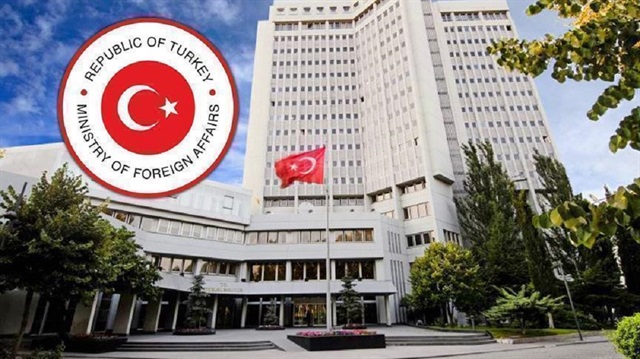
File photo
Turkey's Foreign Ministry late Monday refuted that a Turkish man with links to the Fetullah Terrorist Organization (FETÖ) had been kidnapped in Mongolia.
Videos of a FETÖ-linked teacher named Veysel Akcay have been circulating on social media claiming he was kidnapped by a group of men in front of his home on July 27.
In a written statement, Foreign Ministry Spokesperson Hami Aksoy said Mongolia is a country where FETO has a "wide network and threatens Mongolia's national security".
"We have often shared our serious concerns about the issue with officials in Mongolia," he said.
On July 15, 2016 a secret rogue section of the Turkish military launched an operation to overthrow Turkey’s democratically-elected government. The attempted coup was ultimately foiled by the resolute stance of Turkey’s elected government, officials and by the power of ordinary citizens who took to the streets in the hundreds of thousands in an act of mass resistance against the attempted takeover. As the days and weeks unfolded it became abundantly clear that the U.S.-based Fethullah Gulen, the leader of the Fethullah Terrorist Organisation (FETÖ), was the mastermind behind Turkey’s deadliest coup.Turkey has been critical of its NATO allies for not condemning the coup in strong enough terms, instead choosing to focus on Ankara’s crackdown on suspected coup supporters. Moreover, FETÖ-affiliated organizations still operate in countries which are Turkey’s NATO allies. In addition to its base in Europe and North America, FETÖ currently operates in 42 of the 57 countries within the Organization of Islamic Cooperation and runs over 2000 schools globally. Its main selling points in the international arena include its emphasis on education, Turkish culture and “moderate Islam”. While some FETÖ institutions in Africa, Turkic and Balkan countries have been shut down following the coup attempt, Turkey’s Western partners have not acted in a similar vein. Erdoğan: FETÖ is the same as DaeshCurrently, FETÖ institutions have not faced any significant pressure in the West, where they mainly focus on the education sector along with other NGOs, which are used as a medium for their greater institutional ambitions within diasporic communities. The guise of education is often used as a means of funding for its clandestine activities, which target high-ranking bureaucrats and those who hold significant political positions.Three hundred FETÖ associations operate in Germany and, according to figures released by the German Interior Ministry in 2017, more than 600 military officers and civil servants from Turkey have applied for asylum in Germany since 2016. The Confederation of Businessmen and Industrialists of Turkey (Tuskon) are among a number of Gülen-linked groups, which also include Unitee, the European Professionals Network (EPN), the Intercultural Dialogue Platform (IDP), and Zaman.A report by the Foundation for Political, Economic and Social Research (SETA) on the U.K. and Germany found that FETO activities have been prominent in Europe, including the U.K., through the mediums of civil society, media, education and the economy. Boat carrying FETÖ suspects capsizes in NW TurkeyFollowing Fethullah Gülen’s 1993 visit to the U.K., FETÖ’s presence and activities increased significantly in the country with the creation of an extensive sphere in which FETÖ terrorists could operate. Gülen-affiliated organizations operating in the U.K. include the Anatolian Muslims Association, established in 2004, the Mevlana Mosque, the Fellowship Educational Society, Turkey Institute, Dialogue Society and the Rumi Cultural Center, amongst others, which were all unified under the “Voices in Britain” platform after 2013. The U.K. House of Commons Foreign Affairs Committee avoided referring to FETÖ as the “Parallel State Structure” (PSS) or as a terrorist organization in the report published after the July 15 coup attempt. The report’s lack of acknowledgment of FETÖ’s terrorism has been widely criticized in Turkey. At the same time, it should be noted that the U.K. declared its support for Turkey’s elected government against the coup attempt, in contrast with the more ambiguous stance of other European governments, something that has not gone unnoticed and unappreciated by Turkey. Also, Akin Ipek, one of the leading funders of FETÖ, moved to the U.K. and currently is under the prosecution process in the country.FETÖ’s freedom to operate is largely due to the fact that they are not regarded as a terrorist organization by many states outside of Turkey. A report on Turkey released by the European Commission (EC) in April angered Ankara after it referred to the Gülen network as “the Gülen movement” rather than FETÖ. The EC has also refused to recognize the culpability of FETÖ terrorists for the 2016 coup attempt.Video: July 15 Democracy and National Unity DayWhere the EC criticism has shown skepticism in regards to Ankara’s anti-Gülen measures, evidence of their infiltration of key state institutions and their role in the coup attempt has been too substantial to ignore. However, the lack of an explicit acknowledgement of FETÖ’s role in the attempted coup has undoubtedly caused a strain on relations between Turkey and the EU, and further adds weight to Turkey’s deep concern of FETÖ operating within parallel structures.Focusing on civil society within the states in which they operate globally, the elite within the Turkish diaspora are seen by FETÖ as a key asset for the group to widen their influence within structures that will further their ambitions. However, It appears as though their power and influence in the diasporic community has decreased since Dec. 17/25, 2013 when FETÖ used its resources in the police, intelligence and judiciary against the elected government of Turkey. During that process, 12 complaints from unknown sources and without proof were sent to the prosecutor on the night of Dec. 17, 2013, who subsequently initiated the process to take many influential politicians into custody, including bureaucrats, politicians and businessmen.The last straw for the Turkish diaspora was the coup attempt of July 15, 2016 which ultimately led to the dissolution of FETÖ’s influence within the general community. While the power of FETÖ over the Turkish diaspora has decreased, many followers moved or fled from Turkey to European countries, which has the potential to re-constitute the political power of FETÖ-aligned communities in the Turkish diaspora if European states do not take necessary measures. The best way for removing the influence of FETÖ-affiliated organizations in Europe can only be by way of collaboration with Turkey. Currently, 108 FETÖ linked schools were replaced by the Turkish Maarif Foundation in African countries, and protocols were signed with 25 countries to take over new FETÖ-linked schools. byYasmina Allouche, Researcher at TRT World Research CentreSelcuk Aydin, Researcher at TRT World Research Centre
FETÖ presence in Europe after the July 15 coup attempt
Aksoy said Turkey "rightfully" expects all FETO members to be brought to trial, but Turkey "does not interfere with other countries' domestic security measures".
"Therefore, we are very uncomfortable about what happened on Friday is being reflected as a kidnapping operation," Aksoy said.
Turkish President Recep Tayyip Erdoğan attended the opening ceremony of the new building of Turkey’s embassy in Pretoria, South Africa, on Thursday.“Turkey has been working to strengthen its international diplomacy recently. Especially in Africa, we would like to increase the number of embassies. Turkish embassies in the African continent have increased from 12 to 41 during the Justice and Development (AK) Party’s rule. Turkey’s biggest diplomatic mission is in Somalia,” Erdoğan said.“The efforts of businessmen and nongovernmental organizations to bolster Turkey’s ties with South Africa is indisputable. This ensured both countries to get better acquainted with one another and bolster our cooperation,” he added.Erdoğan, Putin to meet on BRICS summit sidelinesErdoğan on Wednesday arrived in Johannesburg to attend the BRICS summit. Erdoğan will meet the Turkish community in South Africa, as well as prominent businesspeople and opinion leaders of the Muslim community.“Turkey ranks first in the world in helping the least developed countries with $8.2 billion. It is not enough for Turkey to be ranked as the world’s fifth in terms of diplomacy. As politicians, we will lead the way, however all our businessmen and diplomats must work together to actualize tenders and negotiations,” Erdoğan said.“Daesh, FETÖ, PKK, Boko Haram and al-Shabaab terrorist organizations are all common enemies of humanity. FETÖ is the same as Daesh. We will discuss these matters with South African President Ramaphosa. Unfortunately, South Africa is one of the countries in which FETÖ is most active. Turkey won't allow the Fetullah Terrorist Organization to turn South Africa into a base,” he added.Erdoğan arrives in Johannesburg to attend BRICS summitFETÖ and its U.S.-based leader Fetullah Gülen orchestrated the defeated coup of July 15, 2016, which left 251 people martyred and nearly 2,200 injured.FETÖ is also behind a long-running campaign to overthrow the state through the infiltration of Turkish institutions, particularly the military, police, and judiciary.Video: Erdoğan arrives in Johannesburg to attend BRICS summit
Erdoğan: FETÖ is the same as Daesh
"These claims are false and strictly rejected by us."
Aksoy added that the foreign ministry also held a meeting with Mongolia's envoy to Ankara and protested how the issue had been reflected in Mongolia.
"The smear campaign that FETÖ are trying to carry out in Mongolia should be seen as an alarming situation for our friends in Mongolia, within the scope of the group's ability to lie and manipulate people," Aksoy said.