

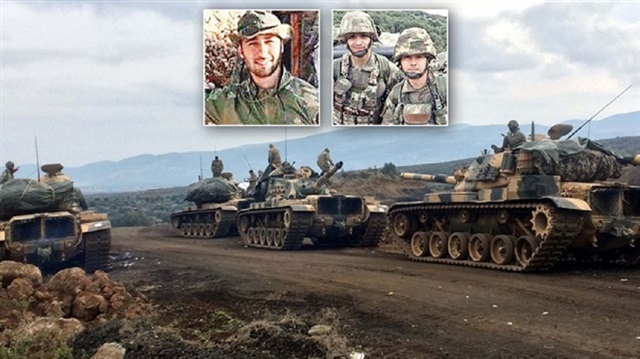
Terrorists accused of involvement in attack that martyred 2 Turkish soldiers in Afrin
Two YPG/PKK terrorists accused of being behind an attack that martyred two Turkish soldiers during Operation Olive Branch in northern Syria were remanded by a court in the southern Hatay province Wednesday, after being brought to Turkey from Syria, according to a judicial source.
The terrorists were caught as part of an investigation of the incident by the Turkish National Intelligence Service (MIT) and the Turkish gendarmerie forces, following the remanding of nine other YPG/PKK terrorists related to the incident, said the source, who asked not to be named due to restrictions on speaking to the media.
On Sept. 14, the nine YPG/PKK terrorists were also captured and brought to the southern province of Hatay.
They are accused of involvement in the Jan. 23 terror attack in Rajo, Afrin, northern Syria that martyred Lt. Oguz Kaan Usta and Specialist Sgt. Mehmet Muratdagi.
The terrorists had taken away the body of the lieutenant, which was only found two months later.
The terrorists were caught in light of the confession of a Syrian national PKK terrorist, identified as M.C., who was arrested by Turkish security forces on Sept. 3 in Rajo.
On Jan. 20, Turkey launched Operation Olive Branch to remove YPG/PKK and Daesh terrorists from Afrin. On March 18, Turkish troops and the Free Syrian Army liberated the Afrin district center.
The U.S. military presence east of the Euphrates River and the Kurdistan Workers’ Party (PKK) threat is on the agenda of Turkey, Russia and Iran, the guarantors the Astana peace talks. Northern Syria’s Tell Rifaat and Manbij are hotbeds for the PKK/PYD terror group.The priority regarding the west of the Euphrates is to clear Tell Rifaat of terror elements. It is expected that in the upcoming period, this region could also be demilitarized as a result of talks and military cooperation between Russia and Turkey.While Turkey works to keep Idlib safe, it is also preparing to make a move regarding the outdated Manbij map.The YPG-dominated SDF controls an area of about 53,000 square kilometers with a percentage of 28.6 of Syrian territory. The Turkish military cleared a 2,500 square mile (4,000 square kilometer) area from Daesh and YPG/PKK terrorists as part of the Euphrates Shield and Olive Branch operations in Syria.Syrians ask for Turkey’s help against US-backed PKK terroristsStalling in ManbijTurkey will take action east of the Euphrates River in Syria and impose safe zones as it has done in the northwest of the country, President Recep Tayyip Erdoğan said during his official trip to New York for the United Nations General Assembly.“In the upcoming period we will increase the number of safe zones in Syria, encompassing the east of the Euphrates," Erdoğan said.The Manbij roadmap agreed between Ankara and Washington has become obsolete. Tactics to stall in Manbij, which is seen as a safety door against the east of the Euphrates, are ongoing because the U.S. is aware that if it keeps its Manbij promise, Kobani, Ayn Issa, Tell Abayd, Resulayn, Dirbesiye, Qamishli, al-Hasakah and Raqqa are next.The Manbij deal between Turkey and the U.S. focuses on the withdrawal of the PKK-affiliated YPG terror group from the city in order to stabilize the region, but has no far not yielded concrete results.US removing some missile systems from Middle EastSafe zones inevitableErdogan has in the past warned of new military operations against the YPG along the Syrian border and if necessary into northern Iraq. Turkey is on the field in order to form a safe zone that extends from the Euphrates to Tigris.If the Idlib demilitarization zone that Turkey and Russia agreed on last week is successful, a similar model could be implemented to the 50 to 60 kilometer-deep area that extends to Turkey’s borders from the Aleppo-Fishabur road.Return of Syrian refugeesClose to one million displaced Syrians currently reside in tent cities in Turkey’s border towns. Ankara is pressing the matter of the return of these refugees to their homelands across many international platforms.It seems that demilitarized zones are unavoidable from Kobani to Rimeylan for displaced Syrians to be able to return to their homes.N. Iraq: PKK terrorists' testimonies reveal child abuseTurkey currently hosts nearly 3.5 million Syrian refugees, more than any other country in the world.Syria has only just begun to emerge from a devastating conflict that began in 2011 when the Assad regime cracked down on demonstrators with unexpected ferocity.PKK bars out Manbij localsMohamad T., a 22-year-old who wanted to visit his father in Manbij recently, stated that PKK terrorists did not let him enter the city. The Manbij local said his watch, glasses, cell phone and money were taken from him by the PKK.“I’ve lost my right to stay. My only chance is if two PKK terrorists vouch for me,” said Mohamad, adding that he was sent to Jarabulus after two days of interrogation.Turkey seeks to clear out “terror swamp”Retired Brigadier İhsan Başbozkurt evaluated Erdoğan’s comments that “currently, the biggest problem for the future of Syria is the terror swamp, expanding under the auspices of some of our allies, east of the Euphrates.”“Turkey, which renewed its defense line by joining the Euphrates and the Mediterranean, now seeks to join the Euphrates and Tigris. The demilitarized zone that is to be implemented in Idlib and probably Manbij may also be implemented east of the Euphrates,” Başbozkurt said.Turkish doctors save Syrian patient's life
Turkey determined to establish safe zones in eastern Euphrates
Drug trafficking is the main source of funds for the PKK terrorist organization, said an official report by Turkey.A Turkish police report released on Monday reveals the PKK terrorist organization is active in all the phases of drug trafficking including the production, delivery, distribution, and sales.PKK terrorist organization earns $1.5 billion from drug trafficking annually, said the 2018 Turkish National Drug Report that contains the data of previous year.The terror group reportedly produces heroin in laboratories established in its camps in northern Iraq and sells it to Europe.Syrians ask for Turkey’s help against US-backed PKK terroristsIn its production process, the PKK terrorist organization forces civilians to produce cannabis roots in eastern and southeastern provinces of Turkey and uses that money to fund terror activities.The report also reveals that the terrorist group also makes money from hashish production in the rural areas of the southeastern Diyarbakir province, which has been the scene of ongoing anti-terror operations against the PKK.Quoting Justice Ministry statistics, the report states as of 2017, out of 232,182 prisoners and convicts in Turkey's 386 jails, 50,278 were in for drug-related crimes.The number of suspects arrested in connection with drug offenses rose to 170,175, showing a 48.9 percent increase over the previous year.N. Iraq: PKK terrorists' testimonies reveal child abuseAccording to the report, 86 suspects were detained in six operations in 2017 against PKK's narcotic activities, and 150 kilograms of cannabis roots, 50 kilograms of heroin and 100 grams of cocaine were seized in these operations.In its more than 30-year terror campaign against Turkey, the PKK -- listed as a terrorist organization by Turkey, the U.S. and the EU -- has been responsible for the death of some 40,000 people, including women and children.Two security guards martyred in PKK attack in SE Turkey
PKK terror group trades drugs for arms: report
Syrians living in towns occupied by the U.S-backed Kurdistan Workers’ Party (PKK) terror organization have been suffering under grim conditions for over two years.The number of Syrians who have fled their homes has reached a staggering figure as terrorists continue their atrocities in east of the Euphrates, primarily in Raqqa, Hasakah and Manbij.Speaking exclusively to Yeni Şafak daily, Sobhi Dassouqi, a journalist in Raqqa, expressed his excitement on the recent Idlib deal brokered between Turkey and Russia in Sochi and said he was hopeful Raqqa would be next.Noting that PKK terrorists have been forcing children to take up arms, that they could not even go out onto the streets because of the terrorists’ harassment, and that their homes were being looted, he called on Turkey saying, “Save us from persecution.”N. Iraq: PKK terrorists' testimonies reveal child abuseCivilians face dire conditionsDassouqi revealed the details about the PKK terror organization’s barbarity and said, “People in Raqqa, Hasakah and Manbij do not have safety of life and property. There is a curfew in the area after 6 p.m. The houses of people who leave during the daytime are being robbed. The thieves are PKK terrorists and there is no authority to whom we can file complaints.”“More than 6,000 houses were booby-trapped by the PKK after the Daesh threat so that people could not return to their homes. They sold their construction materials and steel they stole from people’s homes. The PKK wages war against every living being; they stole everything we have under the tutelage of the U.S.”Underscoring the significant number of people internally displaced, he said, “Because of PKK terrorists and the U.S. there are only 500,000 people left in the region that once hosted 4 million. They keep civilians by force in camps in Ayn Isa. They are forced to live in disgusting conditions to receive UN funds for refugees. No one can leave these camps.”Two security guards martyred in PKK attack in SE TurkeyPKK doesn’t allow civilians to rebuild housesStressing that there is no attempt to rebuild the towns of Raqqa, Hasakah and Manbij, he said, “These places are in ruins and not a single thing has been done to rebuild. They don't even allow civilians to build a wall. People are trying to survive despite incurring all kinds of difficulties; they are setting up tents at ruins because they are not allowed to rebuild their destroyed houses. They have no other choice.” “Many American soldiers, civilians, bureaucrats and politicians have been visiting Raqqa, Hasakah and Manbij,” he added, underscoring the U.S support of PKK terrorists.Raqqa, a former Daesh stronghold, was captured by the YPG/PKK last October with air support from the U.S.In February, the U.S. said it would invest money in “stabilization” efforts there. However in March, U.S. President Donald Trump decided to freeze more than $200 million for recovery efforts in Syria while Washington reassessed its role in the conflict, administration officials said.Washington protects Daesh terroristsDassouqi stated that the U.S slaughtered more than 3,000 civilians under the pretext of fighting Daesh in the region in just two weeks in 2016.“However, Daesh terrorists were the ones who gave the U.S. the coordinates of the places to be bombed. The fight of the U.S is not against Daesh, but against the civilians living in Raqqa, Manbij and Ayn al-Arab”.The U.S has supplied the PYD terror organization and its armed wing, the YPG, with more than 5,000 truckloads of weapons to allegedly use in the fight against Daesh, despite Ankara’s warnings that the fact they are the Syrian offshoots of the PKK terror organization.
Syrians ask for Turkey’s help against US-backed PKK terrorists
The PKK terrorists, who are under the custody of Turkish security forces, revealed children in the group’s squad were exposed to abuse by their fellow terrorists in northern Iraq.According to the testimonies of surrendered PKK terrorists, a “child squad” was comprising of around 30 children of ages ranging from 9 to 14 years in northern Iraq’s Zap region, said the security sources on condition of anonymity due to restrictions on talking to the media.Some of the girls in this squad were raped and those who got pregnant were taken to the nearest hospital in the region to terminate their pregnancy despite the risk of their lives, the sources added.Some of the children reportedly attempted suicide as they could not overcome the trauma of the incident.Another terror group member said in their testimony that some of the girls were executed after they were subjected to abuse.The terrorist said he/she escaped the terror group as the situation did become unbearable.According to the testimonies, quitting the terror group is on the rise while the influence of so-called ringleaders in Iraq's Mt. Qandil on other PKK terrorists has also decreased.Mt. Qandil is home to the PKK terror group's headquarters.In its more than 30-year terror campaign against Turkey, the PKK -- listed as a terrorist organization by Turkey, the U.S. and the EU -- has been responsible for the death of some 40,000 people.PKK’s Qandil cadre runs amok in Syria’s ManbijSeven civilians killed as YPG/PKK raids Syrian villageThree PKK terrorists neutralized in southeast TurkeyPKK ‘terror swamp’ east of Euphrates biggest issue for Syria, Erdoğan says
N. Iraq: PKK terrorists' testimonies reveal child abuse