

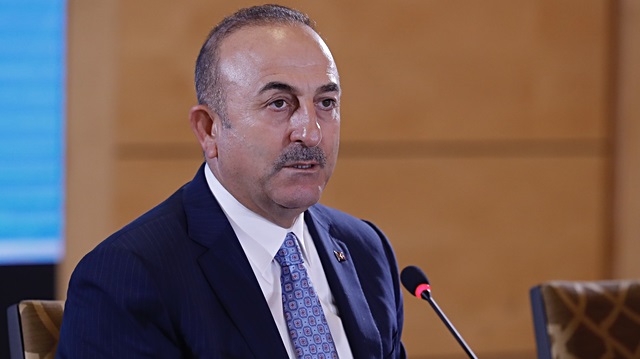
Turkish Foreign Minister Mevlüt Çavuşoğlu
Turkey's foreign minister on Thursday hailed Turkey's efforts at humanitarian aid, comparing $8 billion in Turkish aid in 2017 to $6-7 billion in aid from the U.S., which has the world's largest GDP.
"Turkey is at the highest level in humanitarian aid. Last year we spent $8 billion and the U.S. -- the richest country in the world -- spent $6 or 7 billion," Mevlüt Çavuşoğlu said in the Albanian capital Tirana, at the University of New York Tirana's school year opening ceremony.
"I'm just giving an example. In 2016, the U.S. spent $6.3 billion while Turkey spent $6 billion. The U.S. was first, Turkey second."
Founded in 2002, the University of New York Tirana was Albania's first private university, and Turkey's Maarif Foundation (TMV) assumed stewardship of the school this August.
Turkey has managed refugee influx “remarkably well,” said the United Nations Population Fund’s representative in the country.“It [Turkey] set a standard for the world to follow [...] A good response must address the entire development range, for example, economics, employment, social welfare, education, health, and infrastructure,” Karl Kulessa told Anadolu Agency.Turkey hosts some 3.5 million Syrian refugees -- more than any other other country in the world -- spending more than $32 billion from its own national resources to help and shelter refugees since the beginning of the Syrian civil war.Kulessa also talked about population dynamics in Turkey and the world, as well as the fund’s recent report on global fertility trends and reproductive rights, titled “The Power of Choice: Reproductive Rights and the Demographic Transition”.In order to create understanding about reproductive health and contraceptive choices for each person, he said a “sustained and culturally sensitive approach" involving government, community leaders and individuals themselves.Russia and Turkey give more time for Idlib deal in Syria: UN‘Syrians always warmly welcomed in Turkey’
‘Turkey managed refugee influx remarkably well’
Çavuşoğlu said Turkey is dealing with many problems in the region such as terrorism and migration and underlined Turkey's efforts for 3.5 million Syrians and more than a half million migrants from other countries.
International institutions must be transformed to be more comprehensive and representative, he also argued.
"International institutions and systems should be more visible and more effective. They need to be reformed," said Çavuşoğlu.
"Which policy of the European Union is satisfactory for the Western Balkans? Can the UN represent the world of today? No.
Turkey's agriculture and forestry minister has said construction of the "Ambouli Friendship Dam" in Djibouti is halfway through.Underscoring the dam will strengthen the Turkish-Djiboutian relations even further, Bekir Pakdemirli told Anadolu Agency that 50 percent physical realization has so far been achieved in the project."The dam being built by DSI (State Hydraulic Works of Turkey) will serve two purposes. Apart from providing drinking and usable water to the people in the region, the the dam will protect the capital Djibouti -- where 75 percent of the country's population lives -- from overflows," he said.Pakdemirli also said the aim is to complete the dam in 2019, bring it into service, and have their friendship as well as the cooperation in the area of water to a higher level.Turkey and Djibouti reached on an agreement in May 2014 to construct the dam in the flood-prone valley of the Ambouli River.The strategic economic partnership of the two countries rose significantly after Djibouti's President Ismail Omar Guelleh visited Ankara in 2009 and his Turkish counterpart Recep Tayyip Erdogan visited Djibouti in 2015.
Turkey halfway through dam construction in Djibouti
"Comprehensive? No. Representative? No. Can it prevent any conflict? No.
"Can the UN bring solutions to any problems or conflicts today through peaceful negotiations and mediation?"
Turkey has long pushed for the UN Security Council to be larger and more representative of the entire world.