

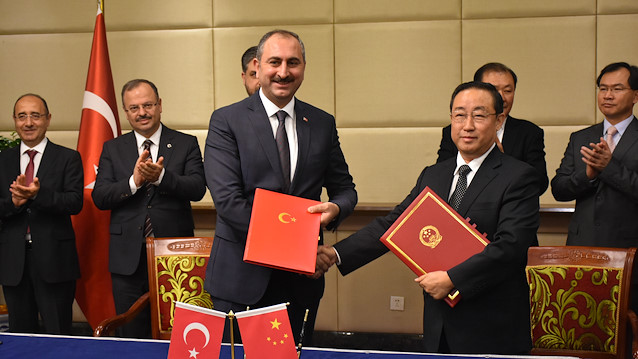
Turkish Justice Minister Abdulhamit Gul in China
The Turkish and Chinese justice ministers on Wednesday signed a deal on enhancing cooperation between the two ministries.
Turkey’s Abdulhamit Gül, in Beijing for talks, signed a memorandum of understanding with his Chinese counterpart Fu Zhenghua.
“We had a very fruitful meeting with the minister of justice. We talked about our problems,” said Gül.
“We spoke very openly about cooperation on the judicial issues of both countries and [our efforts to] solve our problems on these issues, as well as increasing cooperation,” Gül added.
Dialogue between Turkey and China has increased due to contacts among the two countries’ leaders, said Gül, and this led to cooperation in the economy, trade, and politics as well as the judiciary.
Gül said Fu was invited to next year’s International Istanbul Law Congress. He said that with the help of this congress, officials from both countries will meet every year to discuss cooperation and judicial problems.
He added that eight Turkish prosecutors and judges are getting Chinese language education at Beijing’s Public Security University and that it is very important to know both the Turkish and Chinese judicial systems.
Turkey can play a big role in the new global order, according to a Japanese political scientist.In an exclusive interview with Anadolu Agency, Yuichi Hosoya, a professor of international politics at Tokyo's Keio University, said that Turkey has the potential to act as a bridge between Western and non-Western countries, increasing its role in the new global order."I feel that both Japan and Turkey need to bridge the different worlds -- the Western world and non-Western world -- and also liberal democracies and authoritarian regimes," he said."By doing that we can create a much more inclusive and comprehensive international order," he added.Noting that previously international order was created by Western powers and liberal democracies such as the U.S. and Western Europe, Hosoya said: "The basic nature and the norms of the liberal international order has been based on Western norms.""But nowadays we are seeing the rise of non-Western states like India and China, and it is possible that we will see a clash between Western powers and non-Western powers, liberal democracies, and authoritarian regimes," he added.As Japan and Turkey are both located between the Western and non-Western worlds, both have Western elements in their society but at the same time they have differences with the Western powers, he said.Noting that both countries are allies of the U.S., Hosoya said that Japan and Turkey enjoy "very strong trade relations with the Western world," which is why Turkey could also play a bigger role.- Expanding cooperationThe Japanese scholar said Turkey also has the potential to expand its role in the region thanks to its strong relations with Islamic states."The center of economic growth is now moving from the Asia-Pacific region to the Indian Pacific Ocean, and if we look at the Indian Ocean, it is surrounded by Islamic countries and of course Turkey has a very important place in the Islamic community and Islamic states," Hosoya said."So it means that without cooperation with Turkey, Japan cannot fully understand the Muslim world surrounding the Indian Ocean," he added.
‘Turkey can play bigger role in new global order’