

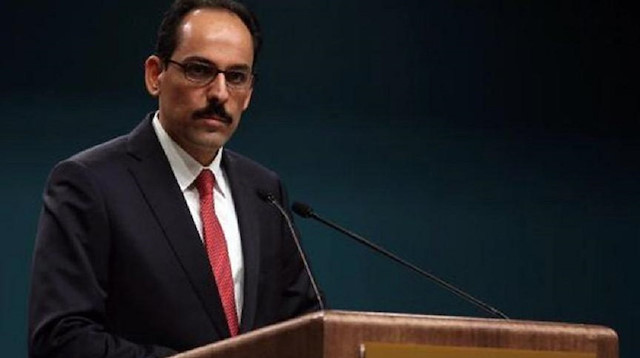
Turkish Presidential Spokesman İbrahim Kalın
Turkey cannot tolerate the creation of small state-like structures led by PKK and its wing in Syria, Turkish presidential spokesman said, stressing that Turkey will take every measure to protect its borders.
"That poses a direct threat to our national security," İbrahim Kalın said speaking at 18th Doha Forum "Identifying a European Role: Navigating Polarization across the MENA Region."
Kalın said Turkey's measures were not just for own interest but also for Syria's territorial integrity.
Turkish presidential spokesman said the U.S. presence in Syria went beyond its purpose and became "another theater for proxy games in the region."
The National Coalition for Syrian Revolutionary and Opposition Forces (SMDK) has voiced support for Turkey’s planned military operation in Syria, east of the Euphrates River, near Turkish borders.In a statement, Abdurrahman Mustafa, head of the coalition, said the Syrian people continue to suffer at the hands of the Bashar al-Assad regime forces, as well as Iranian Revolutionary Guard Corps, Hezbollah and the PYD.YPG/PKK terrorists continue to pose threat to TurkeyTurkey’s planned operation gives hope to SyriansAny military operation to eliminate these terror groups "will be welcomed and supported by us," Mustafa said, adding: "We are working with our Turkish ally to liberate all cities and towns from the control of terrorist forces."He also stressed that all the Free Syrian Army members stand ready to cooperate and join in the upcoming military operation."We share this view with the Turkish Republic the separatist projects and terror constitute a direct threat to Turkey’s national security as well as to Syria’s territorial integrity and unity," he added.On Wednesday, President Recep Tayyip Erdogan said that within days Turkey would launch an operation east of the Euphrates to clear the region of PKK/YPG terrorists.Previously, Turkey launched two successful anti-terror operations since 2016 to foil the formation of a “terror corridor” along Turkey’s border.In its more than 30-year terror campaign against Turkey, the PKK -- listed as a terrorist organization by Turkey, the U.S. and the EU -- has been responsible for the deaths of some 40,000 people, including women and children. The YPG is its Syrian branch.
Syrian opposition backs Turkey’s planned operation
The YPG/PKK terror group continues to pose a threat to Turkish territories using the internal conflict in Syria as an opportunity.The terrorist organization, which occupied a 480-kilometer (298 miles) of land on Turkey-Syria border, recently increased its activities against Turkey.In the last three years, Turkey came under many harassment fires by the terrorists.Their efforts to carry out terror activities inside Turkey have been prevented by successful operations of security forces, who seized large amounts of explosives in border cities such as Hatay, Kilis, Gaziantep, Mardin and Sanliurfa.- Operation Olive Branch dealt heavy blow to YPG/PKKThe Operation Olive Branch, which was conducted by Turkish Armed Forces in Afrin, ended the terror group YPG/PKK’s presence in northwestern Syria.The terrorists targeting civilians in Hatay and Kilis provinces killed seven people, while injuring 113 others by rockets and mortars they fired as Turkey started operation in the region.During the operation, terrorists carried out rocket and mortar attacks 60 times on Hatay, and 34 times on Kilis.The terrorists also targeted a mosque in Kilis, and caused the death of two civilians.Many houses, vehicles and shops were damaged in the residential areas in the two provinces, which came under the terror attacks.- Harassment fires on police stationsIn 2015-2017, the YPG/PKK conducted 12 attacks on border posts in Hatay and Kilis, and martyred two soldiers, and injured another.In April 2017, the terrorists attacked a tank with a howitzer in Sanliurfa province. Turkish forces responded the attack, which caused no loss of lives.During the same period, the YPG/PKK terrorists attacked border posts in Mardin five times. Three soldiers were slightly injured, while security forces destroyed terror targets in a response.In January 2018, the terrorists also targeted border posts in Mardin’s Nusaybin district with harassment fires for two days in a row. No loss was reported in the attacks.- Plans to drown cities in bloodEight Syrian suspects carrying 146 kilograms (321 pounds) of explosives were captured as they tried to enter Turkey from the YPG/PKK-occupied region of Syria in July 2017.One of the terrorists confessed in his testimony that they had buried some of the explosives in soil after covering them with powdered chili pepper to prevent detector dogs from finding them.In August 2018, security forces seized 25 kilograms (55 pounds) of explosives from a vehicle travelling from Hatay to Gaziantep. More explosives of 5 kilograms (11 pounds) were also found in a raid at homes of the terrorists.Last month, a terrorist, who entered Turkey from YPG/PKK-controlled Tal Abyad region and learned to have been trained to be a suicide bomber, was captured in Gaziantep.Over 247 kilograms (544 pounds) of explosives were also seized from a vehicle during controls in Mardin province. The terrorists, who brought the explosives into Turkey, were preparing to carry out attacks in metropolitan cities of the country.Eight anti-personnel rocket launcher ammunition headers, nine propelling cartridges and 67 Kalashnikov rifle magazines belonging to the YPG/PKK terrorist organization were found in the Bulamacli village of Kilis.In 2016-2018, five tunnels, measuring 35 meters (114 feet) by 400 meters (1,312 feet), were found by security forces in Mardin’s Nusaybin district. The tunnels heading to Syria’s Kamisli region were destroyed by security forces.
YPG/PKK terrorists continue to pose threat to Turkey
"They say that now they are in Syria for three main reasons: One is the enduring defeat of Daesh. Number two is to provide stability and secure Syria's territorial integrity and number three is, now they say it publicly, to get Iran and its forces out of Syria," Kalın said.
Kalin recalled his last meeting with his U.S. counterpart, during which he reported saying, "Look I can understand the first two goals, but good luck with the third one."
"That means Syrian issue is no longer about Syrian issue," Kalın added.
On Wednesday, Erdoğan said that within days Turkey would launch an operation in Syria, east of the Euphrates, near Turkey’s borders, to clear the region of PKK/YPG terrorists.
That operation would follow two successful Turkish operations since 2016 to foil the formation of a “terror corridor” along Turkey’s border.
In its more than 30-year terror campaign against Turkey, the PKK -- listed as a terrorist organization by Turkey, the U.S. and the EU -- has been responsible for the deaths of some 40,000 people, including women and children. The YPG is its Syrian branch.
As Turkey prepares to launch an anti-terror operation east of the Euphrates River, Syrians living in the southeastern Turkish province of Sanliurfa have started hoping of the day when they will return to their homeland.On Wednesday, President Recep Tayyip Erdogan said that within days Turkey would launch an operation in Syria, east of the Euphrates, near Turkey’s borders, to clear the region of PKK/YPG terrorists.Speaking to Anadolu Agency, Vail Abut, a resident of Syria’s Tal Abyad living in Turkey’s Akcakale district, said he is pleased by Erdogan’s statement regarding the expected military operation.“We expect Turkish army to clear the region, located east of the Euphrates, of terrorists as soon as possible. The day, when our soil is cleared of terrorists, we would return to our homes with Allah’s will,” Abut said.Dozens of people in Tal Abyad had to flee to Akcakale district of Sanliurfa province due to the pressure and violence of YPG/PKK terror group. They have been living in Turkey for around three years.Abut said his relatives near Raqqah were ready to give support to the operation expected to be launched by the Turkish military.Hamed Halit, another Tal Abyad resident, also voiced his support for the planned operation.“We are ready to extend support to them [Turkish military], if they need it after the launch of the operation,” Halit said.“YPG/PKK terror group seized our homes and lands by force. We’ve started dreaming of returning to our home with [Turkish president] Recep Tayyip Erdogan’s statement.”“Only Erdogan defends our rights,” he said.Previously, Turkey launched two successful anti-terror operations since 2016 to foil the formation of a “terror corridor” along Turkey’s border.In its more than 30-year terror campaign against Turkey, the PKK -- listed as a terrorist organization by Turkey, the U.S. and the EU -- has been responsible for the deaths of some 40,000 people, including women and children. The YPG is its Syrian branch.
Turkey’s planned operation gives hope to Syrians
The terrorist Kurdistan Workers' Party (PKK) will suffer an "even greater defeat" than the one in Afrin, says a spokesman from the Free Syrian Army( FSA), as Turkey announced it was preparing to launch an operation east of the Euphrates River in the coming days.Free Syrian Army spokesperson, Youssef Hamoud, revealed the details of the upcoming military operation and, telling Yeni Şafak daily in an exclusive interview that “we have been preparing for this operation for six months. PKK terrorists will suffer a far greater defeat than in Afrin.”Hamoud said that the operation will primarily focus on liberating 165 kilometers area, extending from the border of the northwestern Syrian city of Jarablus to Ras al-Ayn on the border with Turkey.He also stressed that 15,000 FSA troops from the 4th Assault Army Corps are awaiting orders to launch the operation.President Recep Tayyip Erdoğan said earlier that an offensive east of the Euphrates River is imminent and Turkey will launch it "within a matter of days" to clear the region of the terrorist group.PKK terrorists are in panicStressing the PKK terrorist’s current state of panic, he said “more than 200 PKK members deserted the terror organization in less than 48 hours after the operation was announced.”Hamoud also said that thousands more will defect from the PKK terrorist organization, resorting instead to escape the battle.Video: Turkish Army destroys PKK shelters in SE
‘PKK terrorists to suffer far greater defeat than one in Afrin’
'Where are the Europeans in Syrian fire?'
"Is Europe devising its own policies on its own or is it always looking for a signal from Washington?" Kalın asked questioning the European approach to the Syria and Palestine issue.
"A lot of people think that on key geopolitical issues, the Europe has developed this tendency of looking at Washington what the signal is, what the position will be, and then they take a position or not, they get involved or not," Kalın said.
Kalın also criticized the Muslim countries for "lack of leadership" and said like European countries Muslim countries were also silent against Syrian and Palestinian issues.
Turkey will continue its anti-terror operations in northern Iraq’s Sinjar region as long as terror groups exist in Iraq, the foreign ministry spokesman said on Saturday.In a written statement, Hami Aksoy said PKK terror group has used Iraqi soil as a base to attack Turkey for many years.“As a result of these attacks, tens of thousands of our people were killed," Aksoy said. "Activities of PKK terror group in Iraqi and Syrian soils have been a national security issue for Turkey."“As long as terror organizations exist on Iraqi soil, these counter-terror operations will continue," he said.In its more than 30-year terror campaign against Turkey, the PKK -- listed as a terrorist organization by Turkey, the U.S. and the EU -- has been responsible for the deaths of some 40,000 people, including women and children. The YPG is its Syrian branch.US's Syria envoy Jeffrey visits PKK in Hasakah as Turkish op loomsYPG/PKK’s terror structure in region east of Euphrates‘Purging Manbij of PKK terrorists will pave the way for Raqqa’s liberation’
Turkey to continue anti-terror ops. in N Iraq’s Sinjar
YPG/PKK terrorists attacked Free Syrian Army (FSA) emplacements in north Syria on Saturday, local sources said.Terrorists targeted north Syria's Mare district near the Turkish border.FSA forces responded with gunfire and the clash between the sides lasted for three hours.It is said that no one from FSA was killed or injured.These FSA emplacements attacked by YPG/PKK terrorists were in the Operation Euphrates Shield zone.Turkey’s Euphrates Shield and Olive Branch operations in northwestern Syria liberated the region of YPG/PKK and Daesh terrorists, making the return of Syrian civilians to homeland possible.Separately, the Syrian regime attacked some FSA emplacements in Syria’s Al-Bab for 10 minutes.No one was killed or injured in this attack.Al-Bab is roughly 26 miles (42 kilometers) from Aleppo.In its more than 30-year terror campaign against Turkey, the PKK -- listed as a terrorist organization by Turkey, the U.S. and the EU -- has been responsible for the deaths of some 40,000 people, including women and children. The YPG is its Syrian branch.
YPG/PKK attacks FSA emplacements in N. Syria
"Where are the Europeans in the Syrian fire? We understand that United States has big military and economic power, they naturally enter the game as a powerful player. That's understandable but there are many other things that we can do," Kalın said stressing that the Europeans were very hesitant to be an active player when it comes to political resolution in Syria.
Kalın also recalled a Syria summit on October 27 in Istanbul with the attendance of Russia, Turkey, France and Germany.
"For the first time we brought together Astana group members and the small group members and that produced two important results. One was the Idlib ceasefire agreement which is now an enduring ceasefire. Secondly, the constitutional issue. So, we made progress on those issues. Is that enough? Obviously not, because we still have a lot of work to do in Syria."
Some 400 Iraqi refugees who sought refuge from Daesh terrorists in Iraq by going to neighboring Syria are set to return home with help from Turkey.The move comes as a result of joint humanitarian diplomatic efforts of the Turkish and Iraqi foreign ministries along with the Istanbul-based Humanitarian Relief Foundation (IHH).After going through customs, the refugees were taken by bus to a buffer zone near the Oncupinar Border Crossing between Kilis, southeastern Turkey and Syria.Officials from Iraq’s Consulate and the Kilis migration office examined the refugees, who were provided with winter clothes and shoes by the IHH charity foundation.The refugees had taken shelter in Syria after fleeing Ramadi, Fallujah, Mosul, Kirkuk and Tel Afar once Daesh terrorists took control of most of these Iraqi cities in 2014.Daesh terrorists say Strasbourg shooter was one of its members, gives no evidenceTurkish supportIraq's government will continue to stand by its citizens, Qaddo Muhammad Nuri, an Iraqi immigration official, told Anadolu Agency.He also expressed thanks for the support of Turkey and the IHH’s logistic help in returning the refugees.Abdullah Altay, coordinator of the IHH's humanitarian diplomacy unit, said the Iraqis’ return was the fruit of negotiations with Iraqi government officials.These refugee children will have the opportunity for a better life in Iraq, he added.Mohammad Jasim, an Iraqi refugee from Fallujah, expressed his joy at being able to go back to Iraq."During our stay in Syria we always dreamed of going home," Jasim said.To date, humanitarian diplomatic efforts by Turkey, Iraq, and the IHH have facilitated the return of 7,000 Iraqis from Syria.The three parties are also in negotiations for the return of another 6,000 Iraqis.After Daesh terrorists took over one-third of Iraqi territory in 2014, millions were forced to flee mass destruction in regions such as Mosul, Anbar, and Saladin.Damage and destruction were seen in thousands of settlements as well as at Mosul Airport, Mosul University, most railway stations, and bridges and hospitals in the old city of the northern city of Mosul. There are dozens of mass graves of victims of Daesh in Mosul and Saladin.The U.S.-led coalition, formed in October 2014 to combat Daesh, provided the Iraqi administration with support, particularly through airstrikes.21 Daesh prisoners escape Iraqi jail, most recaptured
Turkey helps Iraqi refugees who fled Daesh go home