

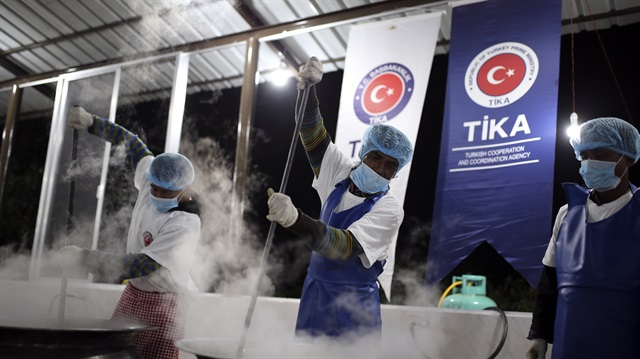
File photo: TIKA establishes largest food supplier tent for Rohingya people
Turkish institutions remain at the forefront of providing aid to Rohingya refugees, who fled Myanmar to Cox’s Bazaar in southeastern Bangladesh after a brutal military crackdown on Aug. 25 last year.
Turkish Cooperation and Coordination Agency (TIKA), Turkish Red Crescent, Turkiye Diyanet Foundation and Disaster and Emergency Management Authority (AFAD) have made major contributions to help the persecuted Rohingya, including providing daily meals, shelters, healthcare and education to tens of thousands of people.
TIKA Bangladesh Coordinator Ahmet Refik Çetinkaya said the agency has been providing aid to Rohingya since Sept. 7 last year, starting with 60 tons of emergency food aid.
A Turkish humanitarian aid agency has provided clothes and shoes to 16,000 Syrian orphans ahead of Muslim festival of Eid al-Adha.Speaking to reporters, Yakup Alaca, Humanitarian Relief Foundation's (IHH) Syrian representative, said they have given special importance to the children, who lost either their father or mother in the war.The aid was delivered at centers established in Syria's northwestern cities of Al-Bab, Jarabulus and Azaz, which were recently cleared of terrorists by Turkey's operations.Alaca added that the agency’s target is to reach 20,000 orphans until the morning of Eid-al Adha.
Turkish aid agency provides clothes to Syrian orphans
Çetinkaya said around one million Rohingya live in Bangladesh with 706,000 seeking refuge in Cox’s Bazaar alone since the August 2017 violence. Some 300,000 locals also asked for aid following the Rohingya migrations, he added.
10M hot meals
Cetinkaya said distribution of hot meals “forms the backbone of our aid activities".
"Since one year, we have provided 10 million hot meals," he said.
The meals include meat, chicken and rice, he said, adding that around 25,000-30,000 people benefit from the daily meals.
"We are also employing 120 people. Half of them are Bangladeshis and the other half are Rohingya," he said.
Turkey's Disaster and Emergency Management Authority (AFAD) distributed 2,500 packages of food aid in Afghanistan's northern Jowzjan province, a statement by the authority said on Monday.The statement said AFAD had meetings with World Food Program’s Country Director Zlatan Milisic, Afghanistan Deputy Minister of Disasters Mohammad Qaseem Haidari and Turkish Red Crescent’s Afghanistan delegation to identify the needy and analyze the humanitarian aid situation.After the meetings, AFAD teams brought 2,500 packages of food aid to needy families in Jowzjan province, the statement said.The food packages, which were distributed in cooperation with Turkey's Mazar-i-Sharif Consulate General, included 10 kilograms of rice, 5 liters of vegetable oil, 3 kilograms of sugar, 2 kilograms of tea, 2 kilograms of pasta and 3 kilograms of beans.
Turkish agency distributes food aid in Afghanistan
The World Food Program also distributes food to refugees in the area, giving them rice, oil and lentils; however, eating rice everyday falls short of providing full nutrition, especially to children, he added.
TIKA’s daily meals, on the other hand, are known to be healthier since it includes meat and chicken, fulfilling the protein needs of the refugees.
Apart from TIKA, the Turkish Red Crescent also provided hot meals to 41,030 Rohingya refugee families in Cox’s Bazaar.
It also provided food aid packages to 50,744 families, special Ramadan food parcels to 11,350 families and 11,350 vegetable/fruit boxes, Turkish Red Crescent told Anadolu Agency.
Separately, the Turkiye Diyanet Foundation also distributed 15,000 food aid packages to Rohingya refugees in Cox’s Bazaar, according to data the foundation shared with Anadolu Agency.
A leading human rights group said on Tuesday that international monitoring was vital in the repatriation of thousands of Rohingya Muslims as Myanmar authority has tortured and imprisoned returnees from Bangladesh.Since Aug. 25, 2017, more than 750,000 refugees, mostly children and women, have fled Myanmar and crossed into Bangladesh after Myanmar forces launched a crackdown on the minority Muslim community, according to Amnesty International.More than 24,000 Rohingya Muslims have been killed by Myanmar’s state forces since August 2017, said a new report by Ontario International Development Agency. Myanmar has promised a safe return to the Rohingya refugees but the latter have expressed doubt about their safety. New York-based Human Rights Watch said on Tuesday that “the reality is that Rohingya who go back still face the persecution and abuses they were forced to flee” despite the promised by the Myanmar government.“The torture of Rohingya returnees puts the lie to Myanmar government promises that refugees who return will be safe and protected,” said HRW’s deputy Asia director Phil Robertson.HRW said in a statement that three Rohingya men and three boys said Myanmar’s border guard police "repeatedly interrogated them at gunpoint [...]".The officers used stress positions; beatings with fists, sticks, and rods and burning and electric shock to force them to confess to an affiliation with Arakan Rohingya Salvation Army (ARSA), it said.HRW said they were among 58 Rohingya returnees who, according to statement of the State Counselor Aung San Suu Kyi’s Office, Myanmar President Win Myint pardoned.“The treatment of these Rohingya refugees should be a warning sign to those who believe the Myanmar authorities are ready to ensure safe returns,” Robertson said. “Myanmar has a long way to go before it can demonstrate it is serious about making the necessary reforms for voluntary, safe, and dignified returns.”The Rohingya, described by the UN as the world's most persecuted people, have faced heightened fears of attack since dozens were killed in communal violence in 2012.The UN documented mass gang rapes, killings -- including of infants and young children -- brutal beatings, and disappearances committed by security personnel.In a report, UN investigators said such violations may have constituted crimes against humanity.Turkish charity to distribute meat among RohingyaRohingya Muslims struggle against famine as world watches silentlyMyanmar army killed over 24,000 Rohingya: reportThe Rohingya lists: refugees compile their own record of those killed in MyanmarMyanmar seeks removal of 'national' tag in Rohingya IDs
Rohingya returnees tortured by Myanmar police: HRW
Infrastructure, hospitals built
Cetinkaya also said TIKA provided six ambulances for hospitals, established a playground and distributed 10,000 blankets.
He said TIKA was also building a 100-meter long steel bridge in the area that would help in the distribution of aid in the camp.
Meanwhile, the Turkish Red Crescent said it built 200 shelters, a community center, 63 bathrooms, two laundries, four solar-powered systems, six water distribution systems and 48 lighting poles.
The shelters provide accommodation to 26,132 families; nearly 5,000 families were also given clothes. Five tube wells were also built to provide water to 12,500 people daily.
Turkiye Diyanet Foundation said it built 450 bamboo shelters for Rohingya refugees at the Kutupalong camp in Cox’s Bazaar and it plans to build 150 more shelters. It also constructed nine wells, five mosques, four bamboo bridges and 4,538 solar illumination systems.
The foundation also provided 4,000 cloth packages, 6,500 cleaning packages, 7,500 kitchenware aid packages and 300 tents.
Also, AFAD built 1,065 bamboo houses, 100 toilets, 100 bath units and six wells for the refugees. It also built a field hospital in coordination with the Turkish Health Ministry, which started operating on Jan. 25. As of Aug. 20, a total of 90,153 treatments were carried out at the hospital; 2,025 patients stayed while 522 medical operations were conducted.
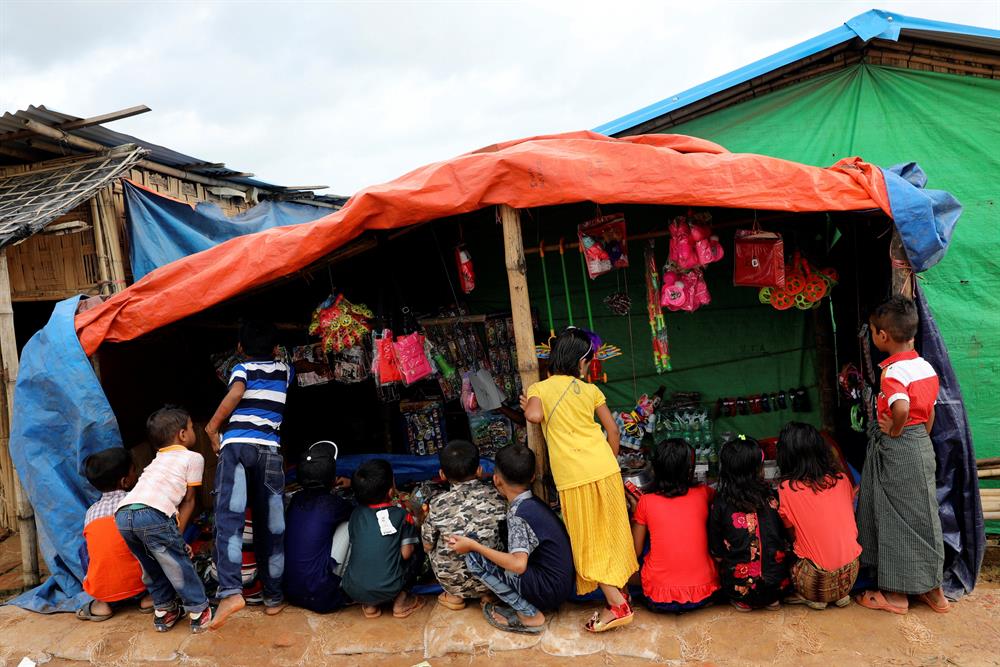
Schools, scholarships for students
Cetinkaya said TIKA has started a project to build 100 semi-permanent schools with UNICEF using concrete and bamboo; so far, 30 have been completed.
Diyanet Foundation has also an education center and a needlecraft education center inside the camp area.
The foundation provides support to Rohingya students studying in different countries. It covered all expenses of 110 Rohingya students studying in different departments of International Islamic University Chittagong in Bangladesh.
Furthermore, the foundation covers all expenses of 16 Rohingya students studying in Malaysia's International Islamic University.
It also supported 3,700 Rohingya students at 100 educational centers in Pakistan's Karachi city while 11 Rohingya students are studying at a high school in Turkey under the foundation's scholarship program.
Since Aug. 25, 2017, more than 24,000 Rohingya Muslims have been killed by Myanmar’s state forces, according to the Ontario International Development Agency (OIDA).
In its recent report titled Forced Migration of Rohingya: The Untold Experience, OIDA increased the estimated number of murdered Rohingya up to 23,962 (± 881) from the Doctors Without Borders figure of 9,400.
More than 34,000 Rohingya were also thrown into fire while over 114,000 others were beaten, the OIDA report said, adding that 17,718 (±780) Rohingya women and girls were raped by Myanmar army and police. Over 115,000 Rohingya houses were also burnt down and 113,000 others were vandalized, it added.
According to Amnesty International, more than 750,000 Rohingya refugees, mostly children and women, have fled Myanmar and crossed into Bangladesh after Myanmar forces launched a crackdown on the minority Muslim community.
The Rohingya, described by the UN as the world's most persecuted people, have faced heightened fears of attack since dozens were killed in communal violence in 2012.
The UN documented mass gang rapes, killings -- including of infants and young children -- brutal beatings, and disappearances committed by Myanmar state forces. In its report, UN investigators said such violations may have constituted crimes against humanity.