

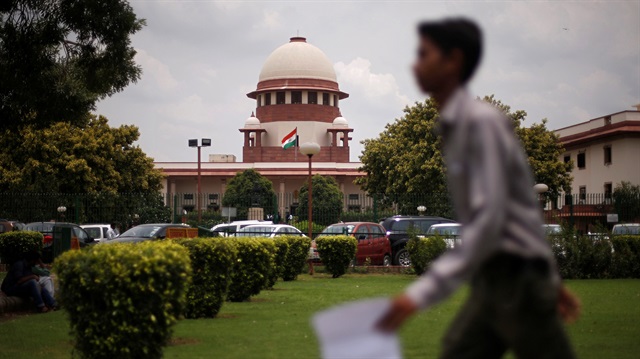
A man walks inside the premises of the Supreme Court in New Delhi, India
Jammu and Kashmir on Monday witnessed a shutdown on the second consecutive day amid fears that India’s top court will revoke a law protecting exclusive citizenship rights.
However, the court on Monday adjourned the hearing of a petition challenging the special status of Jammu and Kashmir that prevents non-residents of the state from purchasing property in the region and thereby maintaining the Muslim majority character of the region.
The case will be heard on August 27.
“The Bench will determine whether the case should be referred to a Constitution Bench. Today, as you see, the other judge is absent and so we have to hear the case another day,” India’s Chief Justice, Dipak Misra, told the petitioners who objected to an adjournment.
Five were killed by Indian forces during an overnight gun battle in the village of Killora, Shopian in southern Kashmir.“We had information that a group of militants are there in the area. Jammu and Kashmir police, army, CRPF cordoned the area. A militant was killed in the encounter last night. The firing was resumed today and bodies of four more militants were recovered. Operation has now been called off,” Jammu and Kashmir police chief Shesh Paul Vaid told reporters on Saturday.As news of the killings spread, people from adjoining villages came out to the streets to protest. Shouting slogans for independence, the protesters threw stones at Indian forces who used pellets and tear gas shells on the protesters, eyewitnesses said.In a separate gun battle on Friday, two militants, including an engineering graduate who had joined the militants just four days before, were killed in Sopore, northern Kashmir. An Indian army soldier was also killed in Friday’s gunfight, while three others were injured.Kashmir, a Muslim-majority Himalayan region, is held by India and Pakistan in parts and claimed by both in full. A small sliver of Kashmir is also held by China.Since they were partitioned in 1947, the two countries have fought three wars -- in 1948, 1965 and 1971 -- two of them over Kashmir.Also, in Siachen glacier in northern Kashmir, Indian and Pakistani troops have fought intermittently since 1984. A cease-fire came into effect in 2003.Some Kashmiri groups have been fighting against Indian rule for independence, or for unification with neighboring Pakistan.According to several human rights organizations, thousands of people have reportedly been killed in the conflict in the region since 1989.
Indian forces kill 5 in Kashmir
Article 35A, incorporated in the Indian Constitution by a 1954 Presidential Order, confers special status to the permanent residents of Jammu and Kashmir, and bars people from outside the state from acquiring any immovable property in the state.
Citing intelligence reports, the local media warned of a possible revolt in the region’s police department if Kashmir's special status was tampered with.
Indian security forces on Saturday killed five in the disputed region of Kashmir, the biggest single-day casualty since Prime Minister Narendra Modi's government took direct control of the state, leading to protests.Modi's Hindu nationalist party pulled out of a coalition government in the state of Jammu and Kashmir in June, citing a deterioration in security, leading to president's rule or direct control by the federal government.Dozens of protesters were injured, two of them critically with gunshot wounds, as a large number of youths gathered in Kilora village in South Kashmir's Shopian district and pelted Indian troops with stones.Video: Indian troops kill five in KashmirWitnesses said troops fired tear gas, pellets and bullets to quell the protests. A doctor at the local hospital said they had received at least two dozen injured people.Srinagar-based Indian Defence Ministry spokesman, Colonel Rajesh Kalia, told Reuters the five were killed on Saturday.The Indian army along with the police on Friday launched an operation, who, they said, were hiding in Kilora village. The officer said they recovered automatic assault rifles.Officials say 227 people, including 52 Indian security force personnel, have been killed this year in the Kashmir conflict.
Indian troops kill five in Kashmir, draw protests
The shutdown was called by the region's pro-Independence leadership.
In a Twitter post, Mirwaiz Umar Farooq, a pro-independence leader, said a strict vigil would be maintained on the situation and that the protest would continue.
Another pro-Independence leader, Syed Aga Hassan, said any effort to “tinker with” the law would create “a Palestine-like situation” in Kashmir.
A retired junior commissioned officer, who served in the Indian army, is among four million people whose names were excluded in the draft list of citizens issued by the Indian government.The government published a draft known as the National Register of Citizens (NRC) on Monday.“This is very unfortunate. I just can’t accept this behavior. I’m deeply hurt,” 50-year-old Azmal Haque, who retired from the Indian Army in 2016, told Anadolu Agency.The NRC list is unique to Assam. It was first tabulated in 1951, four years after independence from British rule, to distinguish Indian citizens from illegal migrants from bordering Bangladesh, which was then part of Pakistan.“I never expected to see this day, even after serving the nation for 30 years, I will not be called as an Indian citizen,” Haque said.“There are around seven such persons who have served the Indian Army or Indian Air Force but their names were not mentioned in the list. We are going to write to the president of India for questioning our citizenship,” says Haque, who is permanent resident of Chaygaon village in Kamrup district of northeastern Assam State.The list includes only those people or their descendants who entered India till midnight of March 24, 1971, when Bangladesh became an independent state.However, the Bangladeshi government labeled it an “internal issue” of India and stated that Dhaka has nothing to do with the matter."Whatever is happening in Assam is an internal issue," Bangladesh's Minister of Information Hasanul Haq Inu told Indian broadcaster WION on Tuesday."Assam is a case of purely ethnic conflict," he said and noted that the Delhi government “has not raised this issue with us.""Bangladesh government is not interested in starting any communication since there is no robust way to stop illegal immigration," Inu said.The first draft of the list published on Monday left out four million people. The move has triggered fears that a huge population would be rendered stateless.The Indian government stated the new law considers those who arrived before the war as legitimate citizens.“Our forefathers have lived here. We have submitted the documents of pre-independence era (1947). So, there is no doubt about that. I think it’s some human error that has kept me out of the list. But I’m pretty sure to get included in the list,” 38-year-old Pitambar Newar from Duliajan, a town in the eastern part of Assam, told Anadolu Agency.- ControversyThe move by the Indian government has triggered a massive political controversy in the country, with many political leaders fearing the move could result into a “civil war”.The ruling Bhartiya Janata Party’s (BJP) President Amit Shah on Tuesday said that those people whose names are not in the NRC are "intruders" as they have failed to prove their Indian citizenship.Assam’s former Chief Minister Tarun Gogoi from Indian National Congress party said there are flaws in the final draft. “We were expecting to have an error-free NRC. But I think there are flaws in the list that was announced on July 30,” he said.However, Prateek Hajela, the NRC coordinator, said those people whose names were not listed should not be worried."This is not the final list. This is just a draft. The individuals will be given ample opportunities. They can fill up a form and claim their names, objections and even clarifications if needed,” Hajela tells Anadolu Agency.The process of filing objections would begin Aug. 30 and continue until Sept. 30, according to the officials.- 'Unacceptable' moveHuman Rights activists have condemned the government’s move, calling it “unacceptable.”"The government should set up an ombudsman along with civil society and neutral entities from within our country, to review every name,” Brinda Adige, a rights activist told Anadolu Agency.The Indian Supreme Court, which is monitoring the process, said no action shall be taken on the basis of NRC draft.“In this regard, the Court would like to observe that what has been published is only the Complete Draft NRC, which naturally being a draft cannot be the basis of any action by any authority,” said the Supreme Court order which was passed on Tuesday.Debasish Bhattacharjee, a professor at the department of political science in Assam University, said the government needs to deal with the situation “very carefully.”“It is difficult to comment about what is going to happen because there is no plan as to what will be the fate of those which will be left out in the final list,” Bhattacharjee said.He said there was a less possibility that adjacent Bangladesh will accept those left out in the final list of NRC.“I think they can’t be sent back anywhere, but they (left out) might be deprived from their voting rights or some civil rights,” he said. “It would create some ill will among those people and they might not turn loyal to Indian sovereignty,” Bhattacharjee added.*Sorwar Alam in Ankara contributed to this story
India’s new citizens’ draft list sparks controversy
“A conspiracy has been hatched to change the demography of the Muslim-majority state,” Hasssan said, threatening a massive agitation if that was done.
The petition challenging Kashmir’s special status came from a non-governmental organization “ We the People.”
According to the petition, Article 35 A is against the “very spirit of oneness of India” as it created a “class within a class of Indian citizens.”
Kashmir, a Muslim-majority Himalayan region, is held by India and Pakistan in parts and claimed by both in full. A small sliver of Kashmir is also held by China.
Since they were partitioned in 1947, the two countries have fought three wars -- in 1948, 1965 and 1971 -- two of them over Kashmir.
Also, in Siachen glacier in northern Kashmir, Indian and Pakistani troops have fought intermittently since 1984. A cease-fire came into effect in 2003.
Some Kashmiri groups in Jammu and Kashmir have been fighting against Indian rule for independence, or for unification with neighboring Pakistan.
According to several human rights organizations, thousands of people have reportedly been killed in the conflict in the region since 1989.