

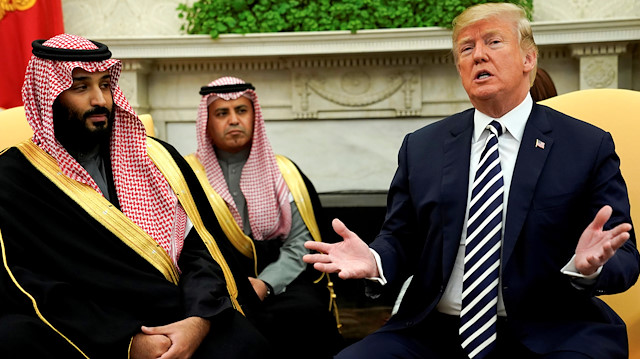
U.S. President Donald Trump welcomes Saudi Arabia's Crown Prince Mohammad bin Salman
A Saudi scholar urged the U.S. to reconsider its support for Saudi Arabia after the murder of a Washington Post columnist Jamal Khashoggi.
In an article titled “Why the U.S. Can’t Control MBS [Mohammad bin Salman]” for the Foreign Affair Magazine, Madawi Al-Rasheed, a visiting professor at the Middle East Centre of the London School of Economics, wrote: “The United States could start by making its support for MbS conditional on his recognition of people’s freedoms and the rule of law.
Norway has suspended exports of defense-related products to Saudi Arabia, the country’s foreign ministry said Friday. “We have decided that, in the current situation, no new licenses are to be granted for exports of defense-related products or dual-use items for military use to Saudi Arabia,” Minister of Foreign Affairs Ine Eriksen Soreide said in a statement.“We stopped processing new applications some time ago, pending this decision. Norway has never allowed exports of arms or ammunition to Saudi Arabia,” Soreide said.“The decision was taken after an overall assessment of recent developments in Saudi Arabia and the region, and the unpredictable situation in Yemen,” the statement added.Impoverished Yemen has remained wracked by violence since 2014, when Shia Houthi rebels overran much of the country, including the capital, Sanaa.The conflict escalated in 2015 when Saudi Arabia and its Arab allies launched a devastating air campaign in Yemen aimed at rolling back Houthi gains.Last month, German Chancellor Angela Merkel ruled out any weapons exports to Saudi Arabia until the murder of journalist Jamal Khashoggi is cleared up.“This must be cleared up. And until it is cleared up, there will be no arms exports to Saudi Arabia. I am saying this quite explicitly,” Merkel said.Khashoggi, a Saudi national and columnist for The Washington Post, was killed Oct. 2 inside the Saudi Consulate in Istanbul. 
Norway suspends arm exports to Saudi Arabia
“This would help restrain a young power-grabbing prince who has so far displayed zero respect for the international community and has severely violated diplomatic trust, especially with Turkey,” Al-Rasheed added.
Khashoggi, a Saudi national and columnist for The Washington Post, was killed Oct. 2 inside the Saudi Consulate in Istanbul.
After weeks of denying involvement, the kingdom admitted Khashoggi had been killed at the consulate but claimed the Saudi royal family had no prior knowledge of a plot to murder him.
So far, 18 people, including security officers, have been arrested in Saudi Arabia in connection with the murder.
Last week, Turkish prosecutors announced preliminary findings that said Khashoggi was strangled to death in a premeditated killing soon after he entered the consulate.
The Istanbul Chief Public Prosecutor's Office said Khashoggi's body was disposed of after being dismembered.
Saudi authorities have so far claimed no knowledge of the whereabouts of his remains.
“The new Saudi totalitarianism, which requires complete subservience and loyalty to the crown prince, has culminated in the scandal of Khashoggi’s murder,” Al-Rasheed wrote.
“But if Khashoggi’s murder ends in nothing but business as usual from the United States, this will not be the last horrific act we see.
“An indifferent response will send a clear message from the United States to MbS: the young crown prince can get away with murder,” Al-Rasheed added.