

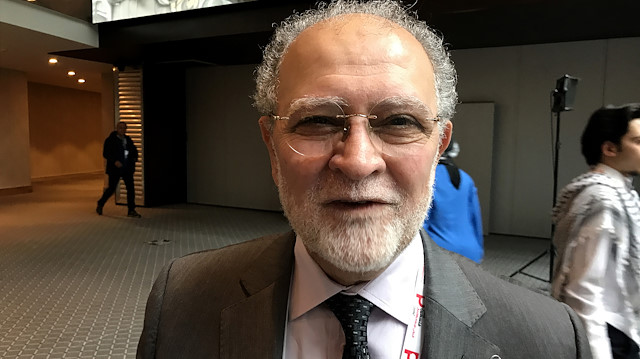
Azzam al-Tamimi, director of the London-based Institute of Islamic Political Thought
The order to kill Saudi journalist Jamal Khashoggi was given by Saudi Crown Prince Mohamed bin Salman, Azzam al-Tamimi, director of the London-based Institute of Islamic Political Thought, has told Anadolu Agency.
According to the Palestinian researcher, bin Salman issued the order because Khashoggi was undermining Saudi efforts to market the crown prince as a “liberal” and “reformist” to western audiences.
Khashoggi’s frequent contributions to The Washington Post, al-Tamimi said, “had been attracting considerable attention”.
“Intellectuals in the U.S. viewed Jamal as an insider vis-à-vis the Saudi administration,” he explained. “And his criticisms were counteracting the propaganda on which the Saudi lobby was spending millions of dollars.”
“Now, for the first time, the international media is focusing on a single issue,” al-Tamimi continued. “Not only because a prominent journalist was brutally killed, but because it took place inside a diplomatic mission.”
According to al-Tamimi, the Turkish government has handled the issue in a very competent manner.
Democratic U.S. Senator Ron Wyden on Monday called on U.S. intelligence officials to publicly release a summary of their findings on the killing of Saudi Arabian journalist Jamal Khashoggi, Wyden said in a statement to Reuters.In the wake of published reports that the Central Intelligence Agency believed Saudi Crown Prince Mohammed bin Salman had personally ordered Khashoggi's murder in Turkey in October, Wyden said U.S. spy chiefs should "come out and provide the American people and the Congress with a public assessment of who ordered the killing."The CIA, relying mainly on circumstantial evidence and their experts' conclusion that the crown prince tightly controlled Saudi government actions, last week briefed Congress on its assessment that the prince ordered Khashoggi's assassination, sources familiar with the matter told Reuters.Turkish authorities have leaked details of what they said were audio recordings of Khashoggi's murder inside the Saudi consulate in Istanbul on Oct. 2, where he went to collect documents for his forthcoming marriage. Some U.S. officials, including CIA Director Gina Haspel, have been given access to the recordings, the sources said.U.S. President Donald Trump has said he has not listened to what he described as a "suffering tape" and has said the crown prince told him he had nothing to do with Khashoggi's murder.Officials have said the Trump administration may issue a more formal statement on Tuesday about what U.S. agencies know about Khashoggi's killing and who was behind it. Khashoggi, a critic of the Saudi government, was a U.S. resident who wrote for the Washington Post.At the United Nations on Monday, Turkish Foreign Minister Mevlut Cavusoglu discussed Khashoggi's murder with U.N. Secretary-General Antonio Guterres, but made no formal request for a U.N. investigation, a U.N. diplomat familiar with the conversation said. Saudi crown prince to attend G20 summit in ArgentinaAfter Khashoggi murder, some Saudi royals turn against king’s favorite son
US senator urges report from spy agencies on Khashoggi killing
Saudi Arabia's crown prince will participate in a G20 summit in Argentina at the end of the month, Al Arabiya television reported on Monday.Crown Prince Mohammed bin Salman will head to the G20 summit as part of a foreign trip, it quoted Saudi Energy Minister Khalid al-Falih as saying.The kingdom is facing a global outcry over the murder of prominent Saudi journalist Jamal Khashoggi at the country's Istanbul consulate in early October, which has strained its ties with the West.After Khashoggi murder, some Saudi royals turn against king’s favorite sonFrance to impose sanctions on Saudi Arabia
Saudi crown prince to attend G20 summit in Argentina
Amid international uproar over the killing of journalist Jamal Khashoggi, some members of Saudi Arabia's ruling family are agitating to prevent Crown Prince Mohammed bin Salman from becoming king, three sources close to the royal court said.Dozens of princes and cousins from powerful branches of the Al Saud family want to see a change in the line of succession but would not act while King Salman - the crown prince’s 82-year-old father - is still alive, the sources said. They recognise that the king is unlikely to turn against his favourite son, known in the West as MbS.Rather, they are discussing the possibility with other family members that after the king's death, Prince Ahmed bin Abdulaziz, 76, a younger full brother of King Salman and uncle of the crown prince, could take the throne, according to the sources.Prince Ahmed, King Salman’s only surviving full brother, would have the support of family members, the security apparatus and some Western powers, one of the Saudi sources said.Prince Ahmed returned to Riyadh in October after 2-1/2 months abroad. During the trip, he appeared to criticise the Saudi leadership while responding to protesters outside a London residence chanting for the downfall of the Al Saud dynasty. He was one of only three people on the Allegiance Council, made up of the ruling family's senior members, who opposed MbS becoming crown prince in 2017, two Saudi sources said at the time.Neither Prince Ahmed nor his representatives could be reached for comment. Officials in Riyadh did not immediately respond to requests from Reuters for comment on succession issues.The House of Saud is made up of hundreds of princes. Unlike typical European monarchies, there is no automatic succession from father to eldest son. Instead the kingdom’s tribal traditions dictate that the king and senior family members from each branch select the heir they consider fittest to lead.Senior U.S. officials have indicated to Saudi advisers in recent weeks that they would support Prince Ahmed, who was deputy interior minister for nearly 40 years, as a potential successor, according to Saudi sources with direct knowledge of the consultations.These Saudi sources said they were confident that Prince Ahmed would not change or reverse any of the social or economic reforms enacted by MbS, would honour existing military procurement contracts and would restore the unity of the family.One senior U.S. official said the White House is in no hurry to distance itself from the crown prince despite pressure from lawmakers and the CIA’s assessment that MbS ordered Khashoggi’s murder, though that could change once Trump gets a definitive report on the killing from the intelligence community.The official also said the White House saw it as noteworthy that King Salman seemed to stand by his son in a speech in Riyadh on Monday and made no direct reference to Khashoggi’s killing, except to praise the Saudi public prosecutor.President Donald Trump on Saturday called the CIA assessment that MbS ordered Khashoggi's killing "very premature" but "possible", and said he would receive a complete report on the case on Tuesday. A White House official referred Reuters to those comments and had "nothing else to add at this time".The Saudi sources said U.S. officials had cooled on MbS not only because of his suspected role in the murder of Khashoggi. They are also rankled because the crown prince recently urged the Saudi defence ministry to explore alternative weapons supplies from Russia, the sources said.In a letter dated May 15, seen by Reuters, the crown prince requested that the defence ministry "focus on purchasing weapon systems and equipment in the most pressing fields" and get training on them, including the Russian S-400 surface-to-air missile system.Neither the Russian defence ministry nor officials in Riyadh immediately responded to Reuters requests for comment.U.S. ROLE KEYThe brutal killing of Khashoggi, a prominent critic of the crown prince, in the Saudi consulate in Istanbul last month has drawn global condemnation, including from many politicians and officials in the United States, a key Saudi ally. The CIA believes the crown prince ordered the killing, according to U.S. sources familiar with the assessment.Saudi Arabia’s public prosecutor has said the crown prince knew nothing of the killing.The international uproar has piled pressure on a royal court already divided over 33-year-old Prince Mohammed's rapid rise to power. Since his ascension, the prince has gained popular support with high-profile social and economic reforms including ending a ban on women driving and opening cinemas in the conservative kingdom.His reforms have been accompanied by a crackdown on dissent, a purge of top royals and businessmen on corruption charges, and a costly war in Yemen.He has also marginalized senior members of the royal family and consolidated control over Saudi’s security and intelligence agencies.He first ousted then-powerful crown prince and interior minister Mohammed bin Nayef (MbN), 59, in June 2017. Then he removed Prince Miteb bin Abdullah, 65, son of the late King Abdullah, as head of the National Guard and detained him as part of an anti-corruption campaign.Some 30 other princes were also arrested, mistreated, humiliated and stripped of their wealth, even as MbS splashed out on palaces, a $500 million yacht, and set a new record in the international art market with the purchase of a painting by Italian Renaissance engineer and painter Leonardo Da Vinci.The entire House of Saud has emerged weakened as a result.According to one well-placed Saudi source, many princes from senior circles in the family believe a change in the line of succession "would not provoke any resistance from the security or intelligence bodies he controls" because of their loyalty to the wider family."They (the security apparatus) will follow any consensus reached by the family."Officials in Riyadh did not respond to a request for comment.The United States, a key ally in economic and security terms, is likely to be a determining factor in how matters unfold in Saudi Arabia, the Saudi sources and diplomats say.Trump and his son-in-law and adviser Jared Kushner have cultivated deep personal relationships with the crown prince. One Saudi insider said MbS feels he still has their support and is willing to "roll some heads to appease the U.S."But Trump and top administration officials have said Saudi officials should be held to account for any involvement in Khashoggi’s death and have imposed sanctions on 17 Saudis for their alleged role – including one of MbS's closest aides.U.S. lawmakers are meanwhile pushing legislation to punish Riyadh for the killing, and both Republican and Democratic senators have urged Trump to get tough on the crown prince.King Salman, 82, is aware of the consequences of a major clash with the United States and the possibility that Congress could try to freeze Saudi assets.Those who have met the king recently say he appeared to be in denial about the role of MbS in what happened, believing there to be a conspiracy against the kingdom. But they added that he looked burdened and worried.Pakistani journalists protest Khashoggi's killingÇavuşoğlu, Guterres discuss Khashoggi murderTrump defends Saudi prince despite Khashoggi murderALLEGIANCE COUNCILWhen the king dies or is no longer be able to rule, the 34-member Allegiance Council, a body representing each line of the ruling family to lend legitimacy to succession decisions, would not automatically declare MbS the new king.Even as crown prince, MbS would still need the council to ratify his ascension, one of the three Saudi sources said. While the council accepted King Salman's wish to make MbS crown prince, it would not necessarily accept MbS becoming king when his father dies, especially given that he sought to marginalise council members.Officials in Riyadh did not respond to a request for comment.The Saudi sources say MbS has destroyed the institutional pillars of nearly a century of Al Saud rule: the family, the clerics, the tribes and the merchant families. They say this is seen inside the family as destabilising.Despite the controversy over Khashoggi's killing, MbS is continuing to pursue his agenda.Some insiders believe he built his father a new but remote Red Sea palace in Sharma, at the Neom City development site -- thrown up in a record one year at a cost of $2 billion -- as a gilded cage for his retirement.The site is isolated, the closest city of Tabouk more than 100 km (60 miles) away. Residence there would keep the king out of the loop on most affairs of state, one of the sources close to the royal family said.Officials in Riyadh did not respond to a request for comment.
After Khashoggi murder, some Saudi royals turn against king’s favorite son
“They [the Turks] shared the information gradually, thus keeping the issue on the [international] agenda,” he said.
What’s more, al-Tamimi said, Khashoggi had not concealed his position regarding the 2011 Arab Spring uprisings, which Saudi Arabia had actively worked to subvert.
“He therefore drew the ire of the Saudi royal court, which ultimately led to his demise,” he said.
"I believe the Saudis hatched the plan, but it failed, after which they tried to blame Ankara for Khashoggi’s disappearance,” al-Tamimi asserted. “But God ruined their plans.”
He added: “Without a doubt, bin Salman ordered the murder.”
“He [bin Salman] enjoys the support of U.S. President Donald Trump and the White House, and now he’s looking to them to evade responsibility,” he said. “But the murder has become an international incident and this [U.S. support] will not save him.”
Al-Tamimi believes that if the crown prince escapes prosecution, “this will be the beginning of the end of the House of Al Saud”.
But if bin Salman is removed from a position of leadership, he added, “the dynasty may yet survive”.
“He [bin Salman] is the one who declared war on Yemen, imposed a blockade on Qatar and detained [dissident] scholars,” al-Tamimi said.
He also noted the close relationship between Saudi Arabia and the United Arab Emirates (UAE), especially during the bin Salman era.
“There are strong ties between bin Salman and Abu Dhabi Crown Prince Mohamed bin Zayed [Al Nahyan],” he said. “Bin Zayed is largely seen as a spiritual godfather to his Saudi counterpart.”
While some have questioned whether bin Zayed played a role in Khashoggi’s murder, al-Tamimi, for his part, does not believe this to have been the case.