

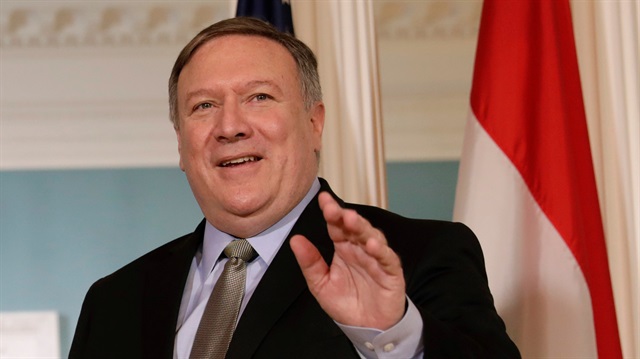
U.S. Secretary of State Mike Pompeo
U.S. Secretary of State Mike Pompeo discussed issues between Baghdad and Erbil in separate phone calls Tuesday with Iraqi Prime Minister Haider al-Abadi and Kurdish Regional Government Prime Minister Nechirvan Barzani.
State Department spokesperson Heather Nauert said in a statement that Pompeo "expressed appreciation for the two leaders’ progress in resolving outstanding Baghdad-Erbil issues according to the Iraqi constitution’s framework for dialogue."
Nauert said Pompeo emphasized the importance of forming a moderate new Iraqi government pursuant to the constitutional timeline that is responsive to the expectations of the Iraqi people.
Hailing the recent "successful" joint operations by Iraqi forces and Kurdish Peshmerga against the Daesh terrorist group, Pompeo "underscored continuing U.S. support for a strong, sovereign and prosperous Iraq as outlined in our bilateral Strategic Framework Agreement".
On Friday, al-Abadi’s Victory Bloc reportedly reached an agreement to form the country’s next government.
According to a statement released by the bloc, the agreement includes nationalist cleric Moqtada al-Sadr's Sairoon coalition, the frontrunner in Iraq’s May 12 parliamentary polls, Ammar al-Hakim’s National Wisdom Movement and Iyad Allawi’s National Coalition.
On Thursday, Iraq's official electoral commission announced that a manual recount of the May 12 poll results was more or less the same as the initial electronic vote count.
For the last two months, results of the poll had remained the subject of a bitter dispute amid widespread allegations of vote-rigging.
According to those initial results, al-Sadr's Sairoon coalition clinched 54 seats, followed by Al-Fatih (47 seats) and al-Abadi's Victory Bloc (42 seats).
Once Iraq’s Federal Court approves the results of the manual recount, incoming MPs will hold a first session to elect a new assembly speaker.
Within 30 days of that first session, the assembly will elect -- by a two-thirds majority -- the country’s next president.
The president will then task the largest bloc in parliament with drawing up a government, which must be referred back to parliament for approval.
The Iraqi government on Tuesday denied reports about a planned visit by Prime Minister Haider al-Abadi to neighboring Iran.“We have not announced any plans or intention by PM al-Abadi to visit Iran,” government spokesman Saad al-Hadithi said in a statement.“All reports [about the visit] are media leaks which we are not responsible for,” he said.The Iraqi premier flew to Turkish capital Ankara on Tuesday for talks with Turkish officials on bilateral cooperation and a host of other issues.Iraqi premier flies to Turkey for talksMedia reports said al-Abadi would continue on to Tehran following his visit to Turkey.On Monday, the Iraqi premier said his government would not make dollar-dominated transactions with Iran -- in line with the U.S. sanctions -- while refraining from implementing the full raft of American penalties recently imposed on Tehran.Last week, the U.S. re-imposed a first round of economic sanctions on Iran, which mainly target the country’s banking sector.The sanctions are intended to hinder Tehran's acquisition of U.S. currency; its precious metals trade; bank transactions denominated in the Iranian rial; activities related to Iran's sovereign debt; and the country’s automotive sector.
Iraq says no plans by premier to visit Iran
Iraqi Prime Minister Haidar al-Abadi left Baghdad for Turkish capital Ankara on Tuesday for talks on bilateral cooperation between the two countries.Talks will tackle bilateral cooperation and a number of issues related to water, electricity, health, industry, investment and security, al-Abadi’s office said in a statement.On Monday, the Turkish Presidency said al-Abadi will meet Turkish President Recep Tayyip Erdoğan during the visit.After his visit to Turkey, the Iraqi premier is expected to go to Iranian capital Tehran.Turkey, Iraq to discuss opening of new border crossing
Iraqi premier flies to Turkey for talks
Turkish and Iraqi delegations will meet in a few weeks to discuss the opening of a new border crossing, Turkish ambassador to Iraq said on Monday.A field visit is also expected following the meeting, Fatih Yildiz told Anadolu Agency on the sidelines of the 10th Ambassadors’ Conference in capital Ankara.The planned Ovakoy Border Gate will directly link Turkey to Baghdad via a 570-kilometer (354-mile) highway.Yildiz said the planned border terminal would also trigger an economic revival in the northern Iraqi city of Mosul.US attempts to sabotage Ovaköy border gate between Turkey, IraqLast week, Qazim al-Akabi, the head of Iraq’s committee for border crossings, said the two sides had agreed to dispatch technical experts to the border region sometime next month to conduct a feasibility study.About Iraqi Prime Minister Haider al-Abadi's upcoming visit to Turkey on Tuesday, Yildiz said counterterrorism and the reconstruction of Iraq would be on the agenda.“Now that Deash is over, they should be inclined to fight against the PKK,” Yildiz said.“The Iraqis know how to fight against terrorism. This is a fight for which power can be used when necessary.”Water, electricity and petroleum management in Iraq are also expected to be discussed.Highlighting water as a significant area of bilateral relations, Yildiz said Turkey is ready to assist Iraq in water management and agricultural irrigation.“Our understanding here is that water should become an area based on a cooperation, not separating the two sides,” he said.On relations with the Kurdish Regional Government (KRG), Yildiz said Turkey is not prone to cooperate with it in case KRG contemplates secession from Iraq.“KRG can find Turkey close to cooperation, when it acts as part of a united and integrated Iraq,” the ambassador said.
Turkey, Iraq to discuss opening of new border crossing
Iraqi forces have uncovered a network of tunnels dug by the Daesh terrorist group south of Mosul in northern Iraq, according to a federal police officer on Monday.Federal police forces raided suspected Daesh positions near the town of Otaiba al-Sharqiya, 60 kilometers south of Mosul, Major Abdul Wahid al-Ansari told Anadolu Agency.“Five underground tunnels were destroyed and eight explosive devices and belts were seized and defused,” he said.He, however, said no militant had been arrested during the raid.Last December, officials in Baghdad declared that Daesh's military presence in Iraq had been all but dismantled over operations backed by the U.S.-led International Alliance. However, from time to time, Iraqi officials announce operations against Daesh-affiliated "sleeper cells" in certain parts of the country.Suspects in Jordan attack support Daesh: MinisterTwin bomb blast kills two in Iraq's Mosul
Iraqi forces uncover Daesh tunnels near Mosul