

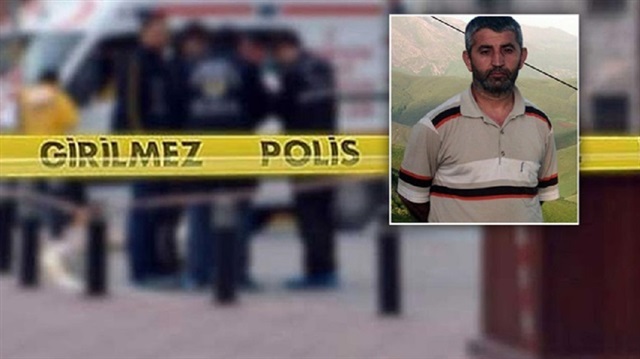
File photo
The dead bodies of Remzi Güler (48) and his mentally-disabled son Mahmut Güler (24), who were livestock farmers, were discovered in the Lice district southeastern province of Diyarbakır on Thursday.
Following a report by two locals who found the bodies, Turkish gendarmerie units were dispatched to the scene, whereupon they discovered a note left which pointed to the involvement of Kurdistan Workers’ Party (PKK) terrorists in the murder.
Preliminary examinations showed that the victims were shot and had been dead for at least nine days, however Diyarbakır’s Governor’s Office stressed that they are still waiting for autopsy results as the investigation continues.
The PKK is listed as a terrorist organization by Turkey, the European Union and the United States. The PKK has been conducting armed violence in the southeastern part of Turkey since 1984. More than 40,000 people, mostly civilians, have been killed in the three-decade long conflict.
Turkish police on Tuesday detained 23 suspects, including two pharmaceutical warehouse owners, a security guard and a police officer, who have been providing the Kurdistan Workers’ Party (PKK)’s Qandil cadre with medication.The police seized medication worth approximately TL 2 million in simultaneous raids.Operation dubbed as “Stop Wayfarer!”Turkish police had been monitoring the suspects for six months and launched an operation dubbed as “Stop wayfarer,” which is related to the Battle of Çanakkale, dealing a great blow to the PKK.It was uncovered that the suspects had been using the identity information of people who are seriously ill and that pharmacy workers who are a part of the network had been adding more medication than was necessary to the patients’ e-prescription. They also prescribed medication to healthy people without their knowledge.Turkey uses a digital e-prescription system which doesn’t allow patients to see how many drugs have been prescribed. The suspects acquired the identities of patients by waiting in front of hospitals, under the pretext of helping them.The pharmaceuticals that the PKK-linked network sent to northern Iraq via the Khabur border gate were used in the treatment of wounded terrorists.Northern Iraq’s Qandil Mountains have been a haven for PKK terrorists over the past few decades. Considered as the main base of the PKK, which control checkpoints and entrances to the mountains, the structuring in the area is used for cover and concealment by terrorists.The PKK is listed as a terrorist organization by Turkey, the European Union and the United States. The PKK has been conducting armed violence in the southeastern part of Turkey since 1984. More than 40,000 people, mostly civilians, have been killed in the three-decade long conflict.Police are still searching for an additional seven suspects.
Turkish police capture 23 suspects providing PKK terrorists with medication
Two PKK terrorists were arrested while attempting to infiltrate Syria’s northwestern town of Afrin, which was liberated from the YPG/PKK terrorist group earlier this year by the Turkish military and the Free Syrian Army (FSA).The two terrorists had tried to enter the town from a nearby mountainous area but were apprehended by FSA personnel.According to FSA sources, the pair -- one of whom is reportedly a Turkish national -- were in possession of guns with silencers and improvised explosive devices.In January, the Turkish army launched Operation Olive Branch with the aim of expelling YPG/PKK and Daesh terrorists from Afrin.On Mar. 18, the 58th day of the operation, Turkish troops and FSA fighters announced that the town had been successfully liberated.In a related development, two car bombs went off in Syria’s nearby city of Jarabulus without causing casualties.Located near the Turkish border roughly 150 kilometers northeast of Afrin, Jarabulus remains under Turkish/FSA control as part of Turkey’s Operation Euphrates Shield, which was launched in mid-2016.Syria has only just begun to emerge from a devastating conflict that began in 2011 when the Assad regime cracked down on demonstrators with unexpected ferocity.
Two PKK terrorists nabbed trying to enter Syria’s Afrin
Turkey has deployed additional units to its border with Syria, the Şanlıurfa Brigade Command, which will guard the historical Suleyman Shah tomb and be in charge of returning it to its previous location in Manbij’s Qara Qozak.The brigade will also be tasked with ensuring security in Manbij.In 2015, the Turkish military relocated the tomb of Süleyman Shah, the grandfather of the Ottoman Empire’s founder, from Syria’s Qara Qozak region in Manbij to the Ashme village of Aleppo, which is located near Turkey’s border, to protect it from the threats posed by the Kurdistan Workers’ Party (PKK) and Daesh terror groups.Following the region’s invasion by the PKK, the U.S. had set up three separate bases in Qara Qozak, which were established shortly after Turkey relocated the tomb to the Ashme village to protect it from terror threats.Turkish forces will firstly purge the region from terrorists and start by taking control of the Tishrin Dam in order to transport the tomb. The Şanlıurfa Brigade Command that undertakes the operation will provide security for Manbij locals once the area is cleared of terrorists.Turkish army conducts 9th round of patrols in ManbijTurkey sends further reinforcements to clear Manbij of terror groupsManbij locals urge Turkish troops to save them from YPGThe Turkish military on Wednesday completed its ninth round of patrolling in the northern Syrian city of Manbij as part of a deal with the U.S. to rid the area of the YPG/PKK terror group.Turkey has said the presence of terror forces near its border constitute a threat and has launched military operations and other efforts to rid the region of terrorists.In its more than 30-year terror campaign against Turkey, the PKK has taken some 40,000 lives.
Turkey sends reinforcements to Manbij in preparation to relocate Suleyman Shah tomb