

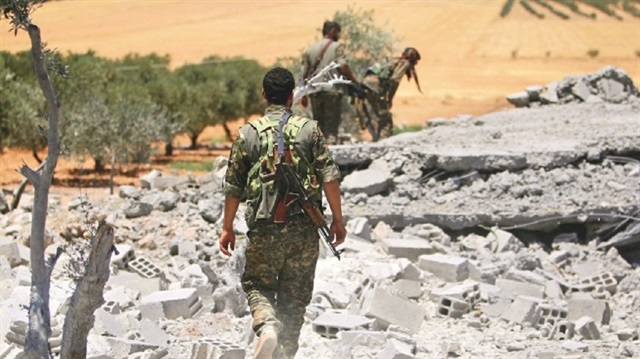
File photo
Yeni Safak daily obtained documents which specify significant details of the Kurdistan Workers' Party (PKK) terror group’s five year-long Afrin occupation and unveils an annual revenue of over $600 million.
The documents show that most of the funds were allocated to terrorist training camps as well as senior PKK officials in Syria’s al-Hasakah and the terror group’s Qandil cadre in Iraq. The documents indicate that the PKK allotted a separate budget for underground tunnels reaching 150 kilometers in length along the Turkey-Syria border.
Abu Abdo, a Free Syrian Army (FSA) commander, stated that PKK terrorists worked for four years to construct tunnels in Shaykh al-Hadid, Jinderes, Rajo, Bulbul and Afrin.
On Jan. 20, 2018, Turkey launched Operation Olive Branch to remove YPG/PKK and Daesh terrorists from Syria’s northwestern Afrin. The PKK is listed as a terrorist organization by Turkey, the European Union and the United States. The PKK has been conducting armed violence in the southeastern part of Turkey since 1984.
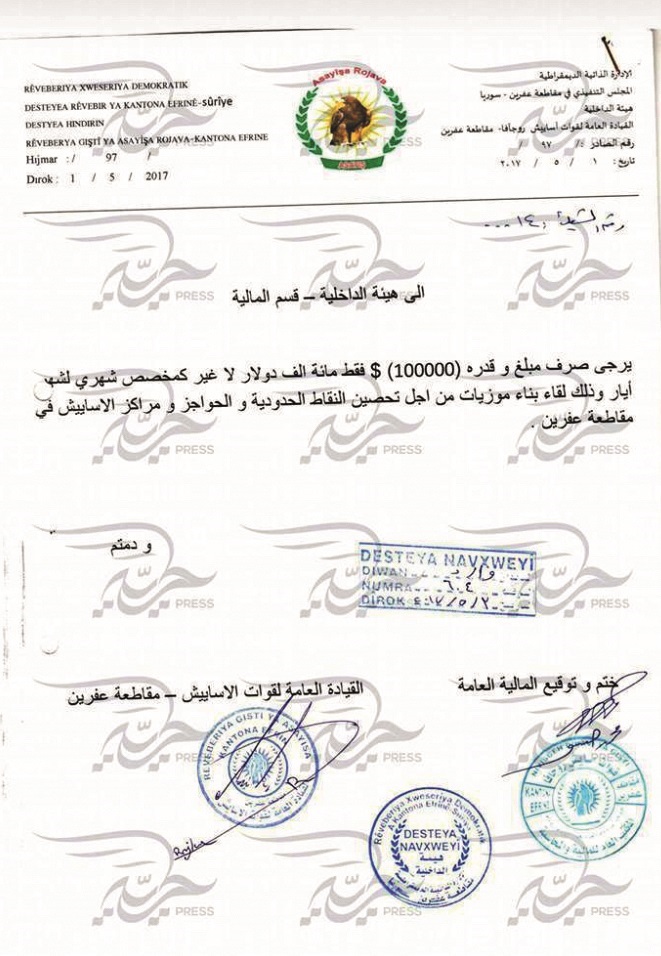
Senior PKK leaders pocket extra funds
The documents show that a special budget was allocated to senior PKK terrorists including Sipan Hamo, Mahmut Berhudan, Hogar and Chekdar Mamo. A portion of the funds generated from many types of crimes such as drug trafficking, human trafficking, fuel and cigarette smuggling and extortion are oftentimes embezzled from the PKK terror group by their own members.
Afrin is a significant source of revenue
The PKK terrorists used Syria's Afrin region as a major revenue base since 2015. The so-called Afrin canton controlled the funds of Manbij, Kobani, Ras al-Ayn and Qamishli.
The terror group obtains its steel, food supplies and logistic needs from regions controlled by the Assad regime, and acquires the cement it needs to construct terror tunnels from French industrial company Lafarge.
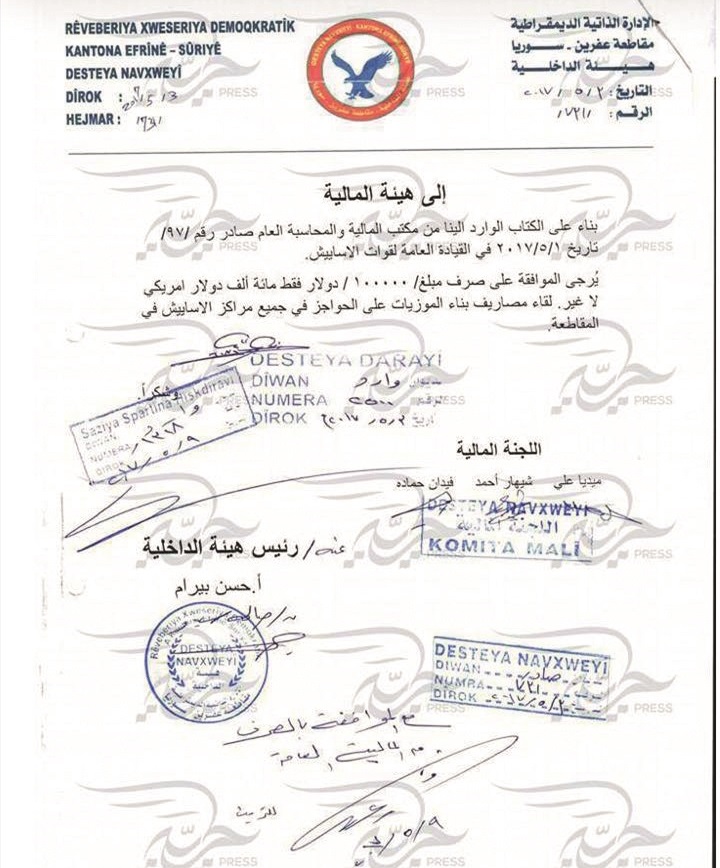
PKK receives international support
U.S.-backed terrorists from the PKK’s Syrian offshoot, the Democratic Union Party (PYD), have been using tunnels they built in the region with cement provided by French Lafarge’s factory in Manbij.
Lafarge, which maintains an operational cement factory in Manbij’s Sunaim region, was previously embroiled in a scandal after evidence detailing its dealings with Daesh terrorists was revealed.
Despite the ongoing civil war in Syria, Lafarge’s factory in Manbij has not halted cement production since 2011.
Syria’s so-called cantons, which are under PKK occupation, have been backed by the U.S and also Russian, German, British and French engineers.
A senior PKK terrorist code-named Gabar who was neutralized by the Turkish army in 2015 had confessed that millions of dollars were stolen during the Afrin evacuation, some of which was transported to Manbij via trucks.
Turkish police on Tuesday detained 23 suspects, including two pharmaceutical warehouse owners, a security guard and a police officer, who have been providing the Kurdistan Workers’ Party (PKK)’s Qandil cadre with medication.The police seized medication worth approximately TL 2 million in simultaneous raids.Operation dubbed as “Stop Wayfarer!”Turkish police had been monitoring the suspects for six months and launched an operation dubbed as “Stop wayfarer,” which is related to the Battle of Çanakkale, dealing a great blow to the PKK.It was uncovered that the suspects had been using the identity information of people who are seriously ill and that pharmacy workers who are a part of the network had been adding more medication than was necessary to the patients’ e-prescription. They also prescribed medication to healthy people without their knowledge.Turkey uses a digital e-prescription system which doesn’t allow patients to see how many drugs have been prescribed. The suspects acquired the identities of patients by waiting in front of hospitals, under the pretext of helping them.The pharmaceuticals that the PKK-linked network sent to northern Iraq via the Khabur border gate were used in the treatment of wounded terrorists.Northern Iraq’s Qandil Mountains have been a haven for PKK terrorists over the past few decades. Considered as the main base of the PKK, which control checkpoints and entrances to the mountains, the structuring in the area is used for cover and concealment by terrorists.The PKK is listed as a terrorist organization by Turkey, the European Union and the United States. The PKK has been conducting armed violence in the southeastern part of Turkey since 1984. More than 40,000 people, mostly civilians, have been killed in the three-decade long conflict.Police are still searching for an additional seven suspects.
Turkish police capture 23 suspects providing PKK terrorists with medication