

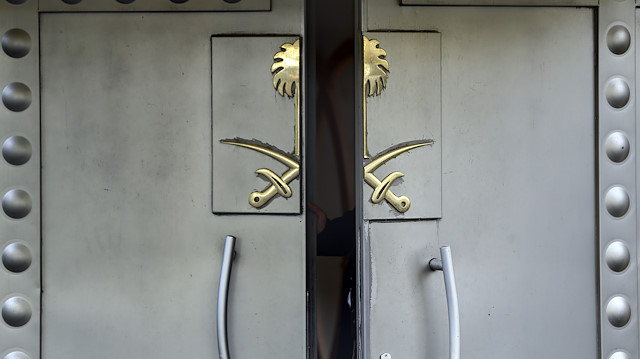
Saudi consulate in Istanbul, Turkey.
The outcry in the United States demonizing Saudi Arabia over the murder of Saudi journalist Jamal Khashoggi in the kingdom's consulate in Istanbul threatens U.S.-Saudi strategic ties, the former Saudi intelligence minister warned on Wednesday.
"We value our strategic relationship with the United States and hope to sustain it. We hope the United States reciprocates in kind," royal family member Prince Turki bin Faisal al Saud said in an address to the National Council on U.S.-Arab Relations, a non-profit advocacy organization.
Turki, to whom Khashoggi once served as an adviser, has also served as an ambassador to London and Washington. His speech denouncing what he called "the demonization of Saudi Arabia" clearly carried Riyadh's imprimatur, as he heads an Islamic research center named after his father, the late King Faisal.
Turkey wants to know the whereabouts of slain Saudi journalist Jamal Khashoggi’s body, the country’s ruling party said on Wednesday.Khashoggi went missing after entering the Saudi Consulate in Istanbul on Oct. 2.After initially saying Khashoggi had left the consulate alive, the Saudi administration admitted weeks later he had died there."We want to know where the body [of Khashoggi] is, we want that our authorities receive information about who the local collaborators are", Ömer Çelik, spokesman for the Justice and Development (AK) Party, said at a news conference in Ankara.Khashoggi's body parts were disposed of after being dismembered: Turkish prosecutorSpeaking about the probe into the murder of Khashoggi, Çelik said it was "not an action to be performed without instructions from a higher level"."Turkey does not blame anyone in advance, but won't allow cover up of anything," he added.Investigation of the incident suggests a special hit squad came to the consulate to kill Kashoggi and cover up the murder.Meanwhile, Turkish President Recep Tayyip Erdogan stressed that all details of the case should be revealed, including who gave the instruction for the "premeditated murder".U.S. President Donald Trump said he could impose sanctions on Saudi Arabia, but also signaled that he did not want to harm bilateral relations.Telephoning Erdogan, Saudi King Salman bin Abdulaziz and Crown Prince Mohammad bin Salman promised necessary cooperation.The chief prosecutor's office in Riyadh also announced that the murder was planned.Cadaver dog used to search Saudi consulate denied entry into consul-general’s residenceTurkey's drilling activitiesÇelik said Turkish army is protecting the drilling ship "Fatih" in the Mediterranean and suggested Greece and Greek Cypriot administration to abstain from any attempt against it.Noting Turkey's gas exploration in the Eastern Mediterranean is being carried out on legal ground, he added: "The block 7 is in Turkey’s continental shelf."The block 7 is one of the blocks located in the unilaterally declared exclusive economic zone by the Greek Cypriot Administration and it wants to invite foreign energy firms for natural gas exploration.Çelik said any attempt from Greece to gradually widen its territorial waters will be “strongly” responded by Turkey.Cyprus has been divided since 1974, when a Greek Cypriot coup was followed by violence against the island's Turks and Ankara's intervention as a guarantor power.It has seen an on-and-off peace process in recent years, including the latest initiative in Switzerland under the auspices of guarantor countries Turkey, Greece and the U.K. collapsing in 2017.Turkey blames Greek Cypriot intransigence for the talks' failure, also faulting the European Union for admitting Cyprus as a divided island into the union in 2004 after Greek Cypriot voters rejected a peace deal.Fake news network vs bots: the online war around Khashoggi killing
‘Turkey will not allow cover up,’ says ruling party
Turki's address came after Istanbul's chief prosecutor on Tuesday said that Khashoggi was suffocated in a premeditated killing and his body was then dismembered.
Khashoggi, who lived in self-imposed exile in the United States, wrote columns for the Washington Post critical of the kingdom's de facto ruler, Crown Prince Mohammed bin Salman.
Some U.S. lawmakers have accused the crown prince of ordering Khashoggi's death - a charge that Riyadh denies - and threatened sanctions. U.S. commentators have strongly condemned the kingdom.
On Oct. 20, Arabic-language website alawatanews.com published a report that Saudi Crown Prince Mohammed bin Salman had been forced out of power.Citing the official Saudi Press Agency (SPA), it said King Salman had signed a decree removing the prince "against the backdrop of growing pressure that accompanies the disappearance of journalist Jamal Khashoggi."The report was false. The SPA has never published such an article, the wording and picture were lifted from a year-old royal court announcement about the removal of a former crown prince and MbS, as he is widely known, remains in his position.The story and the website that published it are part of a fierce information war being waged online over the killing of Khashoggi, a prominent critic of the Saudi government last seen entering Riyadh's consulate in Istanbul on Oct. 2.Automated accounts known as bots have flooded social media in recent weeks, many of them promoting messages which support Saudi Arabia and are intended to cast doubt on allegations that the kingdom was involved in Khashoggi's death.EU reiterates call for 'credible' probe into KhashoggiKhashoggi's body parts were disposed of after being dismembered: Turkish prosecutorBut another effort has also sought to muddy the waters more broadly, using fake news websites and associated bots to sow confusion about developments inside the Saudi government.Alawatanews.com is part of a network of at least 53 websites which, posing as authentic Arabic-language news outlets, have spread false information about the Saudi government and Khashoggi's murder, a Reuters analysis shows.Investigators at Israeli cybersecurity firm ClearSky said a review of host-server addresses and registration details showed the websites were operating as part of the same network. Many of them also have near-identical design layouts and web addresses, or have published the same or similar fake news reports.The alawatanews.com report, which said MbS had been replaced by his brother because of the fallout from Khashoggi's death, was typical of those articles. Another, published by a website called awwtarnews.com on Oct. 22, said an MbS aide had also been replaced for the same reason, which was not true.Saudi prosecutor discusses Khashoggi case with Turkish intelligenceAfter being published online, the false news articles were shared on Twitter by automated bot accounts -- many of which repeatedly posted links to multiple sites from the network.Twitter suspended the accounts shortly after receiving questions about them from Reuters. Alawatanews.com, awwtarnews.com, the Saudi government and SPA did not respond to requests for comment.A person called Mohammed Trabay with a registered address in Egypt is listed online as the owner and operator of the majority of the 53 websites. When reached by phone, a man who identified himself as Mohammed Trabay confirmed he was the owner of the websites but hung up when asked for further details.In subsequent emailed comments he denied any connection to the network and said he had not understood the questions when asked by phone."Sorry, I can't help you," he said. "I don't have any relation with the sites you mention."UN calls for impartial probe into Khashoggi’s killingSaudi Arabia's Electronic ArmyThe Saudi government initially said that it did not know what had happened to Khashoggi, a U.S. resident who wrote columns for the Washington Post, when he disappeared after entering its consulate in Turkey.Under pressure to say more about Khashoggi's fate, and following Turkey asserting that he had been killed, Riyadh later changed its version of events to say he had died in a fight in the Istanbul consulate.When that statement was also widely questioned, Riyadh offered a new explanation, blaming Khashoggi's death on a premeditated "rogue operation" in which Saudi individuals exceeded their authority.U.S. President Donald Trump has said Saudi authorities staged the "worst cover-up ever" but has also made more conciliatory remarks that highlight Riyadh's role as a U.S. ally against Iran and Islamist militants, as well as a purchaser of U.S. arms.Online, the journalist's death has served to show how governments and people are increasingly able to manipulate information and social media to further their political agendas, said Lisa-Maria Neudert, a researcher at the Oxford Internet Institute, a department of Oxford University."Setting up misinformation pages purporting to be real news, leveraging highly divisive and controversial current issues, and using fake accounts and personas to conceal the originators of attacks are somewhat of the ABCs of computational propaganda," she said.At the centre of Saudi Arabia's online efforts is Saud al-Qahtani, a close aide to the Crown Prince who was hired in the early 2000s to run an electronic media army tasked with protecting Saudi Arabia's image, according to a source with ties to the royal court.When Riyadh led an economic boycott against Qatar in June 2017, Qahtani was at the forefront of online attacks against the small Gulf state. On Twitter, he urged Saudis to tweet the names of anyone showing sympathy with Qatar under the Arabic hashtag "The Black List".Qahtani was sacked on Oct. 20 over allegations that he was involved in Khashoggi's murder. A senior Saudi official said he had authorised one of his subordinates to conduct what was meant to be a negotiation for Khashoggi's return to Saudi Arabia. Qahtani did not respond to questions from Reuters at the time.Saudi authorities have not disclosed whether or not he is in detention and the status of his "flies", as his electronic army is known, is unclear. The Saudi authorities did not respond to a request for comment.Opponents of the Saudi authorities have also been active online. Facebook and other companies identified a suspected Iranian influence operation in August which used a network of sham news sites and fake social media personas to spread disinformation, some of it targeted at Saudi Arabia. Iranian officials have dismissed the allegations as "ridiculous".Washington Post awaits answers on Khashoggi murderMystery PerpetratorTwitter said it has removed large numbers of accounts for breaching its terms of use over the last two weeks, many of them originating from the Gulf region."Targeted platform manipulation and coordinated spam are a violation of the Twitter Rules and we will continue to enforce our policies vigorously," a Twitter spokesman said.Reuters has found such bot accounts and influential Saudi users repeatedly posting hashtags on Twitter including "Qatari intelligence kills Khashoggi" and "Saudi Arabia the greatest," although it found no evidence Qahtani or the Saudi government controlled or directed those accounts.Saudi Arabia's biggest online newspaper Sabq has also accused the international media, including Reuters, of using Khashoggi's disappearance to try to undermine the government, and released a statement on Oct. 21 saying a fake news story was being circulated under its name.The websites identified by Reuters as spreading false news about the Saudi government have operated as part of the same network since 2017, said ClearSky analyst Ohad Zaidenberg.Video: First-ever misinformation news-stand opened in New YorkAll bar three of the websites have been taken down, although it is not clear who dismantled the network, when or why, said Zaidenberg, who previously tracked online influence campaigns for Israel's elite 8200 intelligence unit.But the sites which are still online, as well as archived copies of those which are now disabled, provide an insight into the network's operations and aims -- to undermine the official Saudi version of events and spread confusion around its government."Saudi Arabia is considered to be one of the main powers in the Middle East. Accordingly, many operators of fake news infrastructure target the Saudi Arabian audience with increasing frequency," Zaidenberg said, adding that a perpetrator could not be identified at this stage.Web-hosting and support companies Hetzner, GoDaddy and Cloudflare all declined to give any information about the websites' operator, citing client confidentiality. 
Fake news network vs bots: the online war around Khashoggi killing
Recalling that more than 70 years of U.S.-Saudi ties survived previous crises, Turki said, "Nowadays, this relationship is once again threatened."
"The tragic and unjustified" slaying of Khashoggi "is the theme of today's onslaught and demonization of Saudi Arabia in the same fashion as the previous crises. The intensity and gleefulness of it is equally unfair," he said. "Subjecting our relationship to this issue is not healthy at all."
Turki reiterated that the kingdom is committed to bringing to justice those responsible for Khashoggi's murder "and whoever else failed to uphold the law."
The EU reiterated on Wednesday its call for a “credible and transparent” investigation into the case of slain Saudi journalist Jamal Khashoggi.“We have asked and expect that Saudi Arabia cooperates on a thorough, credible and transparent investigation and we insist on the need for clarity on the circumstances of his death and full accountability of all those responsible for it,” the bloc’s Foreign Policy Chief Federica Mogherini said on behalf of the EU.In a statement marking the International Day to End Impunity for Crimes Against Journalists, Mogherini said: “We pay tribute to all those journalists around the world who lost their lives and suffered attacks in the exercise of their profession.“We also pay tribute to all those brave journalists who are taking up the work of their colleagues who can no longer pursue their investigations.”She went onto say that without a “free, diverse and independent media” democracy could not live.Republican senators urge Trump to suspend nuclear talks with Saudi Arabia“The assassinations of investigative journalists Daphne Caruana Galizia and Jan Kuciak in the EU, demonstrate that no region of the world is immune to this,” she added.Galizia was killed in Malta in October 2017 and Kuciak in Slovakia in February 2018 as both of them were investigating high-level corruption cases in their countries.Mogherini urged that those crimes needed to be thoroughly investigated as well as the case for killing of Khashoggi.Khashoggi, a Saudi journalist and columnist for The Washington Post, went missing after entering the Saudi Consulate in Istanbul on Oct. 2.After initially saying he had left the consulate alive, the Saudi administration admitted weeks later he had died there.Khashoggi's body parts were disposed of after being dismembered: Turkish prosecutorInvestigation of the incident suggests a special hit squad came to the consulate to kill Kashoggi and cover up the murderThe international community refused to accept the Saudi claim that the incident was not a premeditated murder.Meanwhile, Turkish President Recep Tayyip Erdogan stressed that all details of the case should be revealed, including who gave the instruction for the “premeditated murder.”U.S. President Donald Trump said he could impose sanctions on Saudi Arabia, but also signaled that he did not want to harm bilateral relations.Telephoning Erdogan, Saudi King Salman bin Abdulaziz and Crown Prince Mohammad bin Salman promised necessary cooperation. The chief prosecutor's office in Riyadh also announced that the murder was planned.
EU reiterates call for 'credible' probe into Khashoggi
The Trump administration is demanding full accountability from Riyadh in Khashoggi's death. In what it called a first step, it revoked the visas of some Saudi officials implicated in the slaying.
The U.S.-Saudi relationship "is too big to fail," Turki said.
Those ties, he noted, transcend oil production, trade, arms sales and investment to cooperation on Middle East peace efforts, stabilizing oil markets, fighting extremism and containing Iran, the kingdom's main regional foe.
The murder of slain journalist Jamal Khashoggi was pre-planned and his body parts were disposed of after being dismembered, the office of the Istanbul Chief Public Prosecutor said on Wednesday.Saudi authorities did not make any statements regarding the local collaborator in the Khashoggi murder, the office said in a statement.Khashoggi was suffocated immediately after entering Saudi Arabia's consulate in Istanbul on Oct. 2, the statement added, as it reiterated a request for the extradition of suspects arrested by Saudi Arabia in the case of the brutal murder.In a statement issued after two days of talks with Saudi Arabia's public prosecutor Saud al-Mojeb, it also said no concrete results were reached in those meetings but that Istanbul Chief Public Prosecutor İrfan Fidan was invited to Saudi Arabia as part of the probe.Republican senators urge Trump to suspend nuclear talks with Saudi Arabia"Despite our well-intentioned efforts to reveal the truth, no concrete results have come out of those meetings," the Istanbul prosecutor's office said.Fidan asked Mojeb about the location of Khashoggi’s body, and whether the Saudi investigation had reached any findings regarding plans to kill Khashoggi.Khashoggi, a Saudi journalist and columnist for The Washington Post, went missing after entering the Saudi Consulate in Istanbul on Oct. 2.After initially saying he had left the consulate alive, the Saudi administration admitted weeks later he had died there.Investigation of the incident suggests a special hit squad came to the consulate to kill Kashoggi and cover up the murderThe international community refused to accept the Saudi claim that the incident was not a premeditated murder.Cadaver dog used to search Saudi consulate denied entry into consul-general’s residenceSaudi prosecutor completes inspections in Turkey, heads to airport
Khashoggi's body parts were disposed of after being dismembered: Turkish prosecutor
Melo, the Istanbul Police Department’s cadaver dog, allegedly reacted to a wardrobe inside the Saudi consulate, and was then denied permission to search the residence of the Saudi consul-general.The cadaver dog barked in front of a wardrobe at the Saudi consulate in Istanbul, and was a part of the Turkish team that searched the premises where slain journalist Jamal Khashoggi disappeared on Oct. 2. It is believed that Khashoggi’s remains, or parts of it, could have been stashed in the wardrobe at some point.Melo has assisted in missing persons cases in Turkey’s Mersin, Adana, Hatay and Denizli in which the cadaver dog quickly located the bodies. The claim comes as Saudi Arabia’s public prosecutor Saud Al Mojeb completed his inspections in Turkey after he held three days of talks that yielded no results with Turkish officials on the killing of Khashoggi.Mojeb carried out inspections at the Saudi consulate in Istanbul, where Khashoggi was killed earlier this month, and held meetings with Turkey's public prosecutor and Turkish intelligence officials.No clear information was obtained from Mojeb regarding 18 suspects arrested in Saudi Arabia over Khashoggi’s death, Turkish security sources said. Questions about the assassination squad were not answered satisfactorily, the sources added.Saudi prosecutor completes inspections in Turkey, heads to airportFrench foreign minister says sanctions against Saudi Arabia possibleSaudi prosecutor discusses Khashoggi case with Turkish intelligenceUN calls for impartial probe into Khashoggi’s killing
Cadaver dog used to search Saudi consulate denied entry into consul-general’s residence